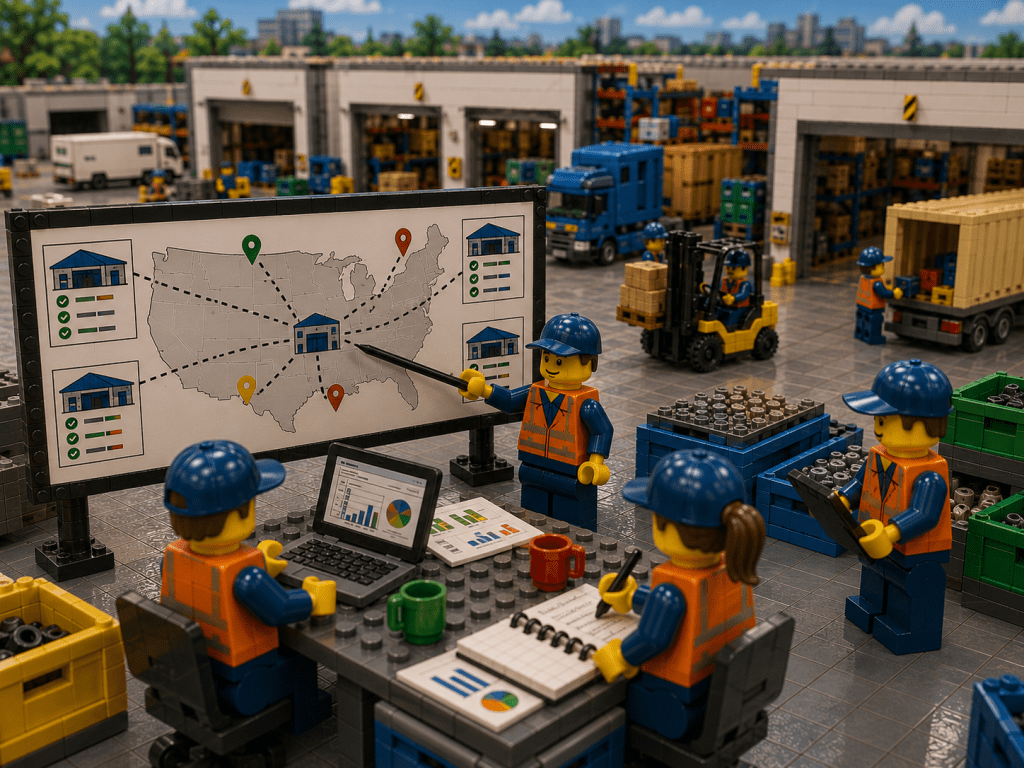
In modern industrial manufacturing, deciding how to structure your warehouse network is a critical strategic choice. Should you centralise inventory in a single warehouse, or spread parts and stock across multiple locations? Each approach, single-location vs. multi-location network design – carries its own advantages and challenges. The right choice depends on factors like order volume, geography, costs and the need for parts visibility across departments. In either case, ensuring inventory accuracy and clear communication between teams is essential.
A well-designed warehouse network brings clarity and efficiency. On the one hand, a single-location strategy concentrates stock in one central facility. This can simplify management, reduce duplicated effort and keep fixed costs lower. On the other hand, a multi-location strategy places inventory at several sites – perhaps multiple warehouses, regional hubs or departmental storerooms – to cut lead times and bring parts closer to where they’re needed. Industrials often balance these approaches: a core hub for bulk stock combined with satellite locations near production lines or field teams. The key is to match your network design to your service goals. In all cases, teams must maintain full parts visibility: everyone from maintenance to production to procurement needs real-time insight into what stock is available and where it lives. By aligning inventory data, using consistent processes and tracking key performance metrics, companies can choose the best network strategy and keep operations running smoothly.
Single-Location Warehouse Strategy

A single-warehouse model means all parts and materials are stored in one central location. This approach offers several clear benefits:
- Centralised control: Managing one facility keeps processes uniform. Stock counts, audits and workflows follow the same procedure for every part.
- Simplicity: With only one site, there are fewer complications in coordinating transfers or reconciling stock between locations. This makes training staff and enforcing policies easier.
- Lower overhead: Operating one warehouse often costs less than running multiple sites (fewer leases, utilities and duplicate personnel).
- Scalability in one place: Expanding storage capacity (racks, shelving, yard space) happens at one site, avoiding scattered expansions.
However, a single-location strategy has trade-offs:
- Longer lead times: If you serve distant plants or customers, shipping parts from one central warehouse can slow down delivery and increase freight costs.
- Risk concentration: An event at the one warehouse – a power outage, equipment failure or disaster – can halt all parts supply. There is less redundancy.
- Internal contention: Different departments (e.g. maintenance, production, R&D) drawing from the same stockpile must coordinate closely. Without clear processes, competing priorities can cause delays.
- Limited flexibility: As business grows or diversifies, one facility may struggle to meet geographically varied demand or expanding product lines.
A single-location strategy fits smaller operations or cases with predictable, centralised demand. For example, a factory with a high-volume parts store may work well with one on-site warehouse that services all departments. The key advantage is focused management and simple visibility: everyone looks at the same inventory system. For industries with just-in-time demands, though, the travel time for parts can be a handicap. Therefore, companies should ensure high operational discipline – strong inventory controls, frequent audits (like cycle counting), and real-time updating – to make a single-warehouse model work effectively. Having clear KPIs (such as inventory accuracy and order fulfilment time) is crucial to monitor performance in this simpler network setup.
Multi-Location Warehouse Strategy
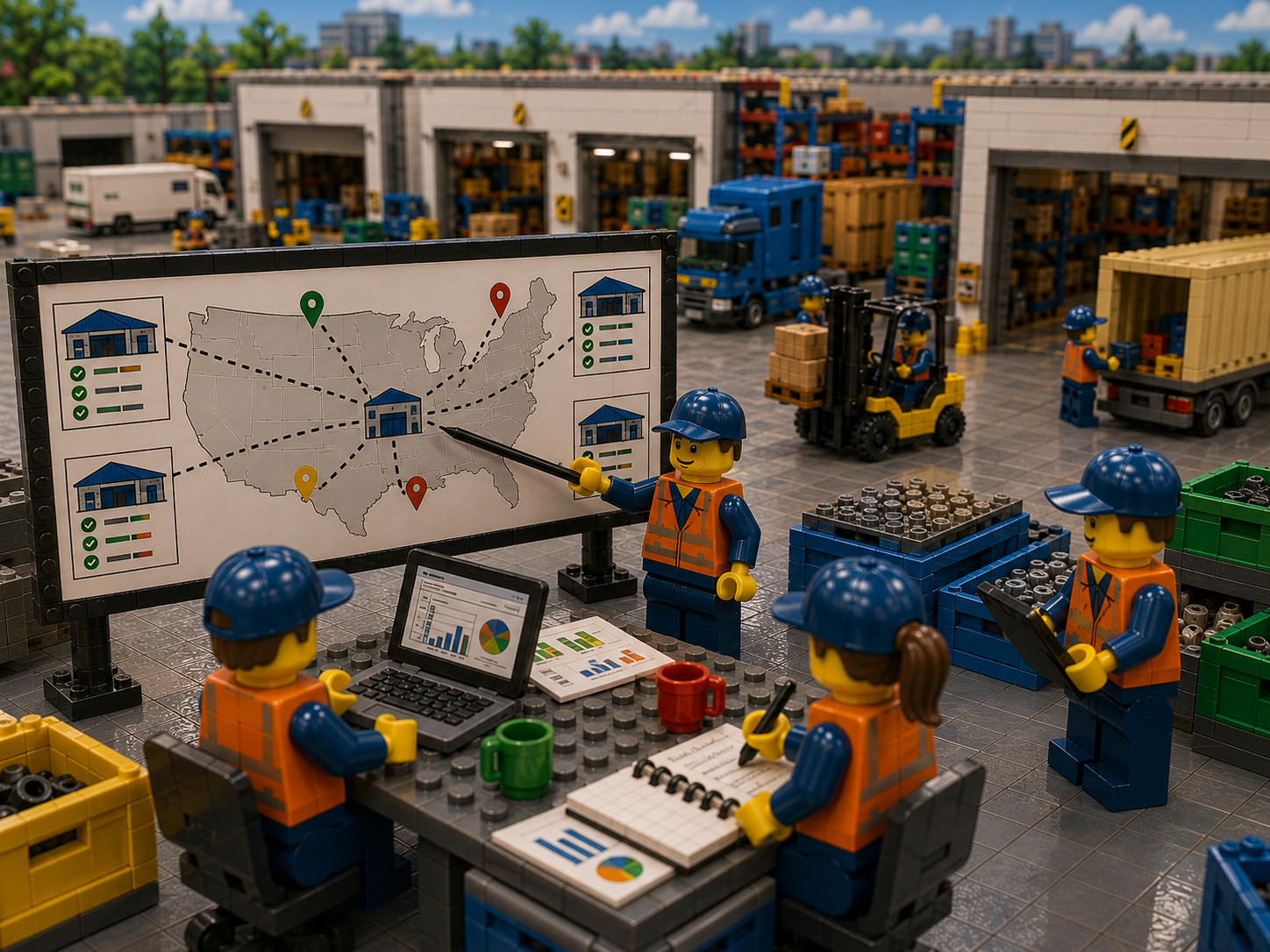
A multi-location network spreads inventory across multiple warehouses, distribution centres, or departmental storerooms. This strategy is common among larger or geographically dispersed operations. Its benefits include:
- Faster responsiveness: Placing stock closer to plants or customers means shorter lead times. When a line needs a spare part, the nearest warehouse can supply it quickly rather than waiting for a distant truck.
- Load balancing: By distributing stock, you can level demand across facilities. If one site runs low, another site can ship inventory. This redundancy also protects against single-site disruptions.
- Scalability: Adding new warehouses or storerooms to new regions or projects helps businesses grow without overloading one building. Each new location can use local space, labor and infrastructure.
- Custom stock levels: Different locations can carry inventory tailored to regional demand or departmental needs. For example, an offshore platform might stock a unique set of parts not needed onshore.
But multi-site networks introduce complexity and costs:
- Inventory visibility challenges: Keeping real-time stock information accurate across sites is harder. Teams need strong systems so they know if a part is available at another warehouse or not.
- Higher fixed costs: Each facility has overhead – lease, utilities, security, staff. Multiple sites usually mean higher total costs than one big central warehouse.
- Logistical coordination: Inter-warehouse transfers and restocking schedules become more complicated. Errors in movement or recording can lead to stock discrepancies.
- Process consistency: It’s critical to standardise procedures (naming conventions, cycle counts, receiving protocols) across all sites. Inconsistent practices can cause confusion and data inaccuracies.
- Communication overhead: More locations and departments require more coordination. Teams must communicate smoothly to avoid overstocking in one place while another runs out.
A multi-location strategy makes sense when service speed or geographic coverage is vital. For instance, an industrial firm with plants in several states might keep local warehouses so each plant doesn’t suffer delays waiting for parts shipped from afar. It also suits scenarios where customer service expectations demand very fast delivery (e.g. emergency repairs). The key challenge is ensuring every team member always sees the single source of truth for inventory. This means investing in good IT systems and clear processes: an integrated inventory management platform (ideally cloud-based) that shows stock levels for all sites in real time. Standardising how parts are named, counted and moved will reduce errors. Training staff in every location on common practices is essential, as is regular auditing to catch any discrepancies early.
Key Factors in Warehouse Network Design

Whether you plan a single hub or a network of warehouses, several strategic factors should guide the design:
- Service Level and Lead Times: How quickly do operations or customers need parts? If next-day delivery is required at remote plants, having regional warehouses can be crucial. A single centre may struggle to meet tight service targets at all locations.
- Transportation Costs: Balancing transportation expenses is key. A centrally located warehouse might lower inbound freight (bulk shipments) but increase outbound last-mile costs. Distributed sites can cut delivery miles but raise total truck runs. Your network should minimise overall transit distance and costs, given your order volume.
- Inventory Carrying Costs: More sites mean more safety stock held overall. Companies must factor in the cost of tying up capital in inventory versus the cost of potential stockouts. Optimising reorder points and safety stock for each location helps control excess inventory.
- Demand Variability: If demand patterns vary widely across regions or product lines, separate warehouses can tailor inventory to local needs. For uniform demand, a single site might suffice.
- Space and Facility Costs: Real estate prices and availability differ by region. Sometimes splitting across smaller, cheaper warehouses near demand centers can beat one expensive urban location.
- Labor and Resources: Operating multiple sites requires hiring and managing staff in each. Consider availability of skilled labor, training requirements, and whether enough work (orders or handling tasks) justifies each location’s staff.
- Risk and Redundancy: Multi-location networks inherently add resilience. If one warehouse has an emergency, others can fill the gap. Single-location networks are more fragile to disruptions (e.g. natural disasters, power failures).
- Technology Capability: Modern networks rely on technology. If you lack robust inventory systems or connectivity, a single site may be easier to manage. A multi-site model demands reliable, cloud-based software for real-time visibility (so that one location isn’t “in the dark” about another’s stock).
- Growth Plans: Anticipated growth or new markets can justify designing for multiple locations in advance. A haphazard expansion (e.g. adding an extra storeroom without standard processes) can create headaches later.
- Product Characteristics: Bulky or heavy parts might favor centralisation due to storage efficiency, whereas small, high-velocity parts might be stored closer to use points in separate locations.
In practice, many industrial operations end up with a hybrid model. For example, one central warehouse might hold long-lead items and slow movers, while faster-moving parts are stocked in satellite stores nearer to production areas. Departments might even maintain internal stores: a maintenance department could have its own storeroom within a plant, yet still feed from the main warehouse via a pull system. Whichever architecture you choose, consciously evaluate these factors. Running a network analysis (even a simple spreadsheet model) can help compare total costs and service levels for different scenarios. Remember that good design is not one-size-fits-all: it should align with business objectives, geographic realities and customer expectations.
Improving Parts Visibility Across Departments

Regardless of network design, one universal goal is full parts visibility. Each department – maintenance, production, procurement, engineering – needs to know what inventory is available, where it is, and how much. Improving visibility across teams requires both good systems and aligned processes. Key best practices include:
- Centralise Inventory Data: Use a unified inventory management platform that holds all stock data for every location and department. This prevents siloed spreadsheets and ensures one version of the truth. With a cloud-based solution, updates by one team are immediately visible to others. A central database makes search and reporting easy, so anyone can check stock counts or find parts across the network.
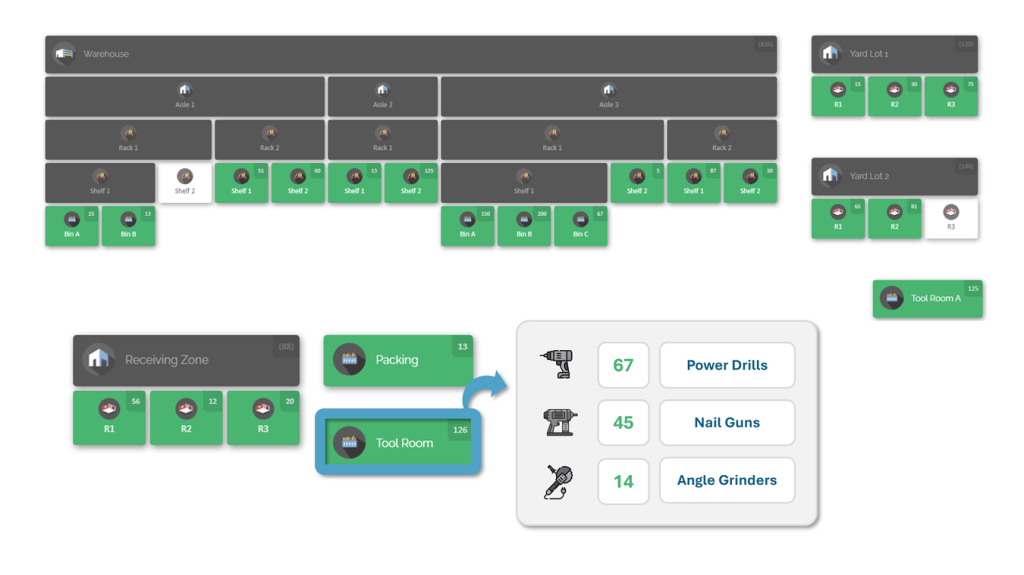
- Visualise Storage Layouts: Maintain accurate maps or diagrams of warehouse and storeroom layouts. If every rack, shelf and bin is mapped in the system, teams can navigate visually rather than guessing. A visual inventory map shows exactly where items are stored. Teams can click on a zone or bin to view its contents. This speed-up finding parts and brings newcomers up to speed.
- Barcode/Label All Parts and Locations: Label parts and locations (aisles, bins, racks) with barcodes or QR codes. When receiving, issuing or moving parts, staff should scan the label. This instantly updates the system with who moved what, where and when, drastically reducing manual entry errors. Even if mobile scanning is not possible, hand-held scanners or printing labels can achieve the same effect. Scanning ensures “what you see” is exactly what’s recorded in data.
- Define Clear Item Master Data: Adopt standard naming and classification for parts (e.g. part numbers, descriptions, category). All departments should use the same terms. This avoids confusion when a maintenance tech calls something by an internal nickname – if everyone refers to the same part number in the system, it’s unambiguous.
- Implement Check-In/Check-Out Processes: For controlled parts (especially tools or consumables), track who checked out an item. Use the system to “assign” inventory to a job, project or department. For example, a technician taking a tool can record it in the system. This level of accountability means nothing goes missing unnoticed.
- Frequent Inventory Audits: Schedule regular cycle counts or physical inventories. Dividing the inventory into zones, audits can be done continuously (e.g. daily cycle counting) rather than waiting for a yearly shutdown count. Audits verify that system counts match physical stock. When discrepancies arise, investigate immediately. Over time, frequent checks will improve accuracy dramatically.
- Standardise Replenishment Rules: Ensure all teams use consistent reorder points and calculation methods. If the maintenance team keeps a minimum stock of spare bearings and procurement uses a different formula, you can end up ordering too much or too little. A harmonised approach to safety stock and reorder quantity (possibly using ABC classification by criticality) keeps stock optimal across the network.
- Clear Requisition and Transfer Workflows: Document how to request parts and how to move them. For example, if production needs extra motors, should they issue a ticket, or simply pick from the store? Define steps and approvals. Similarly, when stock is transferred between locations, require a record in the system. Well-defined workflows stop ad-hoc “pulls” of inventory that later get forgotten by other departments.
- Role-Based Access and Training: Give each user or department the right level of access to the inventory system. A maintenance worker might see which parts are on shelves and place requests, while a storekeeper can adjust counts. Everyone should be trained in how the system works, so they all update it consistently. Cross-training between departments can build empathy – e.g. a production planner learning how maintenance views spare parts.
By following these best practices, an industrial organisation can greatly enhance parts visibility. The goal is that any stakeholder can log into the system and immediately answer questions like “How many [component X] are in stock? Where are they? When was the last time they were moved, and by whom?” Achieving this visibility prevents wasteful duplication of parts (where two departments unknowingly buy the same part), stops embarrassing stock-outs, and empowers teams to plan better. It also streamlines cross-team alignment: when everyone sees the same data and follows the same procedures, communications become straightforward.
Operational Efficiency and Key Metrics

To ensure your warehouse network – single or multi-location – is operating efficiently, it’s important to track the right metrics. These KPIs help identify bottlenecks, measure improvement, and align different departments on common goals. Key metrics include:
- Inventory Accuracy: The percentage of items where the system count matches the physical count. High accuracy (typically above 97–98%) means you can trust your data. Frequent cycle counts drive this number up. Low accuracy leads to unexpected shortages or excess, harming productivity.
- Order Fill Rate: The percentage of inventory requests or orders that are fulfilled completely from stock on hand. A high fill rate (often targeted around 97–98%) indicates that parts are available when needed. Multi-location networks must coordinate to achieve good fill rates – sometimes transferring stock across sites to meet demand.
- Lead Time to Deliver: How long it takes from when a part is requested to when it arrives at the requester’s desk or production line. This includes picking, staging and shipping time. Shorter lead times (ideally measured in hours or days, depending on context) increase operational responsiveness. Comparing this metric for single vs multi location setups can reveal trade-offs.
- Pick and Pack Efficiency: For warehouse operations, measure how many lines or items are picked per hour. This highlights productivity of warehouse staff. Visual tools or optimized layouts (like mapping fast-moving items near the dock) can raise this rate.
- On-Time in Full (OTIF): Particularly in distribution networks, OTIF measures deliveries made on the promised date with the complete order quantity. Internally, this could be “parts delivered on time to production by priority date.” High OTIF (close to 98–99%) reflects reliable execution.
- Inventory Turnover: How often inventory is sold or used up in a period. A higher turnover means stock is moving and not sitting idle (good for cost control). However, too high turnover with low stock can risk stockouts. Balancing turnover involves smart forecasting and safety stock policies.
- Dead or Slow-Moving Stock: The percentage of inventory that hasn’t moved within a given time frame. Monitoring this helps clear out obsolete items and free up space and capital. In a multi-site context, sometimes consolidating or liquidating dead stock from multiple locations can be a strategy.
- Utilisation of Space: How effectively warehouse or store space is used. Metrics like warehouse capacity fill rate or percentage of usable area occupied can show if layout needs optimizing. Visual mapping often reveals empty corners or over-cluttered aisles, guiding reorganisation.
- Carry Cost as % of Inventory Value: The financial cost of holding inventory (including capital cost, storage, insurance) can be measured relative to total inventory value. Lower is better, signaling leaner inventory levels. However, carrying cost must be weighed against service needs.
- Internal Backorder Rate: In manufacturing, track how often an internal order (e.g. maintenance parts requisition) cannot be fulfilled immediately and is backordered. This ties directly to parts visibility and planning.
Measuring these KPIs allows industrial teams to quantify the impact of their network design and visibility initiatives. For example, if implementing a multi-warehouse layout, teams should see faster pick times and reduced lead times. If improving visibility with better systems, inventory accuracy and fill rates should climb. Ideally, operations management sets targets (e.g. 99% inventory accuracy, 95% on-time delivery) and then reviews performance regularly. Aligning departments around shared metrics also reinforces collaboration: everyone from the warehouse manager to the maintenance planner sees how their actions contribute to overall efficiency.
By focusing on continuous improvement – using metrics as feedback – companies ensure that their chosen network strategy evolves over time. Perhaps a single warehouse worked well at first but as production ramps up, key KPIs stall, indicating it’s time to add a satellite location. Conversely, an experiment in decentralised stocking might reveal unneeded overheads, prompting a consolidation. In this way, data-driven performance tracking ties directly back to strategic warehouse design decisions.
Bringing It All Together with CyberStockroom
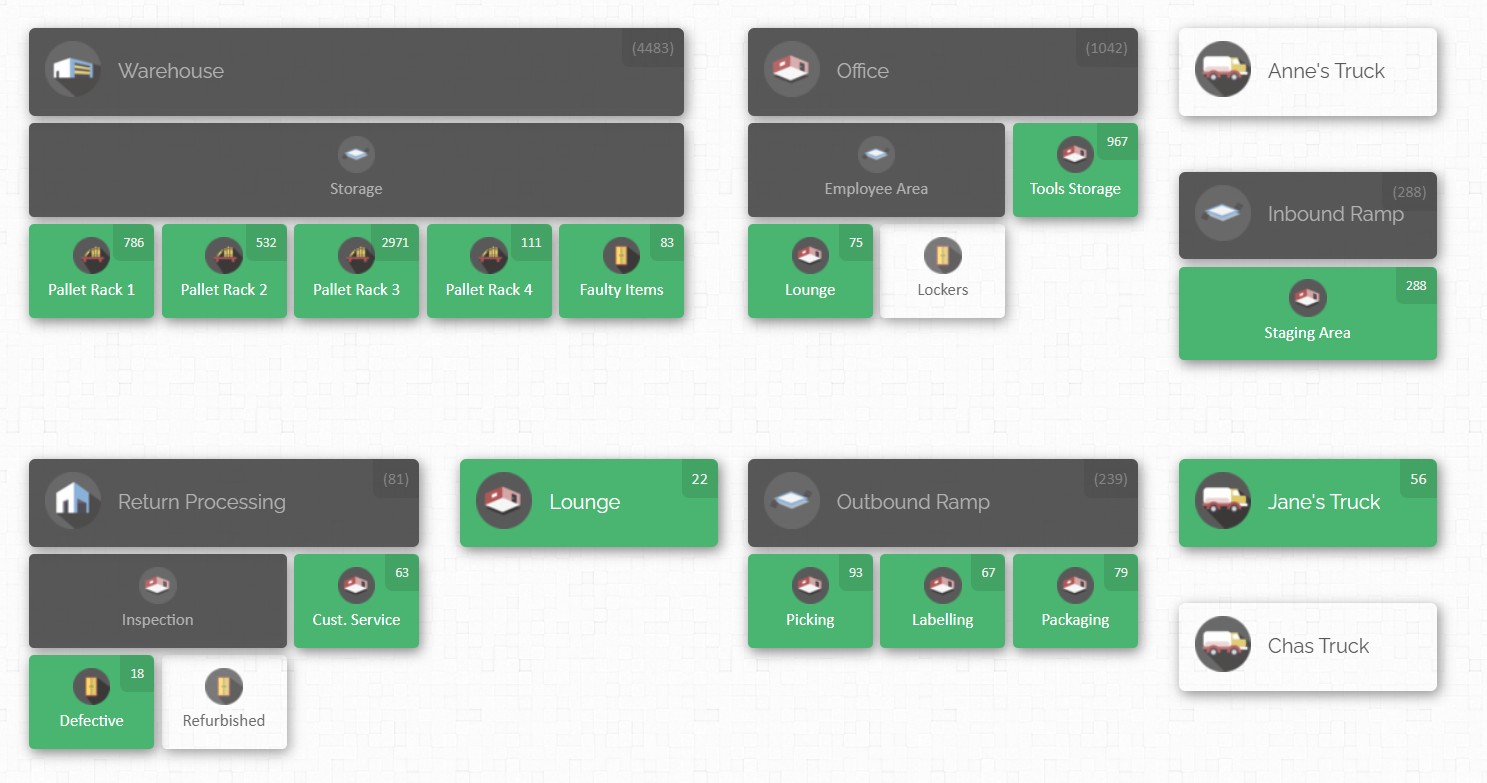
Achieving full visibility and alignment across a warehouse network – whether single or multi-site – requires the right tools. CyberStockroom is a modern inventory management platform built to support exactly these needs, with features that address the challenges we’ve discussed. At its core, CyberStockroom provides live visual maps of your entire inventory network. Every location – be it a warehouse, workshop storeroom, aisle, shelf or even a truck or yard zone – can be defined on a custom map. Teams see at a glance what’s where in real time.
With CyberStockroom, there’s no need to sift through spreadsheets. Instead, users work with an intuitive digital map. For example, if a production team needs a product, they can click on that product in the catalogue in the software and immediately see exactly which warehouse or bin holds it, and in what quantity. The drag-and-drop interface lets storekeepers move stock between zones by simply dragging the item icon on the map. All of these movements are recorded automatically in the system, maintaining perfect accuracy. This method gives operations “X-ray vision” over the network – if you select any item, the system highlights every location where that item exists.
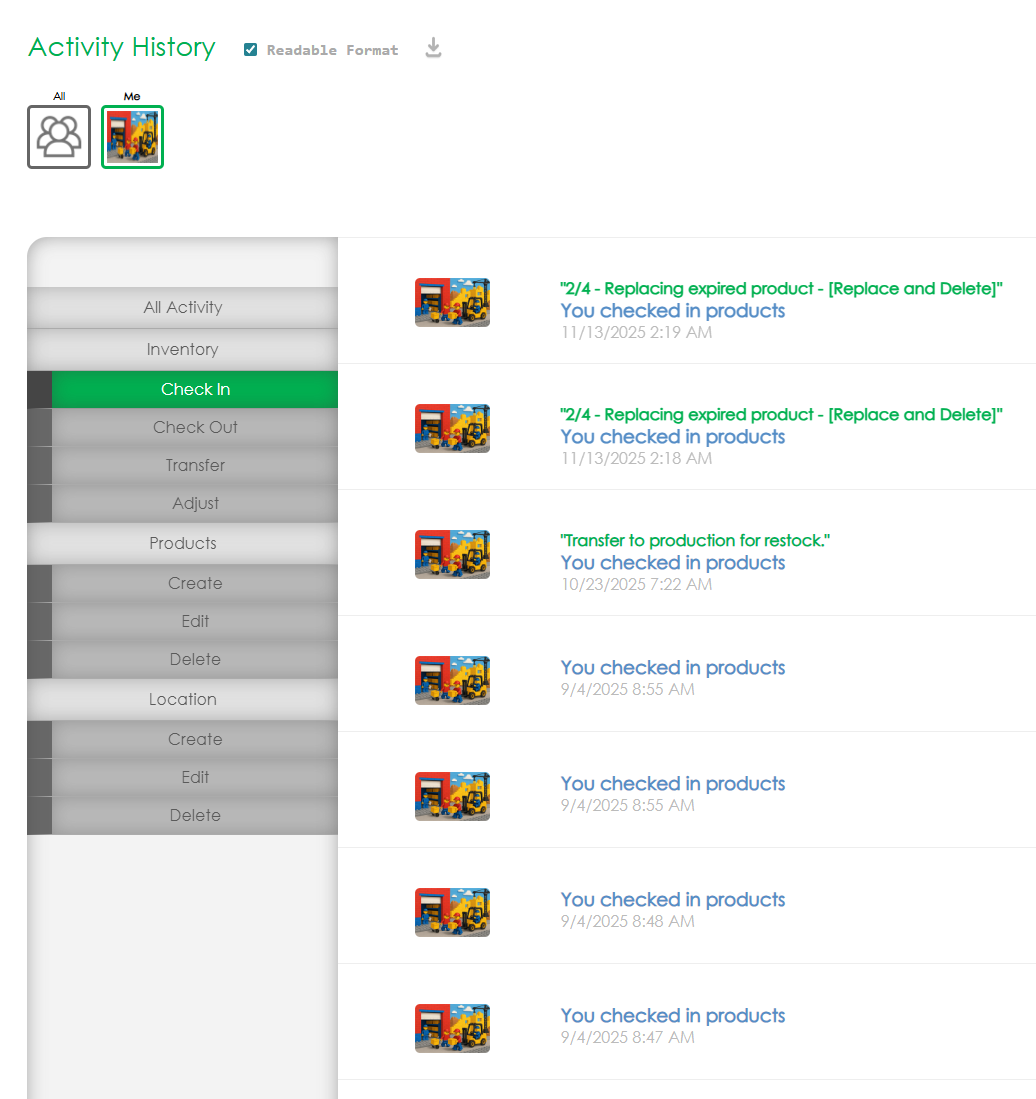
Cloud-based and real-time, CyberStockroom ensures data is instantly up-to-date. As soon as a part is scanned into inventory or withdrawn, that change reflects everywhere. Because the platform is accessed via web browsers, any team member – from maintenance engineers to project managers – can check inventory on any device with internet access. This means a maintenance planner on site and a procurement specialist in the office share the same view. Everyone works off a single source of truth. There’s no delay or confusion from multiple ledgers or outdated counts.
CyberStockroom also simplifies operational workflows. Barcode scanning is fully integrated: staff can scan both parts and location barcodes for speedy transactions. For example, using the “Quick Scan” function, a worker can perform bulk check-ins, check-outs and transfers by scanning a series of barcodes – updating hundreds of items in seconds. Regular audits become far more efficient because the system knows exactly what should be in each bin. Over time, this disciplined approach significantly raises inventory accuracy and trust in the data.
The platform’s flexibility accommodates any layout or strategy. Whether you have one sprawling warehouse or dozens of small storerooms, CyberStockroom lets you connect them visually. You can zoom out to see city-wide or company-wide inventories, and zoom in to aisle-level detail. If your strategy changes – say, opening a new site or reorganising shelving – the map can be updated easily by dragging new locations into place. This visual control also helps optimize space: managers can spot underused racks or overcrowded zones on the map and rebalance stock before issues occur.

Importantly, using CyberStockroom helps reinforce the best practices outlined above. It centralises inventory data, automatically unifies stock counts, and supports standardised procedures. The system’s interface guides users to handle all inventory movements consistently (for example, prompting for a reference or reason when adjusting stock). This consistency is vital for seamless collaboration across departments. In effect, CyberStockroom becomes the platform where all teams align: maintenance knows what’s reserved for their projects, production can claim needed parts without interference, and leadership sees holistic inventory health at any moment.
In summary, a solution like CyberStockroom brings warehouse strategy and inventory operations into one cohesive picture. By mapping out the network and automating visibility, it eliminates the old pain of “not knowing who has what.” This clarity drives better decision-making: you can quickly identify excess stock to consolidate or locate critical shortages before they cause downtime. For industrial firms looking to implement best-in-class warehousing – whether they’re operating one facility or many – CyberStockroom offers the practical capabilities to tie everything together.

Conclusion
Designing an effective warehouse network is about more than just picking a location or two. It involves aligning physical layout with operational goals and ensuring that every team has the information they need. A single-warehouse strategy may simplify management, while a multi-site network can boost speed and resiliency. In either case, the true success factor is visibility: knowing exactly what inventory is available, where it sits, and how it moves through your system.
To reach this goal, inventory teams in manufacturing should adopt a strategic mindset. Map out your current network and processes, identify pain points (such as frequent stockouts or wasted motion), and choose the setup that best balances cost and service. Establish standardized processes for receiving, storing and issuing parts, and make sure every department follows them. Measure performance with clear KPIs like inventory accuracy, fill rate and lead time. And leverage technology to tie it all together. Modern cloud systems with mapping features remove the barriers between departments, giving everyone a shared picture of the inventory landscape.
By carefully considering single vs multi-location options and investing in transparency, industrial organisations can achieve operational efficiency at scale. When every part has a known place and every movement is tracked, internal teams stay aligned and production keeps running. Embracing visual inventory mapping and real-time tracking completes the picture. The result is a warehouse network – however large or dispersed – that operates smoothly, costs are controlled, and teams across the business are confidently working from the same data.
Key Takeaways: Centralise your inventory data for one source of truth; use visual maps to navigate and optimise layouts; track movements in real time (e.g. via barcode scanning); standardise processes and conduct regular audits; and choose the network strategy that fits demand patterns. With these practices and a tool that supports multi-department visibility, your supply chain will be stronger, leaner and more responsive.









Leave a Reply