
Why Supplier Network Resilience Starts With Inventory Visibility
A resilient supplier network is not simply a long list of vendors that can ship parts when purchasing sends a purchase order. It is an operating system for protecting production, maintenance, construction schedules, customer commitments, and working capital when normal supply conditions change. Manufacturers build real resilience when they understand which materials are critical, where those materials come from, how much usable inventory they already have, and which teams can act when a supplier begins to slip. Supply chain mapping, supplier risk assessment, alternative sourcing, inventory buffers, and better visibility are all recognized methods for reducing exposure to disruption.
That connection between supplier resilience and inventory visibility is easy to overlook because procurement and inventory management are often treated as separate responsibilities. Purchasing may focus on supplier pricing, lead times, minimum order quantities, and open purchase orders, while warehouse teams focus on receipts, storage locations, counts, and material issues. Production is concerned with what is available for the schedule, maintenance wants immediate access to critical spares, and finance wants confidence that recorded inventory reflects physical stock. When these groups operate from different versions of the inventory picture, supplier risk becomes harder to see and much harder to manage.
Consider what happens when a critical component moves from a four-week lead time to twelve weeks. Purchasing may immediately conclude that another order is necessary, but the warehouse may already have stock in a secondary storeroom, production may have excess material staged beside an inactive line, and maintenance may be holding identical parts in a separate crib. If nobody can see those quantities together, the company can simultaneously experience a perceived shortage and a physical surplus. As a result, inventory visibility becomes one of the first lines of defense against supplier disruption because it shows what resources the organization actually has before it commits money or changes production plans.
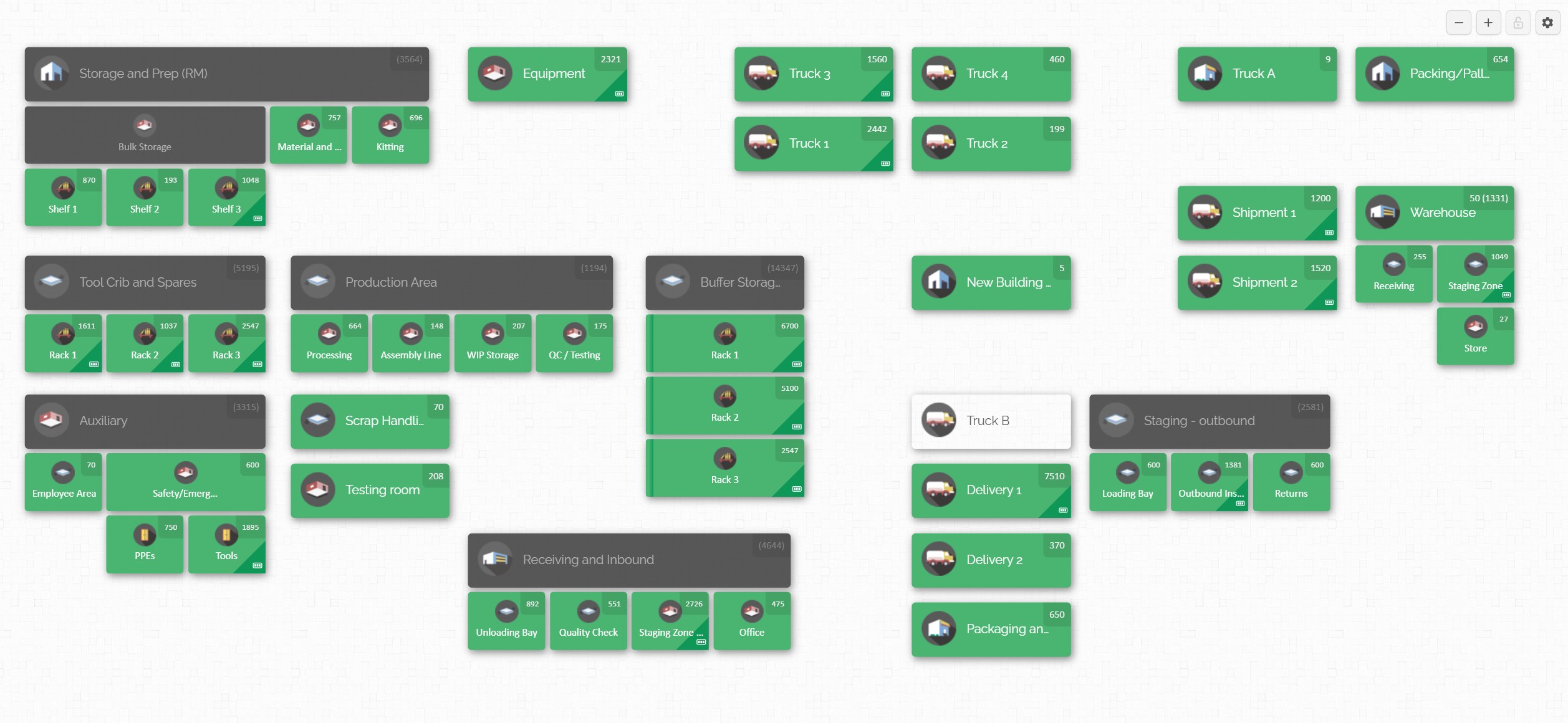
The strongest supplier network resilience inventory manufacturing program therefore begin inside the operation rather than outside it. Before a team adds suppliers, increases safety stock, or rewrites purchasing agreements, it needs confidence in the information driving those decisions. That means knowing not only total on-hand quantity, but also where parts are physically located, which department is using them, whether stock can be moved, and whether recorded quantities match reality. Better visibility turns inventory from an accounting number into an operational resource that procurement, operations, maintenance, and warehouse teams can use together.
This distinction matters because resilience is not the same as carrying more stock. A manufacturer can hold large amounts of inventory and remain highly vulnerable if the wrong parts are being stocked, if critical items are concentrated behind a single supplier, or if employees cannot find material when production needs it. Conversely, a business with disciplined inventory records and clear supplier alternatives may be able to operate with more targeted buffers because decision makers know what is available and where risk is concentrated. Effective resilience combines visibility, diversification, targeted reserves, flexibility, and governance rather than relying on any single tactic.
The same principle applies in industrial construction, fabrication, and project-based operations. Material may be divided among a central warehouse, laydown yard, fabrication area, project store, site container, maintenance shop, and temporary staging zones, even though several departments are drawing from the same supply network. A shortage reported by one project can therefore trigger an unnecessary emergency purchase while compatible stock sits elsewhere in the business. By creating visibility across physical locations and departmental boundaries, teams can distinguish a genuine supply problem from an internal material-location problem.
Supplier resilience also changes the way organizations think about efficiency. Traditional purchasing efficiency may emphasize the lowest unit price, the smallest amount of administrative effort, or consolidation with a preferred supplier. Those practices can still have value, but concentrating too much volume with one supplier can create a single point of failure for critical material. A resilient operating model balances purchasing efficiency with continuity, qualification effort, lead-time risk, inventory exposure, and the operational consequences of a shortage.
Cross-team alignment is what turns that balance into practical action. Procurement needs to understand which parts can stop production, production needs visibility into supplier constraints, maintenance needs a voice in defining critical spares, warehouse teams need accurate location and quantity records, and finance needs to understand why selected buffers are economically justified. These conversations work best when teams are discussing the same materials and the same inventory picture rather than reconciling competing spreadsheets during a disruption. Shared visibility and coordination across forecasting, planning, and inventory management are therefore central to stronger supply chain performance.
Throughout this guide, the objective is to build resilience without creating uncontrolled inventory growth. The goal is not to buy everything earlier, duplicate every supplier, or fill every available rack with extra material. Instead, the goal is to identify where disruption would hurt the business most, improve visibility around those exposures, and apply the right protection strategy to each class of material. Building on this principle, the first useful step is to make the physical inventory environment visible enough that teams can understand it together.
Build the Supplier Risk Picture Around Critical Inventory

A resilient supplier strategy begins by determining which parts deserve the most attention. Many organizations instinctively rank suppliers by annual spend, but the most expensive supplier is not always the supplier capable of causing the greatest operational disruption. A low-cost seal, connector, bearing, fastener, electrical component, or specialized fitting can stop a production line or delay commissioning if no substitute is available. For that reason, supplier risk analysis should combine financial importance with operational criticality rather than using purchase value alone.
Start by identifying materials whose unavailability would materially affect production, safety, maintenance, customer delivery, construction sequencing, or equipment uptime. The exercise should include raw materials and production components, but it should also cover maintenance spares, consumables with long replacement times, project materials, and specialized items that require lengthy qualification. A part becomes more critical when the organization has few substitutes, long replenishment lead times, concentrated supply, limited internal stock, or significant consequences if the item is unavailable. Thinking this way helps teams focus resilience resources where they can prevent the greatest disruption.
Once critical materials are identified, map the suppliers that support them. At minimum, teams should know the immediate supplier, manufacturing or fulfilment location when available, typical lead time, alternate sources, transportation dependency, and whether the supplier relies on upstream sources that may also represent a concentration risk. Supply chain mapping can reveal dependencies that are difficult to see in purchase-order data, particularly when several first-tier suppliers depend on the same upstream producer or region. Looking beyond the immediate supplier is therefore an important part of understanding the real network behind a critical component.
This deeper view prevents false diversification. A manufacturer may believe it has three suppliers for a component because three different companies appear in the purchasing system, yet all three may source the same raw material or subcomponent from a common upstream source. In that case, the organization has commercial alternatives without true supply resilience. Mapping supplier relationships and upstream dependencies helps expose these hidden concentrations before a disruption demonstrates them the hard way.
Geography should also be considered as part of supplier concentration. Two suppliers may be separate companies but operate in the same industrial area, use the same port, depend on the same transportation corridor, or face the same regional disruption. Conversely, spreading sourcing across regions can create resilience while introducing additional lead-time, logistics, quality, or communication complexity that must be managed. Supplier diversification works best when teams understand what specific risk the additional source is intended to reduce rather than simply increasing the vendor count.
Lead time deserves special attention because its effect reaches directly into inventory policy. A part with a stable two-day replenishment cycle presents a different risk from an engineered component with a sixteen-week lead time, even when current demand is identical. Longer replenishment windows increase the period during which demand changes, supplier delays, quality problems, and internal planning errors can affect availability. As a result, lead time should be evaluated alongside variability rather than treated as a static purchasing-system field.
Supplier capacity is another important dimension. A secondary supplier does not provide much resilience if it lacks the equipment, labor, tooling, raw materials, or production capacity required to absorb additional volume during a disruption. Procurement should therefore understand not only whether an alternate source can make the part, but also how much additional volume that source could realistically provide and how quickly it could respond. This is particularly important for castings, machined components, fabricated assemblies, custom electrical equipment, and other materials where increasing output is not instantaneous.
Qualification time must be considered in the same way. A potential alternative supplier may exist, but the source is not a practical contingency if technical approvals, samples, tooling, testing, documentation, or customer requirements would take months to complete after a disruption begins. Resilient companies identify these constraints in advance and decide whether selected backup sources should be qualified before they are needed. Supplier selection should therefore include capability, quality, traceability, delivery performance, and operational fit rather than focusing solely on quoted cost.
Internal inventory should then be overlaid on this risk map. For every high-criticality material, teams should be able to determine the total quantity available and how that quantity is distributed among warehouses, buildings, departmental stores, production areas, maintenance cribs, project locations, and other storage points. A risk score that ignores current inventory can overstate an immediate threat, while an inventory report that ignores supplier risk can understate a future one. Combining the two creates a more useful picture of how long the operation can continue if replenishment is interrupted.
This is where days of cover or operational coverage can become more meaningful than quantity alone. Five hundred units may sound comfortable until planners learn that production consumes 200 units each day, while ten units of a slow-moving critical spare might represent several years of normal demand. Coverage should therefore be evaluated using realistic consumption, planned work, known projects, scheduled maintenance, customer orders, and credible demand scenarios. The purpose is not to create a mathematically perfect forecast, but to give decision makers a common language for comparing inventory protection with supplier exposure.
The analysis should also distinguish replaceable parts from parts with no practical substitute. Standard fasteners, common bearings, commodity metals, and widely available consumables may permit sourcing flexibility, while proprietary controls, custom castings, specialized assemblies, and customer-approved components may not. Engineering and maintenance should therefore participate in resilience planning because they often know whether a seemingly unique item can be substituted, redesigned, standardized, repaired, or sourced under another specification. Cross-functional participation prevents procurement from carrying the full burden of solving a risk that may have an engineering or operational solution.
Finally, supplier risk information should remain usable rather than becoming an oversized assessment that nobody revisits. A concise view showing criticality, primary source, alternate source status, normal lead time, current inventory coverage, major concentration risks, and required mitigation can be more valuable than a complicated score that only one analyst understands. The objective is to help people recognize when conditions are changing and know which response has already been considered. Once the risk picture is clear, the organization can strengthen the internal inventory visibility needed to execute those responses.
Create One Cross-Department View of Inventory

Supplier resilience breaks down quickly when each department maintains its own definition of what inventory exists. Purchasing may rely on an enterprise record, maintenance may keep a spreadsheet of spares, production supervisors may know about line-side material, and warehouse employees may depend on local knowledge that has never been documented. Each view can be individually reasonable while the combined picture remains inaccurate. A resilient operation therefore needs one dependable inventory view that departments can use as a common starting point for decisions.
Creating that view begins with consistent item identification. The same component should not appear as several unrelated records simply because departments use different abbreviations, descriptions, or informal names. Standard part numbers, descriptions, units of measure, and other essential item information reduce the chance that one team orders material another team already possesses under a different label. In practice, basic item discipline is one of the foundations of inventory accuracy because visibility is only useful when everyone understands what the record represents.
Location structure deserves equal discipline. Terms such as “main warehouse,” “maintenance,” or “Building Two” may be too broad when employees need to find a specific component quickly during a disruption. Useful inventory visibility should reflect the physical hierarchy of the operation, such as site, building, room, aisle, rack, shelf, bin, yard zone, project store, or another level that makes sense for the facility. A clear location structure reduces dependence on tribal knowledge and gives different departments a consistent way to describe where material is stored.
Physical organization should support the digital location structure rather than contradict it. If records distinguish racks and bins but materials are routinely placed wherever space happens to be available, employees will eventually stop trusting the location data. Conversely, if the warehouse is meticulously labelled while inventory records only identify the building, much of the physical discipline is lost when somebody searches electronically. Strong visibility comes from keeping the recorded location and the real storage location aligned through everyday receiving, put-away, movement, picking, and counting practices.
Departmental stockrooms require particular attention because they often sit outside the main warehouse process. Maintenance teams may keep emergency spares near equipment, production departments may maintain consumables near work canters, and project teams may stage material close to a job. These local stocks can improve response time, but they also create blind spots when quantities and locations are not visible to the rest of the organization. The solution is not necessarily to centralize every item physically, but to make decentralized inventory visible within a common inventory structure.
That distinction is important for operational efficiency. Moving every spare part to one warehouse can increase travel and slow maintenance, while allowing every department to manage invisible private stock can create duplicate purchases and inaccurate planning. A better approach keeps material where operationally appropriate while making its existence and location visible to authorized teams that need to plan around it. This provides many of the benefits of decentralized storage without forcing the organization to accept fragmented information.
Receiving practices are another major control point. Inventory cannot become visible to downstream departments if material remains physically at receiving while the rest of the business assumes it has been put away, or if employees move stock before its destination is reflected in records. Clear procedures should define when received material becomes available, who assigns its storage location, and how exceptions such as inspection holds or unidentified deliveries are managed. Reliable supplier performance data and reliable inventory data both depend on making these transitions consistently visible.
The same principle applies when inventory moves internally. Parts can travel from warehouse to production, from warehouse to maintenance, between buildings, into project staging, or back from a completed job. Every uncontrolled movement increases the chance that the recorded location becomes different from the physical location, especially in fast-moving environments where employees are trying to keep equipment running. Simple, repeatable movement discipline protects visibility without turning material handling into an administrative burden.
Cycle counting should then be used to test whether the operating process is working. Rather than treating inventory accuracy as something examined only during a large annual count, regular counting allows teams to find discrepancies closer to the time they occur. When a difference is identified, the useful question is not only how to correct the quantity, but also why the record became inaccurate. Regular validation against inventory records is an established method for improving inventory accuracy and identifying weaknesses in day-to-day control.
For resilient inventory management, count frequency should reflect operational risk rather than applying one schedule to every item. Critical parts, high-use components, materials with frequent movements, and items with a history of discrepancies deserve more attention than stable, low-risk stock. A component that can stop an assembly line should not remain unverified for months simply because its annual financial value is modest. Risk-based counting connects inventory control directly to the same criticality logic used in supplier resilience.
Visibility also requires agreement about ownership. Teams should know who is responsible for maintaining the accuracy of a storage area, approving unusual movements, investigating recurring discrepancies, and deciding whether dormant stock can be reallocated. Without that accountability, inventory information becomes everybody’s responsibility in theory and nobody’s responsibility in practice. Clear ownership is particularly important where departments share materials or where parts regularly move between central and local stores.
Once these disciplines are in place, cross-department conversations become much more productive. Procurement can review supplier risk against credible stock levels, production can make schedules using material that employees can actually locate, maintenance can find spares without maintaining isolated records, and finance can have greater confidence in physical inventory control. The organization also becomes better equipped to distinguish a supplier-driven shortage from a problem caused by misplaced, unrecorded, duplicated, or poorly organized stock. That distinction is essential because resilience depends on solving the right problem rather than reacting to every inventory alarm as a purchasing emergency.
Design Resilience Into Sourcing, Stocking, and Material Flow

Once supplier risk and internal inventory are visible, the organization can choose resilience strategies more precisely. Different parts require different protections, and using the same policy for every SKU usually creates either excessive inventory or insufficient coverage. A highly critical proprietary component may justify an alternate supplier and a substantial buffer, while a readily available commodity may require little more than accurate inventory records and a dependable replenishment process. Resilience becomes economically sustainable when the mitigation matches the exposure.
Supplier diversification is often the most visible resilience tactic, but it should be applied deliberately. Adding a second source can reduce dependence on one supplier, yet it also introduces qualification work, supplier management effort, potentially smaller order volumes, and sometimes higher unit costs. Teams should therefore prioritize dual or multiple sourcing where the impact of a single-source failure justifies those trade-offs. The aim is not to eliminate single sourcing everywhere, but to make single-source dependence a conscious decision rather than an unnoticed condition.
Volume allocation should support that strategy. A secondary source that receives no regular business may not be prepared to respond when the primary supplier fails, particularly if tooling, materials, skills, or production slots must be maintained. For selected high-risk components, giving qualified secondary suppliers some ongoing volume can help preserve the commercial and operational relationship. In practice, a supplier that is active before a disruption is generally easier to engage than a name stored on a contingency spreadsheet.
Supplier development provides another path when alternatives are limited. If a strategically important supplier struggles with quality, capacity, process discipline, or lead-time consistency, the manufacturer may gain more resilience by helping improve that source rather than immediately replacing it. Manufacturing support programs recognize process improvement, quality systems, supplier development, lead-time reduction, and performance measurement as important parts of stronger supply chains. This approach can be especially valuable for specialized regional suppliers whose capabilities would be difficult to duplicate quickly.
Safety stock is equally important, but it should be targeted rather than treated as a blanket percentage. Inventory buffers can protect operations when demand or replenishment varies, yet indiscriminate buffer increases can consume cash, storage space, handling capacity, and management attention. Criticality, lead time, demand behavior, supplier reliability, alternate-source availability, and shortage consequences should all influence the level of protection. Supply chain mapping itself can help reveal where more robust buffers are justified and where existing inventory may already be excessive.
Physical distribution of those buffers matters as much as total quantity. Holding all critical spares in one remote warehouse may provide excellent inventory accuracy while delivering poor response time to a plant that needs the part immediately. Conversely, dividing the same stock among too many uncontrolled departmental locations can create hidden inventory and unnecessary replenishment. Teams should position material based on usage, response requirements, handling constraints, and visibility, then maintain a common view of the resulting distributed stock.
Standardization can reduce supplier exposure without adding inventory. When engineering, maintenance, and operations use several slightly different components for similar applications, the business may create multiple supplier dependencies and small pools of stock that cannot be shared. Where technically appropriate, reducing unnecessary variation can concentrate demand on interchangeable materials and allow inventory to serve more than one use case. Standardization therefore improves resilience by expanding the number of situations in which available inventory can protect operations.
Substitution rules can achieve a similar result when full standardization is not possible. Engineering teams can identify compatible alternatives for selected components before a shortage occurs, documenting where substitution is acceptable and where additional approval is required. This turns an urgent shortage conversation into a controlled decision rather than an improvised response under production pressure. For long-lead or difficult-to-source materials, pre-approved alternatives can be just as valuable as an additional supplier.
Order policies should also recognize the difference between purchase-price efficiency and total operational exposure. A large order may reduce unit cost while increasing inventory carrying cost and obsolescence risk, while very small and frequent orders can leave the plant vulnerable to lead-time variation. Similarly, buying exclusively from the lowest bidder may create hidden costs if delivery performance, quality, or response capability is inconsistent. Resilient purchasing evaluates the economic consequences of both excess stock and material unavailability rather than optimizing one line of the purchase order in isolation.
Supplier scorecards can make these trade-offs visible over time. Useful measures may include on-time delivery, lead-time performance, quality, responsiveness, capacity concerns, recurring shortages, and corrective-action performance, with the exact measures adapted to the type of supplier. The purpose is not to create paperwork for vendors, but to identify trends before they become operational emergencies. Performance metrics are also useful for determining which suppliers warrant development, additional volume, closer monitoring, or a sourcing alternative.
Demand planning and supplier planning should then be linked to actual inventory conditions. A forecast can indicate future material requirements, but planners also need reliable information about existing stock, planned consumption, project needs, maintenance requirements, and material already distributed among departments. Without that foundation, the company can transmit distorted demand to suppliers and then compensate for the resulting uncertainty with even more inventory. Better visibility into demand, inventory, capacity, and other operational measures helps organizations recognize risk and evaluate response scenarios more effectively.
The resulting strategy is a portfolio rather than a single resilience policy. One part might be dual sourced, another protected by safety stock, a third standardized across equipment, a fourth covered through a qualified substitute, and a fifth managed through closer supplier development. What connects these choices is visibility into both supplier exposure and internal inventory. Building on that foundation, the organization needs a practical way for different departments to see where parts are stored and how those physical stocks relate to daily operations.
How CyberStockroom Supports Multi-Department Parts Visibility
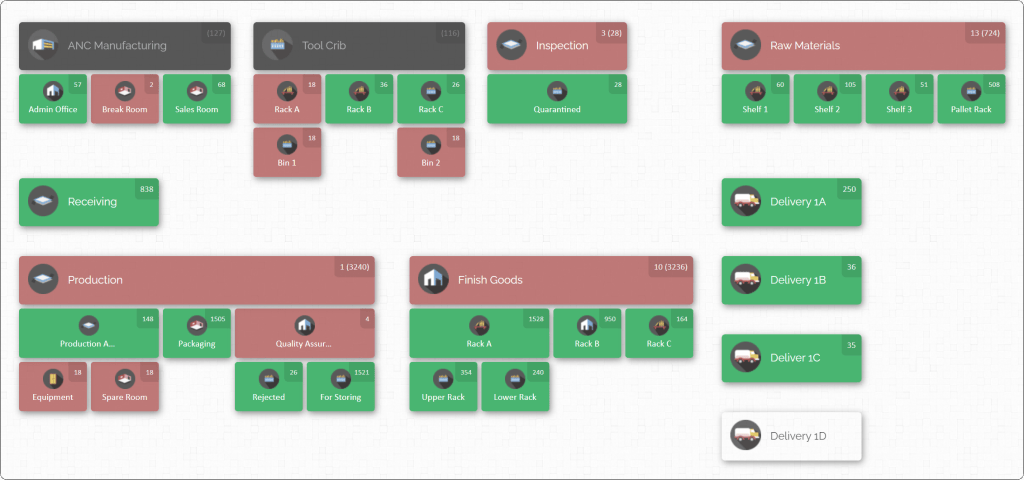
CyberStockroom fits into this resilience model by helping teams represent inventory through visual maps of their physical operations. Instead of treating inventory only as rows in a list, teams can map locations and sub-locations that correspond to the way stock is actually organized across facilities. A business can represent warehouses, stockrooms, rooms, storage areas, racks, shelves, bins, and other relevant locations, then associate inventory with those places. This gives departments a visual reference for answering one of the most important operational questions during a supply disruption: where is the material we already have?
That capability is valuable in manufacturing environments because inventory rarely belongs to a single physical space. Production parts may sit in a central warehouse and at the line, maintenance spares may be distributed across several cribs, and project material may occupy staging areas or separate buildings. CyberStockroom enables teams to create a shared visual structure that reflects those distributed storage areas rather than forcing employees to think of inventory as one undifferentiated quantity. As a result, different departments can understand how stock is spread throughout the operation while referring to the same underlying location model.
Location visibility is especially useful when supplier performance begins to deteriorate. Suppose a buyer learns that a shipment of valves will arrive several weeks late, while the production team believes the plant has insufficient stock to continue the schedule. With a visual inventory structure, employees can examine the mapped locations where those valves are stored instead of limiting the search to the production team’s usual stockroom. CyberStockroom can show inventory across locations and sub-locations, helping teams determine whether usable quantities are distributed elsewhere in the organization.
This shared view also helps reduce unnecessary departmental stock isolation. Maintenance does not have to surrender control of every spare to the central warehouse for purchasing to know that material exists, and production does not need to physically centralize every line-side part simply to make stock visible. Instead, inventory can remain in locations that support efficient work while those locations remain part of a broader inventory map. That approach supports the resilience principle of decentralizing material when operations benefit from it without decentralizing knowledge of the material.

CyberStockroom’s map-based approach can also reduce reliance on employees remembering where parts are normally kept. Experienced warehouse or maintenance personnel often carry substantial location knowledge in their heads, which works until those employees are unavailable or another department needs the same material. By reflecting physical locations visually, the inventory map gives employees a common reference for navigating the operation. This can support faster familiarization with storage areas and easier collaboration between warehouse, production, purchasing, and other teams.
The value becomes clearer when an item is stored in more than one place. CyberStockroom can help users see the locations in which a part is held and the quantities associated with those locations, providing a clearer picture of distributed stock. That matters because purchasing decisions based only on one department’s local quantity can lead to avoidable orders, while production decisions based on incomplete location knowledge can create unnecessary schedule changes. Seeing the broader distribution of a part helps teams decide whether they need to buy, transfer, conserve, or simply locate existing inventory.
Visual mapping can also support better stock organization over time. When teams can see storage areas and inventory locations in context, it becomes easier to recognize whether frequently used or critical parts are scattered across inconvenient locations or stored in ways that complicate retrieval. Warehouse leaders can then review how physical organization supports actual material usage instead of treating location design as a one-time setup exercise. In this way, visibility can contribute to both resilience and everyday operational efficiency.
For multi-building operations, the same concept extends beyond a single stockroom. Plants may contain separate production buildings, maintenance facilities, warehouses, yards, and support areas, all of which can hold materials that affect the same production or project schedule. CyberStockroom’s emphasis on mapping locations and their contents provides a way to organize that complexity visually without requiring employees to remember which local list belongs to which building. This helps create the shared inventory perspective needed for cross-department planning.
Importantly, the value here is not that mapping replaces good inventory discipline. A visual representation cannot compensate for parts that are moved without updating their location, inconsistent item definitions, uncontrolled departmental storage, or a lack of ownership for inventory accuracy. CyberStockroom works best within the operating practices discussed earlier, including clear location structures, consistent stock organization, disciplined movements, and regular validation of physical inventory. The technology makes those practices easier to understand and use, while the organization still owns the process that keeps the information dependable.

That distinction also keeps the resilience program focused on practical outcomes. Teams do not need another layer of complexity simply because supplier risk has become more important; they need a clearer way to understand what they have, where it is, and how multiple departments can use that information together. CyberStockroom enables that visibility through inventory mapping, location tracking, and stock organization, which directly support the internal side of supplier resilience. Once those foundations are established, the remaining challenge is to turn resilience from a periodic project into a repeatable operating discipline.
Turn Supplier Resilience Into a Daily Operating Discipline

Supplier network resilience should eventually become part of normal planning rather than something the organization discusses only after a major shortage. The most effective routines connect supplier conditions, inventory availability, demand, production plans, maintenance requirements, and material-location information before small problems become emergencies. This does not require a daily executive meeting about every supplier, but it does require clear thresholds for escalating critical issues. Resilience becomes practical when employees know which changes matter, who needs to know, and what action should follow.
A regular cross-functional material-risk review is a useful starting point. Procurement can bring information about delayed orders and supplier constraints, warehouse teams can confirm stock conditions, production can identify schedule exposure, maintenance can flag critical spares, and finance can provide perspective on working-capital consequences. The group should focus on exceptions rather than reviewing every item, giving priority to materials where supplier risk and operational criticality intersect. Cross-functional risk teams and shared visibility are recognized approaches for improving the speed and quality of supply chain response.
The meeting should begin with facts rather than anecdotes. For each major risk, teams should understand the affected part, expected requirement, current usable inventory, physical distribution of that inventory, incoming supply, likely disruption duration, alternate-source options, and operational consequence. When those elements are available, the organization can compare responses such as reallocating internal inventory, adjusting the production sequence, expediting supply, approving a substitute, increasing a future buffer, or activating another supplier. Better visibility makes these choices more deliberate because the team is acting on a shared view of the problem.
Scenario planning can strengthen this routine further. Instead of asking only what happens under the current forecast, teams can examine what would happen if a supplier misses another delivery, demand increases unexpectedly, an alternate source takes longer to qualify, or a critical warehouse location becomes temporarily inaccessible. The purpose is not to predict every possible disruption but to identify where the operating plan fails quickly under plausible changes. Scenario analysis and contingency planning help organizations recognize future shortages and evaluate responses before the pressure of an actual disruption.
For critical components, the scenario should include time to recovery and inventory coverage. If a supplier could be unavailable for eight weeks but the business has only two weeks of practical stock coverage, the mitigation gap is obvious. The team can then decide whether the best response is more inventory, another supplier, reduced usage, product substitution, an engineering change, supplier-development work, or some combination of these approaches. This is far more useful than simply labelling the supplier “high risk” without connecting that risk to an operational response.
Inventory accuracy should be monitored as a resilience measure alongside traditional warehouse performance indicators. A resilience plan built on inaccurate quantities can create a dangerous sense of security because the organization believes it has protection that does not physically exist. Regular cycle counting, discrepancy analysis, and correction of underlying process problems help keep the inventory picture dependable. This is especially important for critical components because an error affecting one high-impact spare may matter more operationally than dozens of minor discrepancies involving low-risk items.
Location accuracy deserves its own attention as well. A system can contain the correct total quantity while still failing operations if employees cannot find the material where the record says it should be. Manufacturers should therefore monitor recurring location problems, unidentified stock, material left in temporary staging, and inventory that moves between departments without adequate control. For supplier resilience, “we own it somewhere” is not equivalent to “we can deploy it when needed.”
Supplier performance metrics should feed the same improvement cycle. A pattern of late deliveries, increasing lead times, recurring quality issues, or slower responses may indicate that a source deserves closer attention before a major failure occurs. The appropriate reaction might be supplier development, a sourcing review, additional coverage, or simply a conversation about capacity and upcoming demand. Scorecards become valuable when they trigger thoughtful action rather than existing only as historical reports.
Organizations should also measure the quality of their resilience decisions. Useful indicators can include inventory accuracy, frequency of critical shortages, emergency purchases, expedited freight, supplier delivery performance, time spent locating parts, duplicate purchases, and the amount of critical inventory with a documented mitigation strategy. The exact measures should reflect the operation, but the principle is to track whether resilience practices are reducing disruption without producing uncontrolled stock growth. Metrics allow teams to adjust the program based on operational results rather than assumptions.
Over time, these measures should lead to more precise inventory policies. If a part repeatedly requires emergency purchases despite apparently adequate safety stock, the issue may be inaccurate demand, poor supplier reliability, hidden departmental consumption, or incorrect inventory records. If another part consistently holds excess stock with little operational value, its buffer may be larger than the actual risk justifies. Visibility allows teams to distinguish these conditions and move working capital toward inventory that genuinely protects the business.
A resilient organization also learns from every significant shortage. After the immediate problem is resolved, teams should ask whether the supplier risk was known, whether inventory records were accurate, whether parts could be located quickly, whether another department held usable material, whether an alternate source existed, and whether escalation happened early enough. The goal is not to assign blame to purchasing, warehouse, production, or a supplier, but to strengthen the operating system so the same weakness is less likely to cause another disruption. Continuous learning turns individual incidents into improvements across the supplier and inventory network.
This approach is particularly valuable for manufacturers with multiple facilities. One plant may experience a shortage while another holds excess material, and a local buying decision may make sense only because the organization lacks visibility beyond the affected site. Multi-location inventory visibility allows supply teams to consider internal reallocation before placing urgent external orders, provided the material can be moved without creating unacceptable risk elsewhere. In practice, enterprise resilience improves when locations act as parts of one material network rather than isolated inventories.
Industrial construction organizations can apply the same principle across projects. A project approaching completion may have surplus fittings, electrical components, fabricated material, consumables, or spare equipment that another active project is preparing to purchase. Without accurate location and stock information, both project teams can behave rationally from their local perspective while the business as a whole buys more than it needs. A shared view of warehouses, yards, site stores, containers, and staging areas creates an opportunity to reuse available material before expanding supplier demand.
Procurement policies should reinforce this behavior by defining when internal inventory must be checked before emergency purchasing. This does not mean creating delays when production is at risk, but it does mean establishing a rapid and reliable method for determining whether material exists elsewhere. When location information is easy to understand, that check can become part of normal purchasing discipline rather than an investigative project. The result is a better balance between purchasing speed, working-capital control, and operational continuity.
The same visibility can improve conversations with suppliers. When a manufacturer understands its real inventory coverage, it can communicate priorities more intelligently instead of treating every late order as equally urgent. Procurement may discover that one delayed component has several weeks of coverage while another material from the same supplier could stop production within days. Clear internal inventory information therefore helps suppliers and buyers focus limited capacity and expediting attention where it creates the greatest operational value.
Resilience should also be incorporated into sourcing decisions for new products, equipment, and projects. Engineering and procurement should consider whether proposed components are widely available, whether alternative manufacturers exist, how long qualification may take, and whether the new design introduces another unique spare or supplier dependency. Decisions made during specification can shape inventory requirements for years, particularly for equipment with long operating lives. Addressing supplier resilience before a component becomes embedded in the operation is usually easier than solving the dependency after shortages begin.
For existing materials, teams can use a simple mitigation hierarchy. First, improve visibility so the organization understands what it owns and where it is. Next, determine whether internal reallocation, standardization, or substitution can reduce the exposure before adding external complexity. Then evaluate supplier alternatives, targeted safety stock, supplier development, and other protective measures based on the remaining risk. This sequence helps prevent companies from solving every uncertainty by purchasing additional inventory.
That discipline protects working capital as well as production. Resilience investments are easier to justify when leaders can connect each buffer, alternate supplier, or process change to a defined operational exposure. Instead of accumulating precautionary stock across thousands of items, the organization can concentrate resources on materials where shortages would create meaningful consequences. Targeted resilience therefore supports both continuity and financial control, provided inventory information remains accurate enough for teams to trust it.
Training should reinforce the same principles at the operational level. Employees who receive, move, store, issue, or return material need to understand that location accuracy is not merely a warehouse housekeeping concern. Every undocumented movement weakens the information purchasing and operations may rely on when a supplier fails. When employees understand how their daily inventory practices connect to production continuity, the reason for accurate stock organization becomes much clearer.
Leaders should likewise treat visibility as a shared operational responsibility rather than a warehouse project. Procurement benefits from accurate stock before placing orders, production benefits from dependable material availability, maintenance benefits from faster parts location, and finance benefits from stronger inventory control. Each department therefore has a reason to support consistent item identification, location discipline, movement practices, and inventory verification. Cross-team alignment becomes sustainable when every function can see how better inventory information improves its own decisions.
For organizations that are early in this process, the starting point does not need to be a complete transformation of every supplier and every SKU. Begin with one important product family, production area, maintenance category, or project and identify the critical parts behind it. Map the suppliers, assess concentration and lead-time risk, document inventory locations, verify quantities, and bring the relevant departments together to review the findings. Supply chain mapping can be started around key products and expanded as the organization learns where additional visibility creates the greatest value.
The next phase is to close the most important gaps. That might mean qualifying a second supplier for one component, consolidating duplicate part records, increasing a carefully selected safety stock, mapping a departmental storeroom, relocating critical spares, standardizing a component, or correcting an unreliable material-movement process. These improvements may look small individually, but together they reduce the number of ways a routine disruption can turn into an operational emergency. Resilience grows through a series of practical controls rather than one large initiative.
As the program expands, visibility should remain the connecting thread. Supplier maps show where materials come from, while inventory maps show where those materials reside after they enter the operation. Procurement information explains what is expected to arrive, while accurate physical inventory explains what the company can use right now. Connecting those perspectives gives decision makers a much stronger foundation for balancing continuity, efficiency, and working capital.
This is the central lesson of a strong supplier network resilience inventory manufacturing strategy. Supplier resilience cannot be separated from inventory accuracy, and inventory accuracy cannot deliver its full value when parts remain invisible across departments and locations. Manufacturers protect operations by knowing their critical dependencies, diversifying where appropriate, maintaining targeted buffers, improving supplier performance, and creating one dependable view of physical stock. Each layer strengthens the others, turning resilience from an emergency response capability into part of normal operational control.
CyberStockroom supports that operating model by making the physical side of inventory easier to see and understand across departments. With visual inventory maps, teams can represent storage locations, organize stock according to the way the facility actually operates, and see where parts and quantities are distributed across the business. That visibility gives procurement, warehouse, production, maintenance, and other teams a common picture to use when supplier conditions change. In an environment where minutes of confusion can turn into hours of searching or unnecessary purchasing, clarity about existing inventory becomes a practical resilience advantage.
Ultimately, a resilient supplier network is not defined by never experiencing disruption. Suppliers will still encounter capacity problems, transportation delays, quality issues, material shortages, and unexpected changes in demand, while internal operations will continue to face their own constraints. The difference is that a resilient organization can see the problem early, understand what inventory it has, coordinate departments around the same information, and choose from several realistic responses. When supplier strategy and inventory visibility are managed as parts of the same operating system, manufacturers are far better positioned to protect production without sacrificing the accuracy, efficiency, and financial discipline required for long-term performance.







Leave a Reply