
Comparing CyberStockroom vs. inFlow is a useful exercise because the two platforms start from very different assumptions about what an inventory problem is. inFlow is widely used as an order-driven inventory management system, built to help product-based businesses manage sales orders, purchase orders, and stock levels in one place. CyberStockroom is built around a different question, which is where each part physically sits and how everyone in the operation can see it. In industrial construction, manufacturing, and maintenance environments, that distinction matters, because a part that appears in the records but cannot be found on the floor creates the same delay as a part that was never ordered. This comparison examines both tools through the lens of inventory visibility across departments, so that you can decide which approach fits the way your teams actually work.
Before going further, it is worth saying that neither tool is a universal answer, and a fair comparison should respect what each one does well. Teams that spend most of their day processing orders and managing product catalogs will naturally gravitate toward a transaction-centered system. Teams that spend most of their day searching for spares, staging materials, and reconciling what is on hand with what is on the shelf will care more about location clarity. As you read, consider which of those descriptions sounds more like your own operation, because that single observation will shape nearly every conclusion that follows. We begin with a look at what a location-centered inventory actually looks like in practice.
See the CyberStockroom Inventory Map in Action
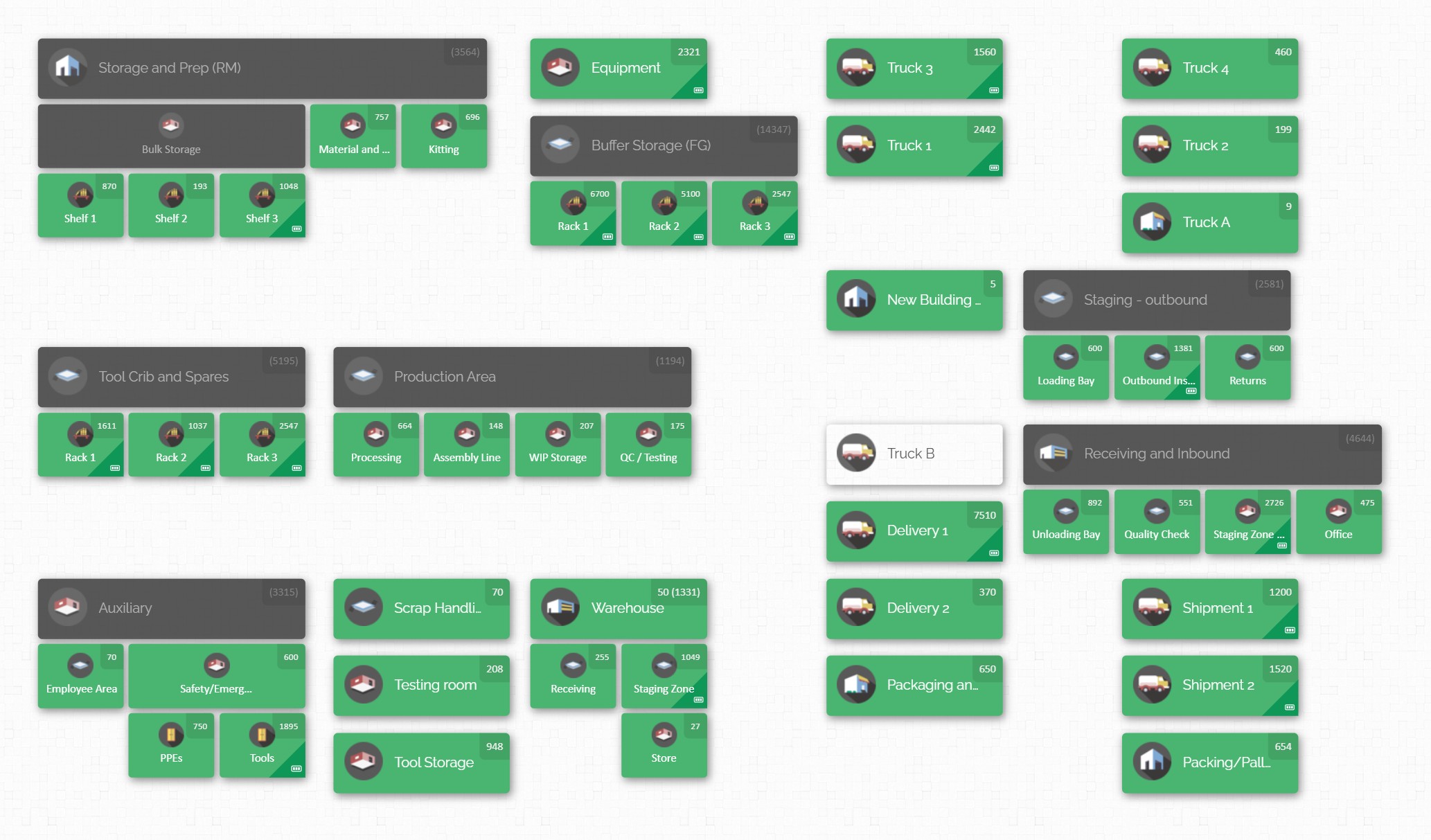
Before getting into the details of the comparison, it helps to see how a location-centered inventory presents information. The demo above shows stock organized around the physical places where it is stored, so a user can see not only that a part exists but exactly where to go and get it. This matters because most day-to-day inventory frustration is not caused by missing records; it is caused by records that describe quantities without describing places. As you explore the demo, notice how a question such as “where are the spare gaskets for the transfer pump?” becomes a quick visual lookup instead of a phone call.
Keeping that experience in mind will make the rest of this article easier to evaluate. Throughout the comparison, we will return to one practical test: when a planner, a technician, a buyer, and a supervisor all need to know about the same part, how quickly and how consistently can each of them get the answer? Tools tend to reveal their true character in those moments, when several departments depend on the same piece of information at once. With that test in place, we can turn to why cross-department visibility deserves so much attention in the first place.
Why Inventory Visibility Across Departments Matters

Inventory visibility is the ability of everyone who touches a part to know what is on hand, where it is stored, and whether it is ready to use, without having to ask another person. In many operations, that visibility is fragmented because each department maintains its own version of the truth. Maintenance may track critical spares on a private list, procurement may rely on purchase history, and the warehouse may trust whatever it counted at the last audit. As a result, the same part can appear to exist in three places or in none, depending on whom you ask.
The cost of fragmented visibility is easy to underestimate because it is spread across many small failures. A technician who cannot find a bearing orders another one, a project manager pays rush freight for a component that was sitting in a different building, and a finance team discovers that carrying costs have quietly grown. Each incident feels like an isolated mistake, yet together they form a systematic drain that increases with every additional department and storage area. In practice, the larger the operation becomes, the more expensive it is to rely on memory and informal conversation. This is especially important when schedules are tight and downtime is measured in thousands of dollars per hour.
Visibility also shapes trust, which is harder to measure but just as valuable. When people believe the inventory system is wrong, they build side spreadsheets, hoard spares in their own corners, and stop updating records, which makes the system even less accurate. Breaking that cycle requires a tool and a process that make the correct answer easy to find and easy to maintain. Building on this idea, a team that trusts its inventory can plan work earlier, order with more confidence, and spend less time verifying what the system already says.
Finally, cross-department visibility is not only a technology problem; it is an alignment problem. Departments use different vocabularies, work under different time pressures, and often define “available stock” differently. A planner may consider a part available the moment it is received, while a technician considers it available only once it has been staged near the work area. Unless those definitions are reconciled, even the best software will show numbers that people interpret in different ways, which is why the best practices below matter as much as the platform you choose.
Best Practices for Improving Inventory Visibility Across Departments

The first best practice is to establish a single source of truth for every part, meaning one record, one location, and one accountable owner. When two teams maintain separate lists for the same item, discrepancies are inevitable, and resolving them consumes time that should be spent on production or maintenance. A practical way to begin is to select the system that will hold the authoritative record and then retire every parallel spreadsheet on a scheduled date. In practice, this change feels uncomfortable for a week and then saves hours every month. Once teams see that the shared record is reliable, they stop keeping private copies on their own.
The second best practice is to define a location structure that mirrors the physical layout. Whether parts are stored in a tool crib, on a mezzanine, in a fabrication bay, or in a set of racks and bins, every storage point should have a clear and unique name that all departments understand. For example, a pattern that moves from site to building to area to shelf allows a new hire to find a part without asking for directions. Vague names such as “back room,” “old cage,” and “storage B” are the enemy of accuracy because they mean different things to different people. A disciplined structure turns location tracking from an art into a routine.
The third best practice is to standardize how parts are described. Names, categories, units of measure, and key attributes should follow written rules so that “1/2 inch ball valve,” “valve, ball, 0.5 in,” and “BV-12” do not become three separate records. Consistent descriptions make search dependable, reduce duplicate purchasing, and allow different departments to find the same item using the words they naturally use. It also helps to capture a short list of attributes that matter in your industry, such as size, material, pressure rating, or manufacturer. When descriptions are consistent, the value of every other capability in the system increases.
To make these practices concrete, consider the following short checklist that teams can use when preparing for a rollout or an audit:
- Assign one owner to each storage area and each part category.
- Name every location using a single agreed pattern, from site down to shelf or bin.
- Write down the rules for part names, categories, and units of measure.
- Set a recurring cycle count schedule that prioritizes critical and fast-moving items.
- Decide who may add, move, and adjust records, and who may only view them.
A checklist like this works only when it is treated as a living standard rather than a one-time exercise. Each item reinforces the others, because clear ownership supports consistent naming, and consistent naming supports reliable counts. Teams that review the list every quarter tend to catch drift early, before it becomes a serious accuracy problem. With these fundamentals defined, we can turn to the criteria that should guide any evaluation of inventory management software.
What to Look for When Comparing Inventory Management Software
A fair comparison starts with the problem you are trying to solve rather than with a feature list. If your greatest pain is that people cannot physically find parts, then location clarity should outweigh almost everything else. If your greatest pain is processing a high volume of customer orders and purchase orders, then transaction handling will matter more. Writing down your top three problems before you open a single demo protects you from being impressed by capabilities that you will never use. In practice, teams that complete this exercise make faster and more confident decisions.
Next, examine how each tool represents the physical world. Some platforms treat location as a field attached to a stock record, while others make location the organizing principle of the entire experience. The difference affects how quickly a new user learns the system, how fast a part can be found, and how easily the structure can be changed when operations evolve. It is worth asking how the tool handles awkward situations, such as parts stored in more than one place, items staged temporarily near a job, or areas that are reorganized mid-year. These edge cases reveal more about a platform than any marketing page ever will.
Then consider who will use the tool and how often. A platform that only inventory specialists can navigate will not deliver cross-department visibility, no matter how many capabilities it offers. Look for a tool that a maintenance planner, a buyer, and a project superintendent can all understand after a brief introduction. This is especially important in industrial construction and manufacturing, where crew turnover can be high and training time is limited.
Finally, weigh the total cost of adoption, which includes subscription cost, setup effort, data cleanup, and training. A lower price can be offset by weeks of configuration, while a somewhat higher price can be justified by a faster path to a trusted inventory. Ask each vendor how long a typical team takes to move from first login to a usable, accurate view of stock. With those criteria established, we can look more closely at inFlow.
inFlow at a Glance: Strengths and Typical Use Cases
inFlow is best understood as an inventory and order management system for businesses that buy, hold, and sell products. Its core workflows revolve around product records, purchase orders, sales orders, and stock levels, which makes it a natural fit for distributors, wholesalers, and small manufacturers that must tie inventory to commercial transactions. Users can maintain a product catalog, track quantities across multiple stocking locations, and follow stock as it is received and shipped. For a company whose main challenge is keeping order fulfillment and purchasing in sync with stock on hand, this transactional approach is a genuine strength.
The benefits of this model are most visible in businesses where inventory is a commercial asset moving in and out on a predictable cycle. When a sales order is entered, the system can reflect the commitment of stock, and when a purchase order is received, quantities increase accordingly. This keeps the numbers aligned with business activity and helps teams anticipate shortages before they affect customers. For a distributor with a defined catalog and a steady flow of orders, that alignment can be worth a great deal. As a result, inFlow is often selected by teams that think of inventory primarily as products to be sold.
The model is less naturally suited to a different kind of operation, which is one that holds parts, spares, and materials mainly to support work rather than to sell them. In an industrial construction or plant maintenance setting, the urgent question is rarely “which sales order does this belong to?” but rather “which shelf, bay, or storage area is it in right now?” A tool designed around orders can certainly store location information, but location is not the center of the experience. In practice, teams in these environments may find themselves working through transaction-oriented screens to answer what is fundamentally a spatial question.
It is also worth noting that a broad platform asks more of its users at setup. Product records, pricing structures, order workflows, and stocking rules all need to be configured thoughtfully to realize the full value. Organizations with dedicated administrators and a clear commercial process will find that effort worthwhile. Organizations whose main goal is simply to see what they have and where it is may find that much of that configuration is surplus to their needs. That observation leads directly to the alternative approach that CyberStockroom takes.
CyberStockroom at a Glance: A Location-Centered Approach
CyberStockroom is built on the idea that inventory is a physical thing and should be organized the way it exists in space. Instead of asking users to infer a location from a field in a record, it lets teams represent their storage areas visually and place stock within them. This makes location tracking a first-class part of the experience rather than an attribute buried in a form. For industrial construction, manufacturing, and maintenance operations, where “where is it?” is often the most urgent question, that design is a natural match.
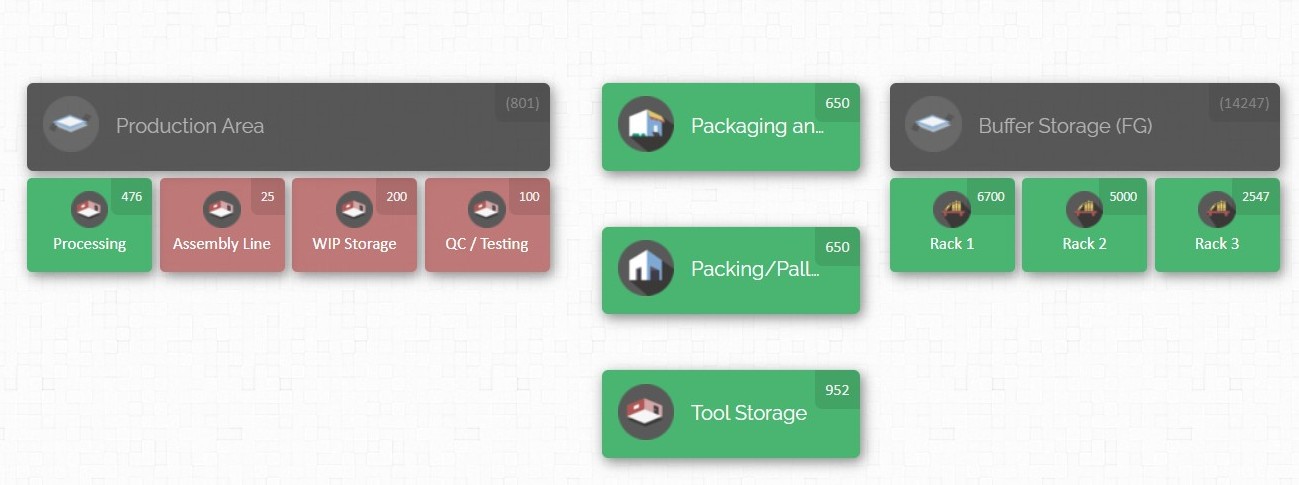
In practice, a location-centered approach removes a translation step that slows people down. A technician searching for a spare does not need to remember a category scheme or a product code convention; they can look for the part and see where it lives. A buyer checking whether a purchase is necessary can confirm on-hand stock in the same view the warehouse uses. Because everyone is looking at the same picture, conversations between departments shift from “which list are you looking at?” to “let’s go get it.”
CyberStockroom is also deliberately focused. Its strength lies in inventory mapping, visibility, location tracking, and stock organization, and it concentrates on making those capabilities clear and dependable. That focus is an advantage for teams whose main challenge is knowing what they have and where it is stored. Instead of learning a large collection of unrelated modules, users work with a tool built around the problem they actually face each day.
Transaction-Centered vs. Location-Centered Inventory Management
A transaction-centered system organizes inventory around events. Stock goes up when something is received, goes down when something is shipped, and every change is tied to an order or an adjustment. This model is powerful when the business question is financial or commercial, such as how much stock is committed to customers or what needs to be reordered. It provides an excellent audit trail for buying and selling activity, and it keeps the books aligned with the warehouse. The strength of the model is that it treats inventory as a flow.
A location-centered system organizes inventory around place. Each part is associated with where it sits, and the primary way of exploring stock is to look at the space where it is stored. This approach is powerful when the business question is operational, such as where to send a technician or whether a required component is physically staged. It removes ambiguity because a location is an objective fact, not an interpretation. The strength of this model is that it treats inventory as a landscape that people move through.
Consider a plant with a maintenance cage, a main warehouse, and an outdoor storage area. A pump seal might be received against a purchase order, issued to a repair job, and returned partially unused to a different shelf. A transaction-centered view will faithfully record each of those events, but a planner who needs the seal in thirty minutes cares most about where the remaining units sit today. In a location-centered view, all units are visible wherever they are stored, so the planner can decide immediately whether to retrieve one or order another.
Neither model is inherently superior, and the right choice depends on the dominant problem in your operation. If your team measures success by orders fulfilled and margins protected, transaction-centered tools will serve you well. If your team measures success by uptime, crew productivity, and the speed with which parts reach the work, location clarity will deliver more value. For many industrial organizations, the second description fits better, which sets the stage for a closer look at how CyberStockroom supports visibility across departments.
How CyberStockroom Supports Multi-Department Parts Visibility
CyberStockroom enables teams to place their stock on a visual representation of their real storage areas, so every department sees parts in the context of where they actually live. Instead of reconciling separate lists, maintenance, procurement, warehouse, and project staff work from one shared picture of the inventory. This directly supports the single-source-of-truth practice discussed earlier, because there is one place to look and one record to trust. As a result, the debates about whose spreadsheet is correct tend to fade. The shared view becomes the starting point for every conversation about parts.
With CyberStockroom, you can organize locations in a way that mirrors your site, which supports the consistent location structure that accurate inventory depends on. Storage areas can be laid out and labeled so that a new team member immediately understands where things are, even without a guided tour. This is particularly valuable when contractors, temporary crews, or newly transferred staff need to find parts quickly. Because the structure is visible, it is also easier to spot gaps, overcrowded zones, and areas that have no clear owner. In effect, the layout doubles as a diagnostic tool for improving the organization itself.

Search and location tracking work together in CyberStockroom to shorten the path from question to answer. A user can look for a part and see where it is stored, which removes much of the back-and-forth that normally occurs between departments. For example, a procurement specialist who is about to place an order can confirm whether the part already exists on site, and exactly where, before spending money. Likewise, a technician preparing for a shutdown can verify that critical spares are in their expected places and flag any that are missing. These small checks prevent duplicate purchases and last-minute scrambles that erode operational efficiency.
CyberStockroom also supports stock organization in a way that respects the different needs of each department without splitting the data. A warehouse team can think in terms of racks and bays, while a maintenance team thinks in terms of equipment areas, and both are looking at the same underlying records. Because the information is shared rather than copied, updates made by one team are reflected for the others. This is what cross-team alignment looks like in practice: different perspectives, one consistent set of facts.
Taken together, these capabilities map closely onto the best practices outlined earlier. A single shared record supports accuracy, a visible location structure supports consistency, and an intuitive layout supports adoption among departments with different levels of technical comfort. CyberStockroom does not try to be everything to everyone; it concentrates on making inventory visible, locatable, and well organized. For teams whose primary challenge is parts visibility, that clarity is the whole point. The next section tests both platforms against realistic scenarios to show where the differences matter most.
Head-to-Head Scenarios: Finding, Verifying, and Staging Parts

The most revealing way to compare two inventory tools is to run them through the situations your teams face every week. The first scenario is the urgent search, in which a technician needs a replacement part during a breakdown and every minute of downtime carries a real cost. In an order-oriented tool, the technician typically begins with a product record and then reads location details from it, which works but adds steps. In CyberStockroom, the technician can search for the part and see where it is stored, which shortens the path from need to retrieval. In practice, the difference may be only a few minutes, but multiplied across dozens of events each year, those minutes become a meaningful operating advantage.
The second scenario is the purchasing check, where a buyer must decide whether to order a part or use stock that already exists on site. Buyers rarely walk the storage areas, so they depend entirely on what the system tells them. If the tool shows a quantity but not a clear place, the buyer may hesitate to trust it and order anyway, just to be safe. When the tool shows where each unit is stored, the buyer can ask a specific person to verify a specific shelf, which makes confirmation fast and credible. This is especially important when lead times are long and a duplicate order ties up working capital for months.
The third scenario involves preparing for a shutdown, turnaround, or major construction phase. Planners need to confirm that every required component is on site, correctly stored, and accessible before the work window opens. Totals alone can be misleading, because a required quantity may be split across buildings or stored in an area that is hard to reach. A location-centered view makes that dispersion apparent at a glance, which allows the planner to consolidate parts or arrange transfers well before the deadline. As a result, surprises during the event itself become much less common.
The fourth scenario is onboarding, which is often overlooked in software comparisons. A new storekeeper or contractor must become productive quickly, and the speed of that ramp-up depends on how intuitive the system is. A tool with extensive order and catalog workflows may require more training before a new user feels comfortable. CyberStockroom’s layout offers a different kind of intuitiveness, because anyone who has walked the site can recognize the structure and navigate it without memorizing a process. Which advantage matters more depends on whether your day-to-day work is driven by orders or by the physical movement of parts.
Inventory Accuracy: Counts, Corrections, and Confidence
Inventory accuracy is not a feature that a tool can switch on; it is the result of habits supported by a tool. The best platforms make the right behavior the easy behavior, so that people update records at the moment they move a part rather than days later. In both inFlow and CyberStockroom, accuracy begins with clear organization, because it is difficult to count what you cannot find. When every item has a defined home, counting becomes a matter of visiting known places instead of hunting for stray stock. This is why location clarity and accuracy are so closely linked in industrial operations.
A practical accuracy program relies on cycle counting rather than annual wall-to-wall counts. Cycle counting means checking a defined portion of the inventory on a regular schedule, with higher frequency for critical and fast-moving items. In a location-centered tool, a counter can move through the layout area by area, which gives the process a natural route and makes it easy to see which zones have not been checked recently. In a transaction-centered tool, the same program is entirely possible, but the counter may need to work from lists organized by product rather than by walking path. Over time, a count route that follows the physical space tends to be faster and less error-prone.
Correcting discrepancies is the other half of accuracy, and it is where cross-department visibility pays off. When a count reveals that a part is missing, the next step is to determine whether it was moved, consumed, or misfiled. If maintenance, the warehouse, and project teams all work from the same shared records, the trail is easier to follow, and the answer is usually found quickly. If each department keeps its own copy, the investigation turns into a negotiation. In practice, one shared source of truth shortens every reconciliation.
Confidence is the outcome that accuracy is meant to produce. Teams that trust the numbers stop padding orders, stop hoarding spares, and stop maintaining parallel lists, all of which reduce cost and effort. Building that confidence requires visible, consistent, and easily verified information, which is exactly what a well-organized location structure provides. Whichever platform you select, measure success by how often people say “the system is right” rather than by how many records it holds. That perspective leads naturally to the question of how well each approach aligns different departments.
Cross-Team Alignment: Getting Maintenance, Procurement, Warehouse, and Projects on the Same Page

Alignment starts with a shared language, and a shared language starts with a shared picture. Departments often disagree not because they hold different facts but because they describe the same facts in different terms. When a part is shown in a visible place, the vocabulary problem shrinks, since a location is a location regardless of which department is looking at it. This is one of the quieter benefits of a location-centered approach like CyberStockroom’s. People can point to the same place on the same screen and understand each other immediately.
Alignment also depends on clear ownership and predictable handoffs. Every storage area should have a responsible person, and every movement of stock between areas should be recorded by the person who makes it. For instance, when materials are transferred from a central warehouse to a project area, the record should change at the moment of transfer, not at the end of the week. Tools that make location updates quick and visible encourage this discipline, while tools that make updates tedious invite shortcuts. Over time, the habit of recording moves in real time becomes part of the culture.
Sharing information across departments also requires thoughtful access practices. Not everyone needs the ability to edit every record, but everyone who depends on parts needs the ability to see them. A common and effective pattern is to give broad viewing access to planners, buyers, and supervisors while limiting editing to those responsible for physical handling. This keeps the data clean without hiding it from the people who need it to do their jobs. In practice, openness to view and discipline to edit is the combination that sustains long-term accuracy.
Finally, alignment is reinforced by routine communication that uses the inventory as its reference point. Weekly planning meetings, pre-shutdown reviews, and purchasing approvals all become more efficient when participants can open the same inventory view and discuss real stock. Instead of debating whose numbers are correct, the group can spend its time deciding what to do about the numbers. Teams that adopt this habit often find that meetings shorten and follow-up tasks become clearer. With alignment addressed, it is fair to consider where each platform is the stronger choice.
Where inFlow Is the Stronger Fit
inFlow is a strong choice for businesses whose inventory is tied closely to buying and selling. If you manage a product catalog, process customer orders, issue purchase orders to suppliers, and need stock levels to reflect those commercial activities, an order-driven system aligns well with your workflow. Distributors, wholesalers, and small manufacturers that sell finished goods often fit this profile. For them, the ability to connect inventory to the order lifecycle is more valuable than a detailed representation of physical space. In those cases, a location-focused tool would address only part of the need.
inFlow also makes sense when the people managing inventory are the same people managing sales and purchasing. A small team that wears several hats benefits from having orders, products, and stock in one environment rather than spread across several tools. The familiar structure of product records and order documents can help such teams stay organized without extensive customization. If your priority is keeping customers supplied and your purchasing disciplined, that integrated approach is a real advantage. A candid comparison should acknowledge these strengths plainly.
The key is to be honest about what your operation actually does all day. A tool that is ideal for an order-fulfillment business can feel heavy for a crew whose main task is finding and staging parts for work. That does not mean the tool has failed; it means the problem it was designed to solve is different from yours. Reviewing your requirements annually helps you notice when your priorities have shifted. When the dominant need becomes physical visibility across departments, a location-centered platform deserves serious consideration.
Where CyberStockroom Is the Stronger Fit
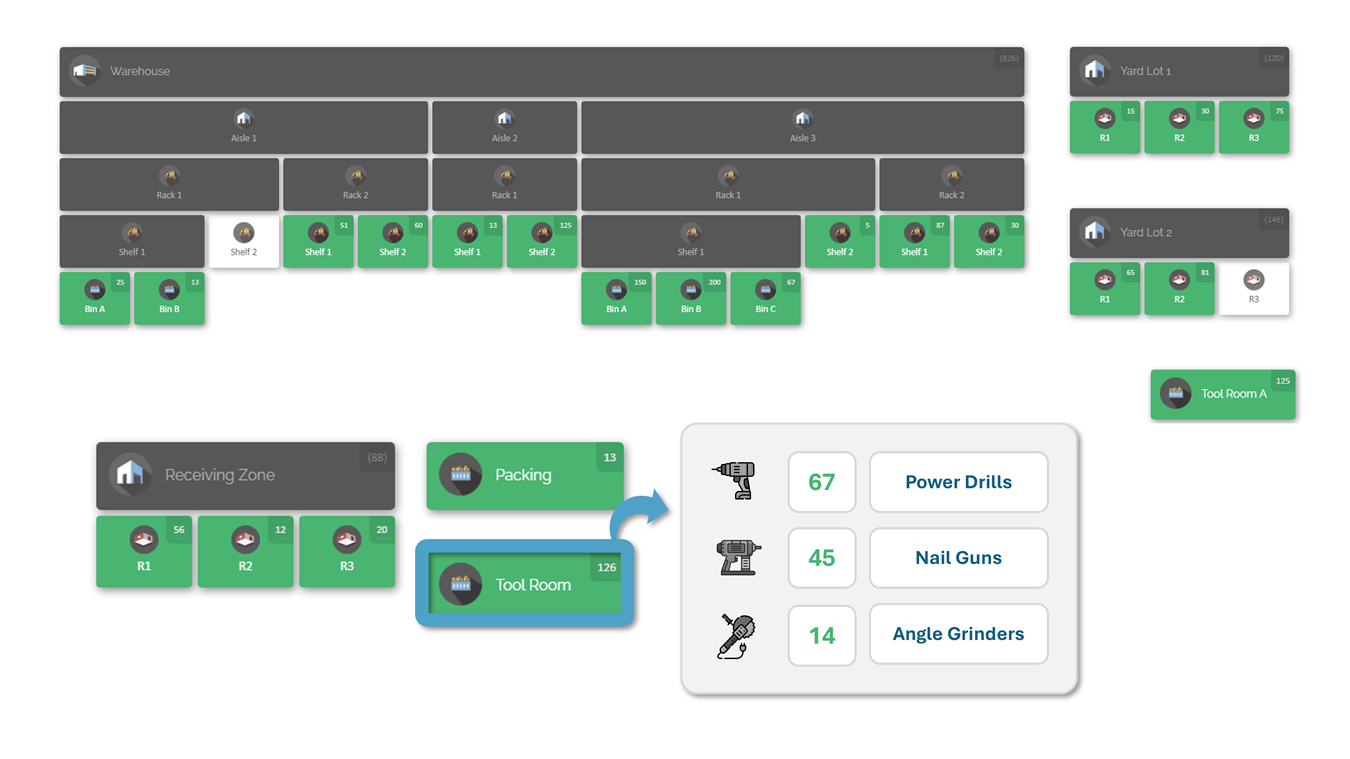
CyberStockroom is the stronger fit when the central question in your operation is “where is it?” and when several departments need the same answer. Industrial construction firms, manufacturers, and maintenance organizations with multiple storage areas, equipment zones, and teams frequently face exactly this situation. In those environments, the cost of a missed part is high, and the value of seeing stock in its physical context is correspondingly large. A location-centered view turns scattered records into a coherent picture that different roles can read the same way. This is where CyberStockroom’s design delivers the most benefit.
It is also a strong fit for organizations that struggle with inconsistent organization. If your teams use different names for the same areas, keep private lists, or rely on a few experienced people who remember where everything is, a visible structure can bring order without a heavy training burden. Because the layout reflects the real space, new users learn it by looking rather than by studying documentation. This reduces dependence on tribal knowledge, which is a significant risk when experienced staff retire or move on. In practice, capturing that knowledge in a shared structure is a form of operational insurance.
CyberStockroom’s focus is another reason it suits certain teams well. Because it concentrates on inventory mapping, visibility, location tracking, and stock organization, it avoids the clutter that comes with trying to do everything. Teams that want a clear, purposeful tool for knowing what they have and where it is stored will appreciate that clarity. If your goal is to improve visibility across departments rather than to manage a full sales and purchasing process, that focus is an asset. The practical result is a tool that people actually use, which is the true test of any inventory system.

A Practical Evaluation Checklist for Your Team
Before committing to either platform, it is wise to run a structured evaluation using your own data and your own people. A demo with sample items can look impressive, but it will not reveal how the tool handles your naming conventions, your storage quirks, or your handoffs. The best approach is to load a representative portion of your inventory, invite a few users from different departments, and observe how they perform real tasks. This short pilot will surface strengths and frustrations that no feature comparison can predict. In practice, two weeks of realistic use is usually enough to see a clear pattern.
The following questions can guide that pilot and help you compare the platforms consistently:
- How long does it take a first-time user to find a specific part and identify exactly where it is stored?
- Can a buyer confirm on-hand stock and location without asking another department?
- How easily can the location structure be changed when an area is reorganized?
- Does the tool make it simple to record a move at the moment it happens?
- Can new team members become productive after a short introduction?
Each of these questions connects to a best practice discussed earlier, which means the answers reveal how well a tool will support your goals over time. Record the results in a simple scorecard so that the decision rests on observations rather than impressions. It is also helpful to ask pilot users what they would miss if the tool were taken away, because that response reflects real value. Teams that follow this process tend to choose with greater confidence and to adopt more smoothly.
Rolling Out Improved Inventory Visibility: A Step-by-Step Approach
Whichever tool you select, the rollout determines whether visibility actually improves. A thoughtful sequence begins with defining the physical structure, continues with cleaning and loading data, and ends with building habits. The steps below outline a practical order that works well in industrial settings:
- Walk the site with representatives from each department and agree on location names and boundaries.
- Clean the existing parts list by removing duplicates, standardizing descriptions, and confirming units of measure.
- Build the location structure in the tool so that it mirrors the real layout.
- Load a first group of critical and high-value items, and verify their locations on the floor.
- Train users in short sessions focused on the tasks they perform most often.
- Establish a cycle count schedule and review results at a regular meeting.
This order matters because each step builds on the one before it. Agreeing on names before loading data prevents rework, and verifying locations on the floor ensures that the first records are trustworthy. Starting with critical items delivers visible wins quickly, which builds momentum and encourages broader participation. Resist the temptation to load everything at once, since a smaller, accurate inventory is far more useful than a large, doubtful one.
After the initial rollout, sustain the gains with a few simple routines. Review a short list of measures, such as count accuracy, time to locate a part, and the number of duplicate purchases avoided, so that improvement is visible to leadership and staff. Hold a brief monthly review to resolve naming drift, reassign orphaned areas, and retire obsolete items. When a department struggles, treat it as a design problem rather than a discipline problem, and adjust the process to make the right behavior easier. Over several months, these routines convert a new tool into a durable operating practice.
Common Mistakes to Avoid When Switching Inventory Systems

One of the most common mistakes is migrating messy data into a clean new tool without first cleaning it. Duplicate records, inconsistent descriptions, and outdated quantities do not improve simply because they have been moved, and they quickly undermine trust in the new system. A short cleanup effort before the migration pays for itself many times over. In practice, teams that skip this step often find themselves rebuilding the inventory a few months later. Taking the time up front is almost always faster in the long run.
Another mistake is designing the location structure from a desk rather than from the floor. Structures created in a conference room tend to reflect how people think the space works, not how it truly works, and they miss the odd corners where parts accumulate. Walking the site with the people who handle the parts every day reveals those corners and produces a structure that people recognize. This step also builds buy-in, because users see their own knowledge reflected in the result. As a result, adoption is smoother and records are more accurate from the start.
A third mistake is choosing a tool for features you will not use. It is tempting to select the platform with the longest capability list, yet unused modules add configuration effort, training time, and opportunities for confusion. The better approach is to match the tool to the two or three problems that cost you the most today, and to verify that it solves them well. Pair that choice with clear ownership, defined update rules, and periodic audits so that good habits persist beyond the initial enthusiasm. With these precautions, even a simple tool can deliver outstanding results, and a purpose-built one can deliver even more.
Final Verdict: CyberStockroom vs. inFlow
The comparison of CyberStockroom vs. inFlow ultimately comes down to the shape of your operation and the nature of your biggest inventory problem. inFlow offers an order-driven approach that ties stock to sales and purchasing, which suits businesses that buy and sell products at volume. CyberStockroom offers a location-centered approach that makes physical placement visible to everyone, which is especially valuable when multiple departments depend on the same parts. Both can improve on spreadsheets and memory, but they do so in different ways and for different kinds of teams.
If your inventory exists mainly to be sold, and your team spends its days managing orders and suppliers, inFlow is a reasonable and sensible choice. If you manage several storage areas, coordinate maintenance, procurement, warehouse, and project teams, and lose time or money when parts cannot be located, CyberStockroom is likely to serve you better. The deciding factor is rarely a single feature; it is whether the tool matches the way your people think about and move through physical space. Running a short pilot with your own data will make that match clear.
Whichever path you choose, remember that software supports visibility but does not create it on its own. The best results come from a single source of truth, a consistent location structure, standardized descriptions, clear ownership, and regular counts. When those practices are paired with a tool that makes inventory easy to see and easy to maintain, departments stop working around the system and start working together through it. For teams ready to see their parts, locations, and stock organization in one shared view, exploring CyberStockroom’s inventory map is a practical next step.







Leave a Reply