
Reducing material waste on an industrial construction site is not simply a matter of putting more skips around the jobsite or asking crews to throw less away. Material waste usually begins much earlier, when teams cannot see what has already been purchased, where stock is stored, which department controls it, or whether another project area has usable material available. In industrial construction, where piping components, electrical materials, structural steel, mechanical parts, consumables, fasteners, and maintenance spares may move between warehouses, laydown yards, containers, fabrication areas, and active work zones, weak inventory visibility can turn valuable material into hidden surplus remarkably quickly. As a result, the most effective way to reduce material waste on an industrial construction site is to treat waste reduction as an inventory management problem as well as a housekeeping and disposal problem. Research into construction material management supports this approach, with procurement and storage systems, on-site material control, centralized material data, and material planning all linked to improvements in material availability and waste reduction.
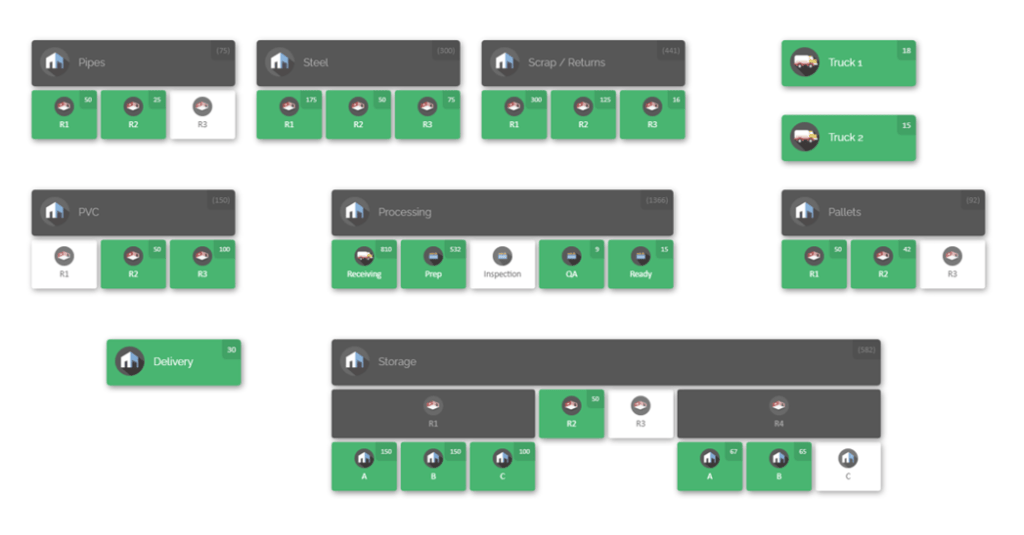
The central challenge is that material rarely becomes waste because somebody deliberately decides to waste it. More often, material becomes waste because a duplicate order is placed, an item cannot be found when a crew needs it, surplus is exposed to weather, material is moved repeatedly until it is damaged, project leftovers are never reclassified, or one department buys something that another department already has. These failures become more common as projects grow because procurement, warehouse personnel, field supervisors, project controls, engineering, maintenance, and subcontractors may all be making decisions from different versions of the inventory picture. Lean construction practices likewise identify excess inventory, unnecessary transportation, waiting, defects, and overproduction as interconnected forms of waste rather than isolated problems.
For that reason, a strong waste-reduction program starts by improving visibility across departments and physical locations. Everyone who influences material demand should be able to answer basic operational questions such as what is available, how much remains, where it is stored, and whether it has already been allocated or moved. That shared understanding reduces the tendency to order defensively, build excessive buffers, or keep unofficial stockpiles near work areas because crews do not trust the central inventory record. In practice, better visibility allows project teams to reduce excess inventory without increasing the risk of shortages, which is the balance that effective construction inventory management must achieve. Lean just-in-time practices make the same connection by aligning delivery timing with actual production demand so that materials arrive when they are needed rather than accumulating unnecessarily on site.
Material control also has a direct relationship with site organization and safety. Poorly managed inventory can occupy access routes, overwhelm laydown areas, create unnecessary handling, expose products to damage, and increase the time workers spend searching for materials rather than installing them. Workplace safety regulatory agencies requires construction debris to be cleared from work areas and passageways and establishes requirements for the safe storage of construction materials, illustrating how material organization and housekeeping are operational disciplines rather than purely administrative concerns. This makes waste reduction especially valuable on industrial projects, where storage space is often constrained and the cost of material damage, replacement, or schedule disruption can be substantial.
The objective, therefore, should not be to drive inventory to the lowest possible level regardless of project risk. Industrial construction still requires reasonable buffers for long-lead components, critical materials, uncertain field conditions, shutdown work, and items whose absence could stop an entire crew. The better objective is controlled inventory: material quantities based on actual demand, stored in defined locations, visible to the people who need to make decisions, and moved through the jobsite according to a repeatable process. Building on this principle, teams can reduce material waste without creating the opposite problem of chronic shortages and expediting. That distinction becomes the foundation for every best practice discussed below.
Why Material Waste Happens on Industrial Construction Sites

The first major source of waste is inaccurate demand planning. Industrial projects frequently buy material before every field condition is fully known, which is understandable when long lead times or schedule pressure make shortages expensive. Problems arise when contingency quantities, design changes, revised work packages, and field purchases accumulate without a corresponding process for recalculating what is still required. In that environment, procurement may continue buying against an outdated demand picture even though enough material already exists in the warehouse or field. Material planning is one of the practices research has associated with improved availability and reduced construction waste, reinforcing the importance of connecting purchasing decisions with current stock information.
Duplicate purchasing is closely related but often has a different root cause. A supervisor may submit a new request not because the material is genuinely unavailable, but because nobody can confirm where the existing stock is located quickly enough to support the work. Procurement then acts rationally based on the information it has, even though the organization as a whole already owns the item. The result may be two inventories serving the same need, one visible and one effectively hidden, followed by excess material at project closeout. Improving cross-department parts visibility reduces this behavior by making a stock check part of the purchasing decision rather than something that depends on phone calls, memory, or searching multiple spreadsheets.
Over-ordering also develops when crews lose trust in inventory accuracy. If the system says that 120 fittings are available but previous experience suggests that the physical quantity may be very different, supervisors naturally protect production by requesting extra material. Over time, that defensive ordering creates larger buffers, which increase storage requirements and make accurate counting even harder. Lean construction guidance warns that overstocking can create additional sorting, handling, storage, and organizational waste, especially when excess material arrives before the site is prepared to manage it. Consequently, improving inventory accuracy can reduce physical waste indirectly by reducing the need for people to compensate for unreliable information.
Poor receiving practices create another early point of failure. Material may arrive correctly but become difficult to manage if deliveries are not inspected, counted, identified, and moved into defined storage locations promptly. Mixed deliveries left in temporary staging areas can quickly become separated from their documentation, while shortages or damage may not be discovered until the material is needed for installation. At that point, replacement purchases may be required, and usable components from the original shipment may remain stranded in an unidentified area. Strong receiving controls therefore prevent waste by establishing location and quantity accuracy at the moment material enters the site.
Storage conditions are equally important because inventory that exists physically but deteriorates before use is still waste. Weather-sensitive products can be damaged by moisture, ultraviolet exposure, contamination, extreme temperatures, or improper stacking, while smaller parts can disappear into poorly organized containers and mixed bins. OSHA’s construction storage requirements emphasize safe placement and handling of materials, while broader federal guidance connects good material management with housekeeping and pollution prevention. In practice, storage design should protect the material, make it easy to identify, and minimize the number of times workers must handle it before installation.
Unnecessary movement adds another layer of risk. Every time material moves from receiving to temporary staging, from staging to a laydown yard, from the yard to a container, and eventually from the container to the workface, there is another opportunity for damage, misplacement, incorrect counts, or lost identification. Lean construction categorizes unnecessary transportation as waste because moving materials more often or earlier than necessary consumes resources without adding value. A better logistics plan reduces touches by establishing a clear route from receipt to protected storage and then to point of use.
Rework can multiply material waste because the loss is not limited to the defective work itself. Incorrect installation may require removing installed pipe, cable, supports, insulation, fasteners, coatings, or other components, after which some of those materials cannot be reused. Replacement materials then have to be issued, transported, and installed again, while the original inventory plan becomes less reliable because actual consumption exceeds planned consumption. This is one reason material management should not operate independently from quality control, engineering revisions, and field execution. The more quickly changes are communicated and obsolete material requirements are identified, the less likely purchasing and issuing processes are to continue supporting work that has already changed.
Uncontrolled point-of-use stockpiles create a less visible form of waste. Crews may accumulate material near their work areas because doing so saves trips to a central store, particularly when previous shortages or long retrieval times have encouraged people to keep personal buffers. Unfortunately, these unofficial caches are usually invisible to procurement and warehouse staff, so the organization may believe the material has already been consumed or cannot be found. They also increase the chance of damage, mixing, and abandonment when crews move to another area. A controlled replenishment system should make legitimate point-of-use inventory visible rather than forcing teams to choose between productivity and inventory discipline.
Finally, project closeout exposes weaknesses that have been developing throughout the job. Surplus pipe, fittings, electrical components, valves, fasteners, spare equipment, consumables, and packaged materials may be distributed across multiple laydown zones and containers by the time installation finishes. Without a planned recovery process, some of that inventory is discarded, left for another team to sort out, or moved to a warehouse without accurate identification. EPA guidance places source reduction ahead of disposal and highlights reuse and recovery as important ways to reduce construction and demolition waste. Treating closeout inventory as recoverable organizational stock rather than project debris can therefore prevent valuable materials from becoming waste simply because the original job no longer needs them.
Build a Cross-Department Inventory Visibility System

Once the main causes of waste are understood, the next priority is building a single operational view of material across departments. Procurement needs to know what exists before buying, warehouse teams need to know where material belongs, field personnel need to know what is available for current work, project controls need confidence in material readiness, and management needs to understand whether inventory is being consumed or accumulating. None of those groups can make consistently good decisions if they maintain separate stock records that drift apart. Shared inventory visibility turns material management from a departmental activity into an organization-wide operating process.
The first step is standardizing how materials are identified. The same valve, fastener, electrical component, or spare part should not be described differently by engineering, purchasing, the warehouse, and field crews if those descriptions prevent people from recognizing that they are discussing the same item. Consistent item names, product numbers, descriptions, units of measure, and relevant identifying information make searches more reliable and reduce duplicate entries. In practice, standardization is especially important for industrial inventories containing many similar components whose differences may involve size, pressure class, material specification, manufacturer, or application. Once identification is consistent, location information can become much more useful.
The second step is creating a location hierarchy that reflects how the operation physically works. A project might begin with a central warehouse, satellite warehouse, north laydown yard, south laydown yard, electrical container, piping container, mechanical staging zone, fabrication area, tool crib, and several work fronts. Within those areas, additional sublocations may be needed for racks, shelves, bins, cages, or marked ground zones. This structure should be detailed enough to help somebody find material without creating so many location codes that updates become impractical. A well-designed hierarchy gives inventory data physical meaning because every recorded quantity corresponds to somewhere a worker can actually go.
Departments should then agree on ownership of each inventory transaction. Receiving personnel may be responsible for confirming deliveries, warehouse teams for put away, field stores for issues and returns, and project teams for declaring surplus or obsolete requirements. The specific allocation will vary by organization, but ambiguity should be removed because shared visibility depends on consistent updates. If everybody can move material but nobody is clearly responsible for recording movement, the system will become inaccurate quickly. Building on this principle, organizations should design the inventory process around actual work rather than expecting employees to perform duplicate administrative tasks after the fact.
Movement between departments deserves particular attention because this is where otherwise accurate inventories often become unreliable. A warehouse may transfer material to a fabrication shop, the fabrication shop may send an assembly to the field, and unused components may later return to the project store. If each transfer is treated informally, the material can remain associated with its old location even though the physical stock has moved. The result is false availability in one area and invisible inventory in another. Recording material movement as part of the transfer itself keeps the digital inventory aligned with the real operation.
A shared stock view also improves procurement discipline. Before raising a purchase request, buyers or requestors should be able to check whether the required material already exists in another department, warehouse, project area, or usable surplus location. This does not mean every available item should automatically be transferred, because ownership, project commitments, condition, and schedule still matter. Instead, visibility gives decision-makers the information needed to ask the right question before spending money. NIST guidance on supply-chain improvement similarly emphasizes shared visibility and coordination across forecasting, operations planning, and inventory management as part of stronger material control.
Field personnel also need a practical way to find stock without relying on tribal knowledge. On large industrial sites, a small number of experienced storekeepers often become the human search engine because they remember where unusual items were placed. That knowledge is valuable, but it creates risk when those individuals are absent, reassigned, or supporting multiple crews. A location-based inventory structure transfers some of that knowledge into a system the broader team can use. As a result, searching becomes a repeatable process rather than a personal skill, which helps reduce wasted labor as well as unnecessary replacement purchases.
Visibility should also extend to inventory status, even when the organization uses relatively simple classifications. Material that is available for issue should not be confused with material awaiting inspection, damaged stock, reserved project material, surplus awaiting disposition, or items being held for another department. The exact terminology can be tailored to the operation, but the underlying principle is that quantity alone does not tell a complete story. Ten items physically present but unavailable for current work should not create the same purchasing decision as ten items that can be issued immediately. This distinction helps teams avoid both false confidence and unnecessary buying.
Physical organization must reinforce the digital location structure. Labels, rack identifiers, bin names, marked laydown areas, designated return zones, and clear separation between usable and non-usable material make it easier for workers to maintain inventory accuracy during daily operations. Lean 5S practices emphasize sorting, orderly placement, standardization, and sustained discipline so that tools and materials are easier to locate and unnecessary searching and movement are reduced. In an industrial construction environment, those principles can be applied to everything from a small consumables cabinet to a multi-acre laydown yard.
Cycle counting then becomes the feedback mechanism that keeps the visibility system credible. Instead of waiting for a full physical inventory to discover months of accumulated errors, teams can count selected high-value, high-movement, schedule-critical, or historically inaccurate items on a regular basis. Differences should be investigated rather than simply adjusted, because recurring variances often reveal a process weakness such as unrecorded transfers, inconsistent units of measure, uncontrolled field issues, or unclear storage locations. The objective is not merely to correct the number but to eliminate the reason it became wrong. Over time, this creates the trust necessary for departments to rely on inventory data when making purchasing and scheduling decisions.
Cross-department alignment is ultimately a behavioral issue as much as a technical one. Employees will bypass an inventory process if using it takes significantly longer than calling a colleague, walking through the yard, or ordering replacement material. The process therefore needs to provide immediate operational value by helping users find stock, avoid shortages, reduce searching, and clarify responsibility. When people can see that accurate updates improve their own work rather than merely generating reports for management, adoption becomes much easier. That is the point at which inventory visibility begins producing sustained reductions in material waste.
Control Waste Through Planning, Purchasing, Receiving, Storage, and Issue
Material waste is easiest to prevent before material reaches the jobsite. During planning, teams should connect upcoming work packages with material requirements, expected installation dates, current stock, outstanding orders, and realistic contingency quantities. This creates a demand picture based on what the project is actually preparing to execute rather than a static list created much earlier in the job. In practice, frequent review is particularly important when engineering revisions, field conditions, or construction sequencing changes the original plan. Source reduction is given the highest priority in EPA’s construction and demolition materials framework because preventing unnecessary material from being purchased or used avoids waste before it exists.
Procurement should convert that demand picture into controlled purchasing decisions. Instead of ordering the maximum conceivable quantity for convenience, buyers can compare required quantities against available inventory and determine whether existing material can satisfy part of the need. Purchase quantities can then reflect true net requirements while still accounting for approved contingency or minimum-order constraints. This is especially effective for common materials shared across departments, projects, or maintenance operations because existing stock may already exist somewhere within the organization. The more complete the stock picture, the less reason procurement has to buy purely as a precaution.
Delivery timing should also be planned deliberately. Receiving every material as early as possible may appear to reduce schedule risk, but excessive early delivery shifts that risk into congestion, additional handling, deterioration, and lost visibility. Just-in-time construction practices seek to align inventory transportation with the production schedule so that material is available when needed without creating unnecessary stock on site. For industrial projects, the appropriate approach is often selective rather than absolute, with long-lead or critical items protected while routine materials are delivered closer to their actual installation dates.
Before each major delivery, the site should know exactly where the material will go. A planned receiving or staging area should have enough capacity, appropriate access, protection from relevant environmental conditions, and a defined route for moving material into longer-term storage if necessary. This prevents the common situation in which a truck arrives and the crew chooses the nearest empty space because no storage decision has been made. Temporary placement tends to become semi-permanent when work accelerates, increasing the likelihood that material will be forgotten or moved several more times. Planned put away therefore reduces waste by eliminating avoidable handling at the beginning of the material lifecycle.
Receiving controls should verify both quantity and condition before material disappears into the site. The receiving team should confirm that the shipment corresponds with expected material, identify obvious damage, capture shortages or discrepancies, and establish the location where accepted stock is being placed. This is especially important for components that may look similar but have significantly different specifications or uses. Discovering a discrepancy immediately allows procurement and suppliers to address it while documentation and responsibility remain clear. Discovering it several weeks later, when a crew is waiting for installation material, usually creates more cost and disruption.
Storage areas should be designed around material characteristics rather than convenience alone. Weather-sensitive products require appropriate protection, high-value items may require controlled access, heavy materials need suitable support and lifting access, and small components need containers that prevent mixing or loss. OSHA’s materials-handling guidance stresses keeping storage areas clear of accumulated material that can create hazards and maintaining appropriate safe storage practices. Proper storage therefore protects both material value and the people who handle it, making organization a core element of operational efficiency.
Material should also be positioned according to expected use. Frequently issued consumables can be stored where retrieval is quick, while slower-moving or long-term spare inventory can occupy less accessible areas. Materials required for the next phase of work can move into designated staging locations without being mixed with general stock. This approach reduces travel and handling while still preserving visibility because the staged quantity remains associated with a known location. Lean construction’s focus on flow supports this principle by seeking to minimize the time people, tools, and materials spend waiting or moving unnecessarily.
Issue quantities should reflect near-term production needs rather than encouraging uncontrolled field stockpiles. Where practical, crews can receive enough material for a defined task, shift, work package, area, or short planning horizon, with replenishment based on actual consumption. The appropriate interval will depend on the material and distance from storage, but the principle is to prevent large quantities from disappearing from controlled inventory long before they are installed. When point-of-use stock is necessary, that area can be treated as a defined inventory location rather than an untracked exception. This preserves accountability without forcing crews into inefficient retrieval patterns.
Returns deserve the same discipline as issues. Usable material that comes back from the field should move into a defined return area where it can be checked, identified, and restored to available inventory rather than being dropped wherever space is available. Damaged, questionable, or incomplete material should be separated so it does not accidentally return to usable stock. This is especially important for leftover components after a work package is completed because crews may otherwise treat them as miscellaneous surplus with no clear owner. A simple returns process converts unused field material back into visible inventory before another department orders the same item.
Waste segregation should occur alongside inventory control rather than after usable material and debris have already become mixed. Clearly defined areas for recoverable stock, recyclable material, packaging, general construction waste, and regulated or hazardous waste help prevent valuable components from disappearing into disposal streams. EPA guidance recommends designated waste collection areas and proper handling practices to reduce environmental risks, while its broader construction materials framework encourages reuse and recycling when waste cannot be prevented. Separating reusable inventory from true waste is therefore both an environmental and financial control.
Housekeeping should be integrated into daily production routines. Waiting until the end of a phase to reorganize storage areas allows empty packaging, scrap, unidentified components, and returned materials to accumulate until sorting becomes a major task. A short daily process can restore materials to locations, remove debris from work areas, identify items that need disposition, and correct obvious storage problems before they grow. OSHA construction requirements call for debris to be cleared from work areas, passageways, and stairs during construction activities. In operational terms, disciplined housekeeping also keeps legitimate inventory visible instead of allowing it to disappear under the physical clutter of ongoing work.
How CyberStockroom Supports Multi-Department Parts Visibility
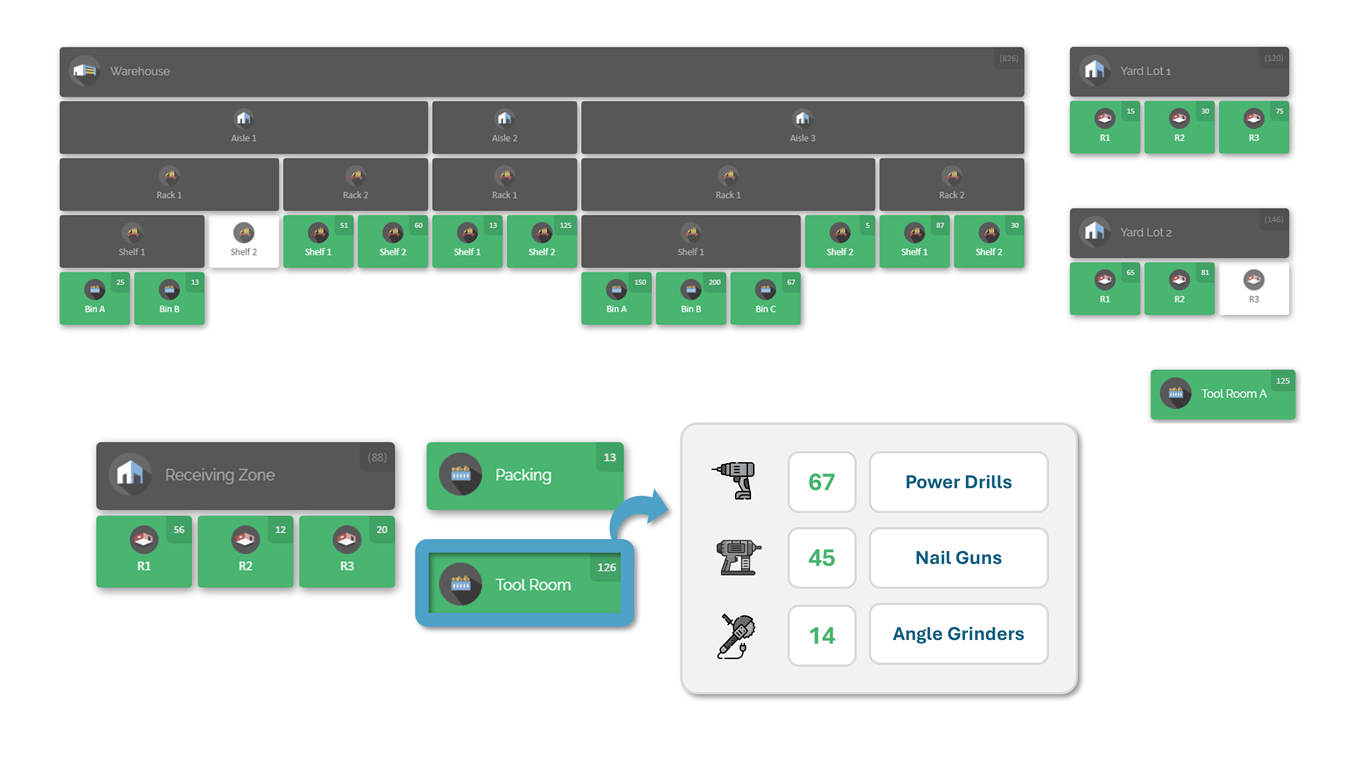
CyberStockroom supports this waste-reduction model by giving teams a visual way to organize inventory around real physical locations. Its inventory map can represent warehouses, storerooms, racks, bins, vehicles, departments, job sites, and other operational areas, allowing users to see where stock is associated rather than navigating only through conventional inventory lists. Main locations can represent larger areas such as facilities or warehouses, while sublocations can represent more specific spaces such as racks, shelves, bins, rooms, or work areas. For industrial construction, that structure can mirror the way material actually moves through a project from central storage to laydown areas and eventually to the workface.
This location-first approach is particularly useful when multiple departments share responsibility for the same inventory pool. Procurement can benefit from knowing whether material already exists before another order is placed, warehouse personnel can see where inventory is organized, and project or field teams can search for the material they need without depending entirely on personal knowledge. A shared visual structure helps remove ambiguity from conversations because users can reference the same location rather than describing stock informally as being “somewhere in the yard” or “in one of the containers”. CyberStockroom’s map search can locate both locations and products, including highlighting locations that contain the searched product. That directly supports the cross-team visibility practices needed to prevent duplicate purchasing and hidden stock.

CyberStockroom also allows locations to represent different levels of operational detail. An organization might create a main location for a project, warehouse, department, or major storage zone, then use sublocations to represent containers, racks, shelves, bins, or defined field areas. This provides enough precision to locate material without requiring the inventory structure to operate differently from the physical site. As the project evolves, locations can reflect how storage is reorganized while maintaining a clear relationship between material and place. In a complex industrial environment, that flexibility can help teams keep inventory visible even when temporary storage areas and project layouts change.
Searchability is important because visibility only creates value when employees can retrieve information quickly. CyberStockroom provides catalogue search capabilities for products and locations, while the map search can help users identify where a product exists within the location structure. In practice, this can shorten the path from “we need this part” to “where do we already have it,” which is one of the key decisions behind reducing material waste. The faster that answer is available, the less incentive employees have to bypass inventory checking and submit another purchase request simply because searching takes too long.
Inventory quantities associated with locations give teams another useful operational reference. Instead of knowing only that a product exists somewhere in the organization, users can understand how stock is distributed across physical areas. That distinction matters when one project area has excess material while another is preparing to buy the same product, or when a warehouse needs to determine whether a field location can return surplus stock. Building on the visibility principles discussed earlier, quantity by location makes cross-department reallocation more practical because teams can identify potential stock before deciding whether another purchase is necessary.
CyberStockroom can also support accountability around inventory movement through activity history. The system’s map dashboard documentation describes access to recent inventory actions and transaction details, including information such as date, time, comments, and the user associated with a transaction. This is useful when teams are trying to understand why stock changed, confirm whether a movement was recorded, or investigate discrepancies during cycle counting. The objective is not surveillance of employees but traceability of inventory decisions, which helps departments resolve discrepancies using recorded activity rather than competing recollections.
Visual organization can be especially valuable for vertical storage such as shelving and racking. CyberStockroom includes vertical-location functionality intended to represent stacked or layered storage areas so teams can distinguish levels, shelves, or bins more clearly. This can reduce searching in warehouse and storeroom environments where knowing the correct building or aisle is not enough to find a specific component efficiently. When physical labels and the inventory map use the same location logic, new employees and occasional users can navigate storage more consistently.
For construction operations, visual inventory can extend beyond permanent warehouses. CyberStockroom’s jobsite inventory capabilities are designed around tracking materials and equipment across active project locations, including job sites, trucks, containers, staging areas, and warehouses. That matters because industrial construction material frequently moves between exactly these types of locations, and waste often appears when inventory becomes invisible during those transfers. Mapping mobile and temporary locations gives teams an opportunity to maintain continuity as material leaves the central warehouse and enters the field.

The most important value, however, comes from combining the technology with disciplined site processes. CyberStockroom cannot prevent material waste if deliveries are not checked, locations are not maintained, transfers are not recorded, and departments continue to make purchasing decisions without reviewing existing stock. Its role is to make the shared inventory picture easier to understand and use so the operational practices described throughout this article can function with less friction. When receiving, storage, field issue, movement, returns, and closeout all reference the same location-based inventory structure, the organization has a much stronger foundation for controlling material throughout its lifecycle. That alignment is what turns an inventory map from a visual aid into a practical waste-reduction tool.
Turn Leftovers, Returns, Reuse, and Project Closeout Into a Controlled Loop
Waste reduction should continue after a material’s original task has been completed. Industrial construction projects often generate usable leftovers because purchase quantities rarely match final field consumption perfectly, especially when materials are bought in standard pack sizes or include planned contingency. The correct question at that stage is not simply whether the original project still needs the material, but whether the organization can use it elsewhere. EPA guidance promotes reuse and recovery of construction materials as preferable alternatives to disposal where appropriate. A controlled surplus process helps organization’s capture that residual value rather than allowing usable stock to become waste by default.
Surplus identification should begin before final demobilization. Waiting until crews are leaving the site creates a compressed closeout period when attention is focused on punch work, documentation, equipment removal, and the next assignment. Instead, project teams can begin reviewing declining material requirements as major work packages approach completion. Items that will no longer be required can be separated, counted, and placed into defined surplus or return locations while knowledgeable personnel are still available to identify them. This creates time for other projects, departments, or maintenance teams to determine whether they can use the stock.
Condition assessment is essential because recovered inventory must remain trustworthy. Material should be classified based on whether it is unused and fully serviceable, opened but usable, incomplete, damaged, contaminated, expired where applicable, or otherwise unsuitable for normal issue. Mixing uncertain material with good stock can create quality problems later and may cause employees to distrust reclaimed inventory altogether. Consequently, the recovery process should protect the credibility of available stock rather than inflating inventory quantities with items that cannot genuinely be used. A clean separation between usable material and true waste makes future decisions much easier.
Project teams should also preserve identification when material is moved. Components that leave their original packaging or storage areas can become difficult to distinguish once labels, heat numbers, part numbers, specification markings, or supporting information are lost. This is particularly important for industrial materials where similar-looking components may have different pressure classes, metallurgy, ratings, dimensions, or approved applications. If identity cannot be verified, material that is physically usable may nevertheless become operationally unusable. Protecting identification therefore prevents a subtle but expensive form of waste.
Recovered material should then enter a visible organization-wide stock pool or a clearly defined surplus location. Keeping project leftovers in an unrecorded corner of a warehouse simply relocates the problem because other departments still cannot see the stock. A visual location system can make returned inventory discoverable while still distinguishing it from normal active stock if the organization wants additional review before issue. This gives procurement and maintenance teams an opportunity to check surplus before placing new orders. Over time, recurring reuse can convert project closeout from a disposal cost into an internal source of material.
Transfers between projects should follow the same discipline as ordinary inventory movements. The sending project should identify what is being transferred, the receiving project should know where it will be stored, and quantities should remain visible throughout the handoff. Otherwise, transferred material can disappear between two inventory records, with the original project assuming it has been removed and the new project failing to recognize that it arrived. This problem becomes especially common when trucks, containers, or temporary yards are treated as transportation only rather than inventory locations. Treating these intermediate points as controlled locations helps preserve visibility through the entire movement.
Procurement teams can reinforce reuse by checking internal availability before buying selected classes of materials. This is especially effective for standardized components, consumables, fasteners, common electrical items, maintenance parts, and other products likely to be used across several projects or departments. The check should not create unnecessary delay for every purchase, so organizations can focus on categories where surplus is common or material value is significant. When employees see that recovered material genuinely offsets future purchasing, the business case for accurate closeout becomes much easier to communicate. Waste reduction then becomes linked directly to avoided expenditure rather than being treated only as an environmental initiative.
Packaging should receive similar attention because suppliers may use pallets, crates, reels, drums, containers, or protective materials that can sometimes be returned or reused. EPA specifically identifies returning packaging to suppliers for reuse as one potential construction material-management practice. Even where supplier return is not practical, separating recyclable packaging from contaminated or general waste can improve recovery rates and reduce the volume of material sent for disposal. The important operational principle is to decide how packaging will be handled before large volumes accumulate around receiving areas and work fronts.
Recycling remains important, but it should follow prevention and reuse in the decision hierarchy. A piece of material that could have been avoided entirely or used on another job may still have economic value even if it can technically be recycled. EPA’s framework prioritizes source reduction and also promotes salvage, reuse, and recycling as complementary strategies for reducing construction and demolition disposal. For industrial construction teams, this means the waste process should distinguish between unused inventory, reusable material, recyclable material, and actual disposal rather than placing all four categories into a single “waste” stream.
Closeout should finish with reconciliation and learning rather than simply clearing the site. Teams can compare planned quantities, purchased quantities, actual usage, recovered surplus, damaged material, transfers, and disposal for important material categories. Large differences may reveal forecasting issues, design changes, excessive contingency, poor storage, uncontrolled field issues, or duplicate purchasing. Those findings can then inform future procurement quantities and site-layout decisions instead of being forgotten when the project team demobilizes. In this way, one project’s leftover material becomes both reusable stock and operational data for improving the next project.
Measure, Standardize, and Sustain Material Waste Reduction

A sustainable waste-reduction program needs measures that connect material performance with daily operations. Total disposal tonnage can be useful, but it does not explain whether the underlying inventory process is improving. Industrial construction teams should also look at indicators such as inventory accuracy, duplicate purchases, stock found outside assigned locations, material damage, surplus returned from projects, internal transfers that prevented new purchases, and time spent searching for parts. These measures reveal whether the organization is preventing waste before it reaches a skip or recycling container. The objective is to identify the operational behaviors that drive material loss and then improve them systematically.
Inventory accuracy is one of the strongest leading indicators because unreliable data encourages defensive behavior throughout the organization. When teams do not trust stock quantities, they tend to hold extra material, create unofficial caches, or order replacements earlier than necessary. Regular cycle counts can show where accuracy is deteriorating and which material categories require tighter controls. Rather than focusing only on the percentage accuracy result, managers should investigate why discrepancies occur and whether the cause relates to receiving, issue, transfer, returns, or storage. Corrective action at the process level prevents the same error from recurring.
Search time is another useful measure because it exposes hidden inefficiency. A material may eventually be found and therefore never appear in a formal waste report, yet several employees may have spent an hour walking through storage areas, making calls, and opening containers to locate it. Lean 5S principles explicitly seek to reduce unnecessary searching and movement by keeping tools, materials, and information organized and readily accessible. Tracking recurring search problems can reveal where location detail, physical labelling, or inventory updates need improvement.
Duplicate purchasing should be examined in a similarly practical way. When a team discovers that material was purchased even though usable stock already existed somewhere in the organization, that event should be treated as a process-learning opportunity. Managers can ask whether the existing inventory was visible, whether it was searchable under the same description, whether another department considered it unavailable, or whether the purchasing process simply did not include an inventory check. Each cause suggests a different corrective action. Over time, reducing duplicate purchases provides a measurable financial benefit from improved cross-department visibility.
Material damage should be categorized rather than combined into one number. Damage during transport suggests a different problem from weather exposure, poor stacking, contamination, mishandling, or deterioration during long-term storage. Knowing the cause allows teams to adjust receiving layouts, storage methods, protective requirements, handling routes, or delivery timing. Safe storage and orderly material-handling practices are also central to OSHA guidance, reinforcing the operational connection between protecting inventory and maintaining safer work areas. A reduction in damage therefore represents both better cost control and stronger site discipline.
Surplus recovery can become a positive performance measure rather than an embarrassing closeout number. Projects should not be rewarded for generating excessive leftovers, but they should be encouraged to identify and return material that genuinely remains after work is complete. Tracking how much returned stock is subsequently reused helps demonstrate the value of inventory visibility across departments. This can also reveal recurring categories where purchase quantities consistently exceed actual consumption, allowing procurement standards or contingency percentages to be adjusted. The aim is to reduce future surplus while recovering as much value as possible from the surplus that still occurs.
Standard work is essential once the organization understands which practices deliver results. Receiving, putaway, transfers, field issues, returns, cycle counts, surplus classification, and project closeout should each have a clear process that employees can follow without reinventing the workflow every time. Standardization does not require excessive bureaucracy, and the best procedures are often short because they align with the physical flow of material. Lean 5S includes standardization and sustained discipline precisely because improvements disappear when orderly practices are treated as temporary clean-up exercises. Construction inventory management becomes reliable when the correct behaviour is the normal way the site operates.
Training should explain why each step matters rather than focusing only on system instructions. A warehouse employee who understands that correct putaway prevents duplicate purchases is more likely to take location accuracy seriously, while a field supervisor who sees that unused material can support another project has a reason to return it rather than leaving it at the workface. Procurement personnel likewise need confidence that the inventory picture is current enough to support purchasing decisions. Cross-functional training helps people understand how their actions affect departments upstream and downstream. This shared understanding is particularly valuable on industrial sites where material moves through several teams before it is finally installed.
Periodic reviews can then use the data to drive continuous improvement. Teams might examine recurring stock discrepancies, materials frequently damaged in storage, categories with persistent over-ordering, locations that generate excessive search time, or surplus that repeatedly appears at closeout. The response should focus on adjusting the process rather than simply instructing employees to “be more careful.” Lean continuous-improvement practices use repeated observation, learning, and process change to eliminate waste over time rather than treating waste reduction as a one-time campaign. Building that mindset into construction inventory management makes improvement more durable.
Leadership also needs to balance inventory reduction with production reliability. Driving stock levels down aggressively without considering supplier reliability, lead times, criticality, and project sequencing can create waiting and emergency purchasing, which simply replaces one kind of waste with another. Appropriate buffers may still be necessary for critical-path materials or shutdown work where a missing component could stop a large workforce. The goal is to distinguish intentional, justified inventory from excess stock created by uncertainty or poor visibility. Accurate location and quantity information makes that distinction much easier because decisions can be based on known conditions rather than assumptions.
Ultimately, organizations reduce material waste when inventory becomes a shared operational system rather than a warehouse record. Planning determines what should be needed, procurement compares that requirement with what already exists, receiving establishes quantity and location accuracy, storage protects material, field teams maintain visibility during use, and closeout returns valuable leftovers to the broader organization. CyberStockroom can support this model by visually organizing inventory around warehouses, departments, racks, bins, containers, vehicles, and jobsites so teams can understand where material is located and how stock is distributed. When those practices work together, reducing material waste on an industrial construction site becomes a repeatable management discipline rather than a clean-up activity performed after waste has already occurred.
The strongest results come from recognizing that waste is usually a symptom of weak information flow, weak physical organization, or weak coordination between teams. Material that cannot be found is often purchased again, material purchased too early requires additional storage, excess storage creates more movement, additional movement increases damage risk, and poor closeout turns usable leftovers into disposal. Breaking that chain requires a shared view of inventory that connects planning, purchasing, warehouses, field operations, and project closeout. Research into construction material management consistently points to the importance of procurement and storage systems, on-site controls, shared material information, and planning, while Lean practices emphasize visibility, flow, just-in-time delivery, and organized workplaces.
For organizations trying to reduce material waste on industrial construction sites, the practical starting point is therefore straightforward: know what you have, know where it is, and make that information usable across departments. From there, purchasing can become more precise, receiving can establish stronger control, storage can become intentional, material movement can be reduced, and leftovers can be recovered before they become waste. A visual inventory approach strengthens each of those practices because location is one of the most important pieces of information in a physical construction environment. With disciplined processes and reliable inventory visibility working together, material waste becomes something teams can prevent upstream rather than merely measure at the end of the job.








Leave a Reply