
From Chaos to Clarity
Construction sites are dynamic, busy places where multiple trades work together in close quarters. Carpenters, electricians, plumbers and steelworkers may all be on-site at once, each with different materials, tools and schedules. For the construction foreman overseeing one or more teams, keeping track of every bolt, board and box of screws can feel overwhelming without a clear overview. Just as a pilot needs an instrument panel to understand the whole runway, a foreman needs a digital dashboard or site map to see the entire material inventory at a glance.
Without complete visibility, projects stall. Imagine a foreman sending a crew to grab wiring from the electrical shed only to find the bin empty, or discovering that the needed set of scaffolding clips was moved yesterday to another zone. Crews waste hours searching every nook of the site for missing materials, or – to avoid running out – end up ordering extra “just in case” only to leave pallets of unused parts. These inefficiencies delay work and inflate costs. Over-ordering ties up cash and storage space; under-ordering or misplacement forces urgent, costly last-minute purchases. A true bird’s-eye view of materials on-site ensures foremen never have to ask “Do we have that here?” because the answer is always visible in real time.
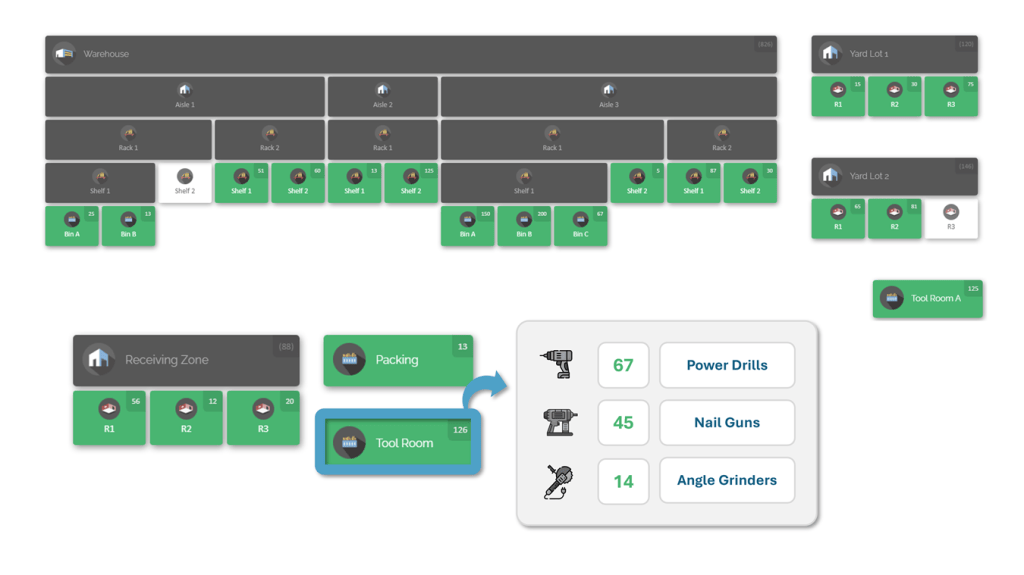
In this article, we explore best practices that give construction foremen better inventory visibility across trades and departments. We highlight strategies for organising stock, coordinating teams and using technology so that material data is accurate and up to date. Then we show how a map-based inventory platform such as CyberStockroom puts all this into practice – giving every foreman exactly the bird’s-eye material overview needed to keep projects on track.
The Foreman’s Perspective: Why Visibility Matters
A foreman’s job is to keep the crew working. That means tasks must never grind to a halt waiting for parts or tools. When a foreman has a complete picture of site inventory, several key benefits emerge:
- Faster task completion: If a foreman can instantly check exactly how many bolts, pipes or plywood sheets are on hand, the crew can start work immediately. There’s no waiting for a colleague to run to storage and report back. This reduces downtime between tasks and keeps labour hours productive.
- Fewer emergency orders: With good visibility, teams know their stock levels well before supplies run out. When inventory approaches a critical low point, the foreman or procurement manager is alerted to reorder. This proactive approach means the crew rarely needs to stop work to place urgent supply orders at premium prices.
- Cost savings: Avoiding excess stock frees up cash and space. When foremen see what’s on hand, they avoid unnecessarily “doubling up” orders. Likewise, they can identify underused items (like dozens of leftover electrical conduits) that can be shared or reallocated before buying new. Accurate visibility cuts waste and shrinkage.
- Better cross-team coordination: On a busy site, materials are often shared. For example, lumber bought for framing might be used by the roofing crew. When each department’s foreman has a shared view of what everyone owns, double ordering is avoided and inventory naturally balances. Communication becomes simpler: “Yes, there are 200 brackets left in storage – use those” instead of crews ordering their own supply separately.
- Increased accountability and safety: Workers are less likely to “lose” tools or parts when usage is tracked. If the foreman knows who took what and when, missing items show up in the records immediately. Moreover, having the right materials at hand means jobs (especially safety-critical ones, like installing scaffolding anchors or temporary guard rails) are done correctly and on time, reducing risk of accidents or rework.
In short, a construction foreman with full visibility of site materials spends less time firefighting and more time keeping the project moving smoothly.
Common Challenges Without Visibility

Before diving into solutions, it helps to recognise the frustrations foremen typically encounter:
- Lost time searching: Crews wandering from one stockpile to another wastes hours. When nobody is sure where things should be, one person might say “somewhere over by the containers”, another checks the tool crib, a third looks under tarps. This “search and wait” is expensive downtime on a critical path.
- Forgotten or duplicated orders: Without a central record, foremen may assume an item is out and order extra, only to later discover the first shipment arrived. Alternatively, a foreman may forget to order a part until too late. Either way, someone ends up scrambling or paying rush charges.
- Siloed information: In many projects, each team or subcontractor maintains its own list of materials (often in separate spreadsheets or even on paper). This segregation means no one has the whole picture. A steelwork foreman might see 50 beams in the yard, but the civil crew doesn’t know and buys their own, doubling the stock unnecessarily.
- Inventory inaccuracies: Manual data entry leads to mistakes. If counts are done irregularly, or people write down on scraps of paper and forget to update the system, foremen distrust the numbers. An outdated inventory level often does more harm than no system at all.
- Misaligned priorities: The foreman on site focuses on day-to-day tasks, whereas an off-site procurement manager thinks weeks ahead about orders. Without real-time data sharing, the procurement team might restock based on stale information (ordering for future projects) that conflicts with the immediate site needs. This disconnect causes either critical shortages on-site or excess goods piling up unseen.
These issues underscore why foremen say having a bird’s-eye view matters. It turns chaos into coordination, guessing into certainty, and reactive work into planned action.
Best Practices for Improving Inventory Visibility
To achieve that bird’s-eye perspective, construction teams should adopt systematic inventory practices. Below are industry-proven strategies that make materials easier to track and share across a large project:
- Maintain a Centralized Inventory System: Use one shared system where all items are logged. This could be a dedicated inventory platform, a cloud spreadsheet, or construction management software. The key is that everyone – foremen, procurement, warehouse staff – enters and reviews data in the same place. When information isn’t spread across silos, every department sees the up-to-date counts.
- Categorize and Label Items Clearly: Break inventory into logical categories (e.g. fasteners, lumber, electrical supplies, safety gear) and create a consistent naming scheme. Each item or bin should have a clear label or code. This way, workers in any department can identify a part at a glance. A simple example: label all shelving units with zone names (“Zone A – Plumbing”, “Zone B – Framing”) and each bin within them. Knowing exactly where a category of parts lives prevents confusion and speeds retrieval.
- Organize by Location on a Map or Layout: For medium and large sites, divide storage locations visually. Mark areas on a site plan or warehouse layout (for example, “Laydown Yard North”, “East Container”, “Spare Parts Room”). Whenever inventory is moved, update the location. This mapping practice gives foremen a literal site blueprint of materials. When combined with a digital map (as we’ll see with CyberStockroom), you effectively get a live floor plan showing where every item sits.
- Implement Barcoding or Scanning: Attach barcodes or QR codes to high-volume items and critical assets. Using handheld scanners or smartphone cameras, crews can quickly update the system as they check materials in or out. Scanning provides accuracy and speed that manual entry cannot match. It also creates a history of movements (who took what and when), which aids accountability and traceability.
- Set Min/Max Levels and Reorder Points: For consumables (like nuts, bolts, nails, adhesives), establish minimum and maximum quantities for safety stock. When a count hits the minimum, the system should flag the need to reorder. This prevents knee-jerk purchases and ensures critical items never run out. Equally, setting a maximum avoids hoarding; once you hit the max, the team knows to hold off until consumption frees up space. That continuous balance keeps inventory lean and accurate.
- Conduct Regular Physical Audits: Even the best system can drift from reality if not checked. Schedule periodic cycle counts or full stocktakes. For example, each month a different section of the yard is audited, or once a quarter do a complete count. These audits catch discrepancies early – a broken pallet of screws miscounted, or a misplaced power tool – and correct records. Over time, frequent audits train crews to be more precise in their routine tracking.
- Use Technology for Real-Time Updates: Modern construction inventory software can update stock levels in real time. Whenever materials move – arriving on site, used up, or relocated – the change appears instantly for all users. Mobile access (even via browser on a phone) means a foreman can update counts from the field. Real-time transparency means one department doesn’t accidentally use parts earmarked for another without agreement.
- Establish Clear Processes and Ownership: Define who is responsible for inventory tasks. Maybe each trade has a dedicated stockkeeper or the foreman delegates one person per shift to log transactions. Document standard operating procedures (SOPs): for example, “All new deliveries must be scanned in within 24 hours,” or “Before leaving for the day, crews must record all materials used.” Clear rules and accountability prevent informal “borrowing” or forgetting to log changes.
- Foster Cross-Team Communication: Hold short inventory sync-ups when shifts change or weekly project meetings. In these discussions, foremen from different trades can mention urgent needs or surplus stock. For example, the plumbing foreman might report running low on flange bolts, prompting the roofing foreman to promise any extras. Such conversations, supported by the shared inventory system, keep everyone aligned on materials requirements.
- Forecast Demand and Plan Ahead: Use project schedules to predict inventory consumption. If concrete work is coming up, ensure plenty of rebar and form ties are in stock. Comparing past projects’ usage helps refine these forecasts. When foremen can anticipate material usage, they order in controlled batches rather than scrambling during crises.
- Prioritize Training and Accountability: Teach all staff how to use the inventory tools and why it matters. A foreman should explain that accurate inventory logging saves labor hours and prevents emergency costs. When workers understand the “why,” they’re more likely to follow the system. Additionally, track inventory withdrawals by person or crew. If an item goes missing, you can trace when it was last logged. This discourages carelessness and helps maintain trust in the data.
Implementing these best practices requires effort, but pays off quickly. In a well-organized site, a foreman knows exactly what materials are available, where they are located, and what is coming next. The reduced uncertainty improves operational efficiency and project delivery.
Coordinating Inventory Across Departments

Large construction projects often involve many departments and subcontractors, each focused on their specialty. Without coordination, one team’s surplus might go unused while another team panics over a shortage. To align across all parties:
- Centralize Inventory Data by Location or Project Phase: Instead of separate lists, consider structuring inventory data by location (building, floor, or section) or project phase. For example, “Foundation Phase – west side” inventory and “Finishing Phase – east block” inventory. All trades working in that area use the same pool. This geographic approach naturally encourages sharing.
- Share Access to the Same Inventory Dashboard: Give department foremen and procurement team members access to the central inventory system. Even if they only track certain categories, letting them see overall stock prevents redundant orders. If the materials owner is a subcontractor, ensure the main contractor’s foreman can still view on-hand quantities.
- Set Common Metrics and Reports: Develop shared reports on stock status. A weekly “inventory health” report might list top ten fast-moving items or critical low-stock alerts. Distribute this to all site leads so everyone stays informed about potential bottlenecks.
- Hold Coordination Meetings: Brief stand-up meetings with representatives from each department can catch issues early. If the electrical foreman knows the concrete team needed a special anchoring plate yesterday, he won’t accidentally procure the wrong type today. These quick syncs, reinforced by the system’s data, promote cross-team alignment.
- Define Transfer Protocols: Sometimes one team finishes its work early and has leftover materials another can use. The process for transferring stock should be clear: log the movement in the system, update the location on the map, and notify the receiving foreman. This way, materials flow to where they’re needed instead of going to waste.
By applying these cross-department coordination practices, material planners turn separate inventory pools into a single project-wide resource. Every foreman then benefits from the complete visibility of that combined inventory.
Leveraging Technology for Better Visibility
Even a great process needs the right tools. Modern inventory management solutions make visibility practical and scalable:
- Interactive Inventory Maps: A map or blueprint of the site (or warehouse, laydown yard and trucks) overlaid with storage locations gives immediate context. Foremen can see at a glance how parts are distributed.
- Mobile-Friendly Interfaces: Foremen should be able to check or update inventory from the field using their smartphones or tablets. This mobile access ensures data is real-time. A foreman stepping off the site can still verify a part’s count from the office, keeping decisions accurate.
- Search and Filter Capabilities: Powerful search tools help a foreman find exactly where a specific material is located or how much is available. For instance, typing “6mm rebar” brings up all locations and quantities of that item on the entire site map. No more wandering from area to area; the system shows you the answer instantly.
- Automated Alerts and Reporting: Set up low-stock notifications or custom reports. If concrete additives drop below a threshold, the foreman or procurement is automatically alerted. Weekly inventory snapshots help in planning the next week’s orders.
- Easy Data Import/Export: It should be straightforward to import existing inventory lists (e.g. from Excel) to set up the system, and export data for accounting or vendor analysis. Many construction inventory tools allow uploading a spreadsheet of parts to rapidly populate the database. This reduces setup time so foremen quickly gain visibility without endless data entry.
- Secure Multi-User Access: Assign user roles so that team leads have editing rights and other stakeholders have read-only viewing. This ensures data integrity while keeping everyone informed. Foremen on site get exactly the information they need, while suppliers or office managers see what is relevant to their function.
Employing technology in these ways turns the abstract idea of “visibility” into a concrete reality. Instead of relying on whiteboards or paper logs, the entire inventory lives in one system.
CyberStockroom: Building a Shared Visual Inventory
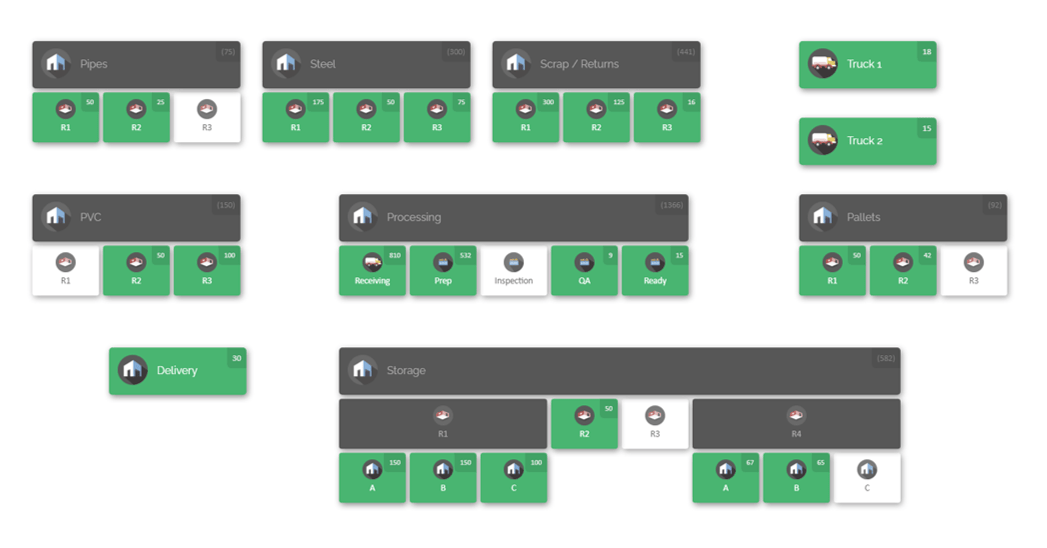
Imagine a platform where everything above is already in place, designed specifically for ease of use by construction and industrial teams. That’s the role CyberStockroom plays in this story. It is an online, map-based inventory tool built to give foremen the ultimate bird’s-eye view. Here is how CyberStockroom aligns with the needs we’ve discussed:
- Map-Based Inventory Dashboards: CyberStockroom revolves around an interactive map of your site. Foremen can draw areas for warehouses, truck trunks, laydown yards or any storage room. Each of these areas becomes a “location” on the map. Then you assign parts to those locations. The result is a visual dashboard – for example, clicking on the “north warehouse” pin shows all items stored there with current counts. This layout lets any foreman see all stocked items exactly where they are kept, without having to drill through lists.

- Drag-and-Drop Stock Organization: Moving inventory from one place to another is as simple as dragging icons on the map. If a foreman shifts some materials from the main barn to a jobsite container, CyberStockroom updates the quantities in both locations instantly. No spreadsheets to update by hand, and no chance to overlook the move. This visual “X-ray” approach to products means at any moment the entire inventory’s distribution is visible. Pick a part and the system highlights all locations where it exists.
- Barcode Scanning and Custom Fields: Each product in CyberStockroom can have a unique barcode, image and extra details attached. When a crew scans items in or out, the system adjusts the counts in real time. For foremen, this means the numbers can be trusted. Scanning reduces mistakes from manual entry, and the attached fields (like supplier, size or brand) let the team search by the exact parameter they know.
- Multi-Location and Multi-Team Visibility: CyberStockroom is cloud-based, so every authorized team member sees the same data. Electricians and plumbers, for instance, can view each other’s inventory if permitted. The platform supports nested sub-locations, too – meaning you can break a big warehouse into aisles or shelves on the map. A foreman in charge of his team’s materials and a logistics coordinator handling overall supplies both get a coherent picture of site stock.
- Import and Real-Time Sync: When starting out, a foreman can import the company’s existing inventory file. CyberStockroom reads Excel or CSV lists to fill the map. After that, any change (an incoming delivery, a used spool of wire, a transferred box of fittings) is immediately updated for everyone. Having real-time data in the system means the whole team can answer questions on the spot: “Do we have enough pipe caps for tomorrow?” The answer is visible without a delay.
- Intuitive Interface with No Training Hassle: The design of CyberStockroom was made to be straightforward, so that foremen – not just IT personnel – can use it easily. The concept of “your inventory on a map” is something anyone working on site can grasp quickly. Unlike generic software, it’s tailored to the way construction crews organize stock, allowing drag-and-drop moves and map layouts that match the physical reality of the site.

By putting all inventory locations and quantities on one screen, CyberStockroom effectively delivers the bird’s-eye view foremen crave. Multiple teams can coordinate within the same system, always seeing up-to-date information. For a foreman, this means making decisions and giving work orders with confidence – the tools they need and the materials they ordered are all accounted for on the map in front of them.
Inventory Visibility in Action
Let’s consider a practical example. Suppose an electrical foreman hears that the plumbing crew has some extra conduit tubes in their laydown area. With CyberStockroom, he simply searches for “20mm conduit” in the system. The map immediately highlights the plumbing crew’s storage point with the quantity available. The foreman confirms the transfer in the software, which reduces the plumbing stock and adds to the electrical team’s storage area – all with a couple of clicks. Meanwhile, everyone on both teams sees this update in real time. No one called or paper note was needed; the inventory system ensured both crews remained in sync.
In another scenario, a civil foreman is preparing for concrete work. He opens the CyberStockroom map and notes the remaining stock of rebar and formwork panels. The dashboard shows that some items are below their threshold point. He instantly creates a purchase order for just the needed quantities. By handling it through the same system, the foreman knows the order has been placed and can track its expected arrival. When the delivery comes, a forklift driver scans the barcodes into the corresponding map locations. Now the entire project team sees that the stock level is back up, without any manual reconciliation needed.
These examples illustrate the practical benefits: foremen spend far less time tracking down who has what. Every material movement – whether on a tablet in the field or at a desk – is captured and reflected on the inventory map. Foremen get the tools they need, when they need them, because the system is consistently updated.
Operational Efficiency and Accountability
A clear inventory view drives efficiency in other ways, too. Cyclical counting in CyberStockroom (essentially automated audits) is much faster than sifting through piles of parts. You can pick a location and quickly verify it matches the system count. This keeps records accurate with minimal effort. When staff leave or rotate, their work is logged: who checked items in or took them out. Accountability like this motivates everyone to follow procedure, since misuse immediately shows up in reports.
Overall, streamlined inventory control translates into tangible operational gains. Projects hit milestones on time because materials bottlenecks are avoided. Budgets stay tighter, as unneeded purchases drop and emergency freight charges shrink. From the project manager’s view, schedules become more reliable. From the foreman’s view, workdays are less stressful, since he isn’t constantly wrestling with unknown stock levels.
Achieving the Bird’s-Eye View

For construction foremen, having a comprehensive view of all on-site materials is not just a convenience – it’s a necessity for modern projects. By adopting best practices such as centralizing data, categorizing stock, and auditing regularly, teams lay the foundation for full transparency. Adding in digital tools makes it possible to achieve that goal: now a foreman can literally see the site’s inventory at a glance.
Solutions like CyberStockroom bring everything together in one place. With inventory mapping, real-time updates and shared visibility, foremen can finally move from the old reactive style (“Let’s check if we have it”) to a proactive, data-driven approach. The foreman who uses these methods gains the confidence of knowing where every beam, bucket and bolt lives. This bird’s-eye control keeps crews working smoothly, reduces waste, and ensures that every department on the site operates in sync. In a fast-paced construction environment, that perspective is worth its weight in concrete.








Leave a Reply