
What future-proofing means for the scalable inventory management future?
Growth rarely breaks an inventory operation in one dramatic moment. It usually breaks it in slow, expensive ways: a second storage room that becomes a “temporary” overflow forever, a third-party site that tracks stock in a separate spreadsheet, a new product line that introduces near-duplicate SKUs, or a busy peak that turns receiving into a backlog that never quite clears. When this happens, the system you have (and the habits around it) stop matching the business you have.
Future-proofing is the discipline of building inventory management that holds up when complexity increases. In practice, that means designing for two things at the same time:
- Scalability is the ability to handle more volume and more complexity without performance dropping or accuracy collapsing. It is not only about “more SKUs”. It includes more locations, more users, more movements, more rules, and more reporting needs.
- Flexibility is the ability to change how you operate without ripping everything apart. New storage zones, new workflows, new responsibilities, new product attributes, and new audit requirements should be manageable changes, not a reimplementation. Modular thinking is a useful mental model here: build with pieces you can rearrange and expand without disrupting day-to-day operations.
Why does this matter now? Because customer expectations and operating environments keep shifting. Warehouses face changing order profiles, unpredictable surges, and expanding SKU counts, and rigid layouts or rigid processes struggle to adapt.
In other words, the “scalable inventory management future” is not a single technology upgrade. It is an operating model: clean data, consistent processes, and tools that make it easy to see what you have, where it is, and what changed.
A practical way to judge whether your inventory management is future-proof is to ask these four questions:
🔴 Can you answer “how many of what do you have, where” quickly, and trust the answer?
🔴 Can you add a new location, a new zone, or a new product category without creating a parallel system?
🔴 Can you trace movement and changes when something goes missing or counts do not reconcile?
🔴 Can you run frequent accuracy checks (cycle counts) without shutting operations down?
If any of those feel hard today, that is not a failure. It is simply the signal that your operation has outgrown the way it started.
The strategy guide to scalable and flexible inventory management

Future-proofing works best when you treat inventory as a system, not a department. That system has five layers: data, locations, workflows, controls, and improvement cadence. The goal is not perfection. The goal is a model that still works when you double volume, add a second site, or introduce a new category.
Start with a “truth model” that can scale
Inventory management is, at its core, the system businesses use to keep optimal inventory levels by organising how items are sourced, stored, and sold or used. That is broad by necessity because inventory affects operations and finance at the same time.
To make it future-proof, define what “true” means in your operation. Most growing organisations need a truth model that answers these questions consistently:
- What is this item, exactly? (SKU, description, unit of measure, critical attributes)
- Where can it live? (site, zone, shelf, bin, vehicle, team, staged area)
- What state is it in? (available, reserved, damaged, returned, expired, ready-to-ship, in-transit)
- What changed, when, and who did it? (audit trail and activity history)
Scalability comes from consistency. Flexibility comes from designing those definitions so you can add to them without breaking reporting.
Build a location hierarchy that mirrors real work
When an organisation grows, it tends to add “sub-locations” faster than it updates systems. That is how ghost stock happens: inventory exists physically, but not logically.
A scalable approach is to define a location hierarchy that stays stable even when your layout changes. Think in layers:
- Site (warehouse, store, facility)
- Zone (receiving, staging, pick face, reserve, returns)
- Container (rack, room, cabinet, cage, pallet area)
- Slot (bin, shelf, drawer, specific position)
The exact labels do not matter. The discipline does. When the hierarchy is consistent, you can expand into new spaces and still make transfers, counts, and audits predictable.
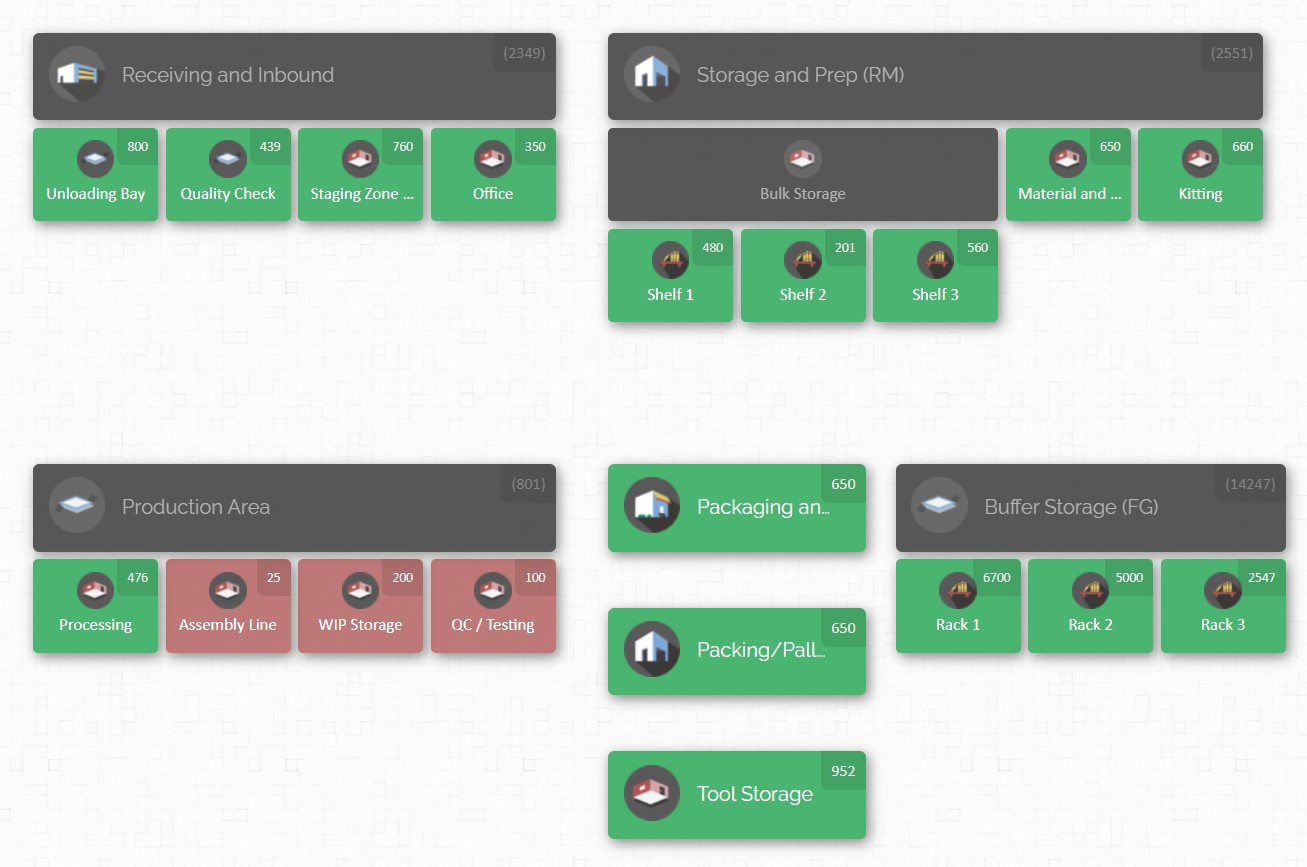
A visual mapping approach can support this because it turns the hierarchy into something people can navigate, not just memorise.
Put SKU and item master governance on the same level as counting

Teams often treat counting as the accuracy solution. Counting matters, but it cannot compensate for messy product definitions.
Item and master data management exists for a reason: it keeps product and asset data accurate, complete, and consistent across an organisation. When master data is inconsistent, transactions may be recorded correctly, but against the wrong item, the wrong unit, or the wrong location.
A future-proof item master typically includes:
- A clear SKU structure and naming standard.
- A small set of mandatory attributes that drive handling and reporting (unit of measure, category, critical dimensions, expiry rules if relevant).
- Rules for creating new SKUs (who can do it, how duplicates are prevented).
- Rules for changes (how edits are approved, how they affect reporting history).
This is data governance applied to operations: assign ownership, define standards, and keep a single source of truth.
If your operation includes similar items that are hard to tell apart, adding product images and attaching key documentation can reduce mis-picks and miscounts, especially as teams expand.
Standardize workflows so new locations do not create new rules
Multi-location inventory management becomes necessary as soon as you add a second location. The common failure mode is that each location invents its own way of receiving, storing, transferring, and counting. That creates data mismatches and forces “manual reconciliation” to become a permanent job role.
Future-proofing means agreeing on standard operating procedures across the lifecycle of inventory movement. At minimum, document and train these workflows:
- Receiving: how items are identified, labelled, and entered into the system.
- Putaway: how locations are assigned, and what rules stop “temporary placement” becoming permanent data errors.
- Transfers: how inventory moves between locations, and what confirmation step makes the transfer real in the system.
- Check-in and check-out or issue and return: how inventory is assigned to teams, projects, or people where relevant.
- Adjustments: who is allowed to adjust counts, when, and how root causes are recorded.
- Returns and exceptions: what happens to damaged items, incorrect deliveries, and discrepancies.
Standardisation does not mean rigidity. It means everyone speaks the same operational language, which is what makes scaling possible.
Make “inventory visibility” a measurable capability, not a slogan
“Inventory visibility” gets used as marketing language, but operationally it has a clear meaning: knowing what you have, where it is, and being able to trust that picture. Visibility fails when transactions are not captured quickly, when data is inconsistent, or when confirmations are delayed.
To future-proof this, choose two rules and enforce them:
- Every movement is recorded as it happens (or as close to it as realistically possible).
- Every location has a place in the system, including temporary staging zones.
Barcode scanning supports both by reducing manual entry and speeding up confirmations. CyberStockroom, for example, frames barcode input as something accepted across interfaces and extends scanning beyond items to include locations.

Use cycle counting as the engine of accuracy
Annual wall-to-wall stock takes have their place, but they are disruptive. Cycle counting is the practice of counting a scheduled subset of items to validate records without pausing operations, with the goal of catching errors early and correcting them before they cause stockouts or overstock.
Cycle counting scales better than annual counts because it becomes part of operations rather than a once-a-year emergency. Automation and structured workflows can improve accuracy and reduce labour costs in cycle counting.
A future-proof cycle counting approach usually includes:
- Item prioritisation, commonly via ABC analysis so high-value or high-movement items are counted more often.
- A stable schedule (daily or weekly cadence) rather than “when someone has time”.
- Root cause tracking for variances. If counts are off, the goal is to find why (receiving errors, mis-slots, unrecorded transfers), not just to fix the number.
Map-based inventory also helps cycle counting because it makes it easier to focus counts by location, then drill into sub-locations. CyberStockroom specifically references performing quick cycle counts on the map for adjustments.
Reorder points and safety stock are where planning meets real life
Visibility and accuracy keep you from lying to yourself. Reorder logic keeps you from running out.
A reorder point is the inventory level that triggers replenishment, and it typically accounts for lead time demand plus a buffer. Reorder point methods incorporate factors like daily usage, lead time, and safety stock.
Safety stock exists because real life is variable: supplier lead times fluctuate and demand fluctuates. Academic and practitioner literature consistently frames safety stock as protection against uncertainty in demand and lead times.
Where teams get stuck is not the formula. It is the organisational discipline:
- Do you measure actual lead times, by supplier and by category, rather than assuming?
- Do you differentiate between locations, since demand variability differs by site?
- Do you update reorder parameters when your business changes (new channel, new seasonality, new packaging sizes)?
For multi-location operations, best practice is often to set reorder points and safety stock by location, using local demand patterns, while keeping a network-level view so you can rebalance stock via transfers when needed.
Treat shrinkage as a systems problem, not a people problem
Inventory shrinkage is the gap between recorded inventory and what physically exists. It can come from errors, damage, loss, or theft.
Shrinkage grows with scale because transactions grow with scale. The future-proofing answer is not suspicion. It is controllability:
- Track activity history so you can reconstruct what happened.
- Use role-based access so not everyone can edit everything, especially adjustments.
- Use cycle counts to catch discrepancies early, while they are still explainable.
CyberStockroom’s loss and theft prevention framing centres on activity history as a ledger, filtering by user and timespan, and exporting reports. That aligns well with the general principle that shrinkage requires traceability and audit-ready logging.
Make your physical space modular enough to match operational change

Future-proofing is not only digital. The physical warehouse and storeroom either support flexibility or fight it.
Warehouse design experts describe modular warehouse design as using flexible, interchangeable components that can be rearranged or expanded without disrupting daily operations, and they frame this as a way to stay agile as SKU counts, order profiles, and growth cycles change.
Even without major construction, you can apply modular thinking in small ways that scale:
- Standardise bin sizes and label schemes so new zones behave like existing zones.
- Keep a formal “staging” area in your system so peak season overflow does not become invisible stock.
- Re-slot fast movers periodically so pick paths match reality, not last year’s velocity.
Physical modularity and digital visibility reinforce each other. If your locations are clearly defined physically and logically, your system remains accurate even when you rearrange racks or add a new zone.
CyberStockroom and why map-based visibility fits a future-proof strategy
A future-proof inventory strategy is easiest to maintain when the system matches how people think and work. Many teams do not naturally think in spreadsheets. They think in places: “the back room”, “rack A3”, “the service van”, “the staging zone”, “the QA shelf”. When your inventory system mirrors that mental model, accuracy work becomes simpler to teach, simpler to audit, and simpler to expand.
This is where CyberStockroom fits into the scalability and flexibility conversation: it is designed around an interactive inventory map that represents locations and sub-locations, and it emphasises visibility and movement through that map.
Here are the CyberStockroom capabilities that matter most for a scalable inventory management future, framed as strategy outcomes rather than feature checklists.
A location model that scales from simple to complex
CyberStockroom maps can represent warehouses, rooms, shelves, and bins, and are built for multi-location and multi-level operations. The core idea is straightforward: you build a map that matches your real layout and use it as the main interface for seeing what is where.
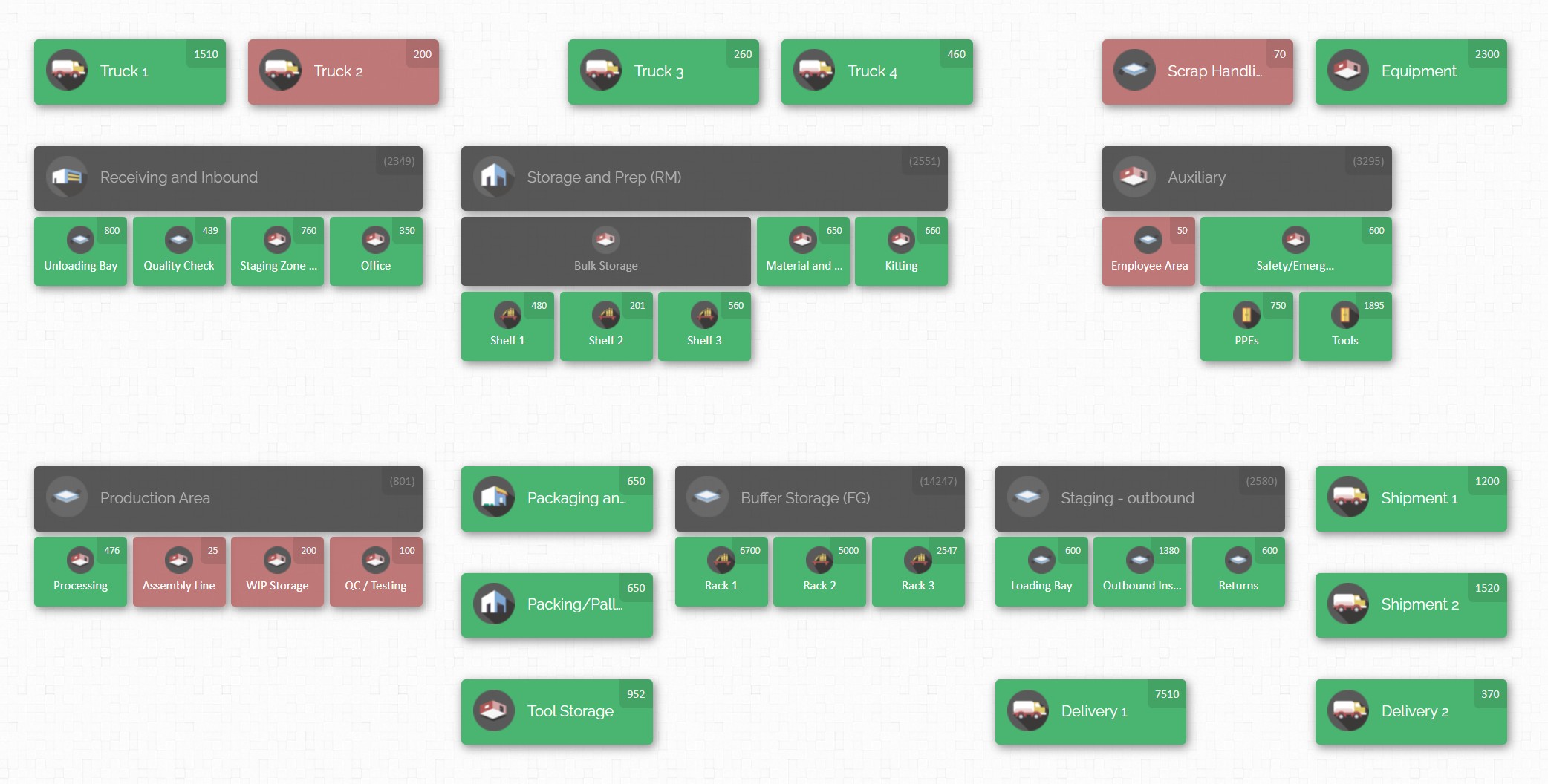
That becomes a scalability advantage because growth often adds “new places” faster than it adds “new products”: a new storage cage for high-value items, a new staging zone, a new site, or a new department that holds stock. A map-based system makes that expansion feel like adding onto the same structure rather than building a second system.
Fast, visual movement with traceability
Transfers are a frequent scaling pain point. The more locations you add, the more movements happen, and the more opportunities you create for inventory to “vanish” between steps. CyberStockroom supports moving items between locations with drag-and-drop transfers on the map, which is a direct fit for teams that need transfers to be fast and routine rather than paperwork-heavy.
Critically, inventory movement only stays future-proof when movement is recorded. CyberStockroom includes activity history and logging so you can see what happened, filter activity, and export reports. That gives you the audit trail you need when something does not reconcile.
Barcode support, including scanning locations as well as items
Barcode workflows are one of the most reliable ways to reduce human error and speed up high-volume tasks like receiving, transfers, and stock takes. CyberStockroom positions barcoding as a core input method across its interfaces, supports scanning items to find and move them, and also supports scanning locations. It also describes a “Quick Scan” tool designed to speed up grouped transactions like check-ins, check-outs, and transfers.
For future-proofing, the important concept is not “barcoding” as a feature, it is disciplined capture. Real-time visibility fails when transactions are delayed, skipped, or recorded somewhere else. Faster capture reduces that gap.

Context attached to products, not just counts
As SKU catalogues grow, confusion grows with them, especially when items have similar names, similar packaging, or similar part numbers. CyberStockroom supports product images, and it also allows attaching files to products (such as manuals or documentation). That matters because future-proofing is partly about reducing tribal knowledge. When someone can click an item and see what it is, the process scales beyond the handful of people who “just know”.
Scaling without a painful migration
Many teams start in spreadsheets, then fear migration because it feels like an all-or-nothing project. CyberStockroom supports uploading inventory from spreadsheets and describes helping customers upload catalogues to get started. It also references batch processing via spreadsheet for bulk edits and moving large quantities of items between locations. That is an underrated form of flexibility: you can move between “daily operational use” and “bulk clean-up work” without changing tools.
Cloud access through a browser
From a future-proofing standpoint, browser access matters because it reduces friction to adoption across teams and sites. CyberStockroom describes a cloud-based approach where records are accessed through a browser and inventory data is hosted on Amazon Web Services infrastructure. That supports the practical reality of growth: more people need access, more often, in more places.
The strategic takeaway: CyberStockroom can be positioned in the article as a concrete example of a broader principle, namely that visibility and location clarity are the first building blocks of scalability. If you cannot reliably answer “what is where” today, flexible planning and optimisation later will rest on shaky ground.

Implementation roadmap and the metrics that keep it future-proof
A strategy guide only becomes useful when it turns into a plan. The implementation below is designed to be practical for growing operations that want scalability without disruption.
A phased rollout that supports real operations
Phase zero: Establish the baseline
Create a baseline snapshot of what you manage today: number of SKUs, number of storage points, number of people who touch stock, and where records currently live (spreadsheets, emails, tribal knowledge). Inventory visibility problems often come from delayed capture and inconsistent records, so the baseline should identify where your process “goes offline”.
Phase one: Clean the item master and location logic
Before you redesign workflows, remove duplicates, standardise key attributes, and define your location structure. Data governance frameworks stress that data becomes trustworthy when definitions, responsibilities, and standards are clear.
Phase two: Map the operation and align it to the real world
This is where a map-based approach can be highly effective. The goal is not art. The goal is to create a live representation of where inventory can exist, down to shelves and bins where necessary. CyberStockroom describes building maps from high-level (cities, warehouses) down to detailed sub-locations (rooms, shelves, bins).
Phase three: Standardise core workflows and train for consistency
Multi-location best practices repeatedly emphasise consistent SOPs for receiving, transfers, counts, and reporting, because software cannot compensate for different rules at each site.
Phase four: Add controls: barcodes, cycle counts, and audit trails
Barcoding reduces errors and speeds up transactions. Cycle counting maintains accuracy over time with less disruption than full counts. Audit trails and activity history support shrinkage reduction and accountability.
Phase five: Improve planning and replenishment rules
Once records are trustworthy, reorder points and safety stock become meaningful rather than guesswork. Establish a review cadence so parameters update when lead times or demand patterns change.
Phase six: Continuous improvement cadence
Future-proofing is sustained by review habits: weekly exception review, monthly KPI review, quarterly slotting and layout review, and periodic process audits. This matches the broader principle that inventory optimisation requires defined goals and a roadmap, not occasional clean-ups.

KPIs that show whether your inventory management is truly scalable
Pick metrics that connect operations to business outcomes. Inventory KPIs are useful because they connect floor performance to cash flow, availability, and service.
Inventory accuracy – Accuracy is foundational because every other metric depends on it. Cycle counting is widely described as a practical way to measure and improve accuracy over time.
Inventory turnover – Inventory turnover shows how many times inventory is used and replaced in a period. A common formula is COGS divided by average inventory value.
Days’ sales of inventory (DSI) / days on hand – DSI indicates how long items sit before being used or sold, and it is often used to judge liquidity and overstock risk.
Stockout rate – Stockouts are one of the most visible symptoms of weak planning and weak execution. Stockout rate is frequently tracked as a percentage of orders affected.
Carrying cost of inventory – Carrying cost highlights the cost of holding inventory over time, including storage and handling. Planning KPI guides commonly emphasise carrying cost as a critical measure alongside stockouts and dead stock.
Shrinkage rate – Shrinkage tracks the difference between recorded and actual physical inventory, and it is explicitly tied to loss, errors, and damage.
Practical KPI cadence:
Run a weekly “exceptions” review (negative stock, unexplained adjustments, repeated variances in one zone). Run a monthly KPI review. Run a quarterly “design” review where you adjust slotting, location structure changes, and training gaps. Modular thinking helps here: small upgrades compound over time, and that is how you stay flexible without constant disruption.
What success looks like
When future-proofing works, you will notice it in everyday behaviour, not just dashboards:
New locations and sub-locations get added quickly and cleanly, using standard naming and structure.
Transfers and stock movements become routine and traceable, rather than informal and hard to reconstruct.
Cycle counting catches issues early, so “inventory surprises” become smaller and easier to explain.
Replenishment decisions become calmer because reorder points and safety stock reflect real lead times and demand variability.
Shrinking and loss become diagnosable, because the system can show what changed and who touched it.
That is the scalable inventory management future in plain terms: growth does not force you into a new system every year, and flexibility does not mean chaos. It means your inventory model, your workflows, and your controls are built to expand and adapt without losing visibility.









Leave a Reply