
Site to site material transfer construction tracking looks simple when it is viewed as a transport task. In reality, it is an operating model problem. The shipment between Project A and Project B is only the visible end of a longer chain that starts with planning, receiving, quality checks, storage, issue control, staging, loading, receipt confirmation, and close-out recovery. If any of those steps are inconsistent, stock becomes harder to trust, teams start expediting instead of planning, and the business pays twice: once in wasted labour and once in duplicated material spend. That is why the strongest transfer systems focus on material traceability, construction inventory tracking, and multi-site visibility as one connected discipline rather than three separate initiatives.
For contractors running multiple jobs, internal transfers become especially risky when stock is spread across a central warehouse, laydown yards, containers, fabrication areas, staging zones, and active workfaces. The same challenge exists in manufacturing environments, where parts move through receiving, inspection, stores, work in progress, maintenance, dispatch, and departmental reserves before they are ready for use. In both cases, the operational question is not simply “Do we own the item?” but “Where is it, in what condition, under whose control, and is it genuinely available to move?” When those questions cannot be answered quickly, site to site material transfer construction tracking turns into phone calls, spreadsheet hunting, and urgent collections.
The best-practice answer is a formal material logistics plan backed by a clear location hierarchy, disciplined item and location identification, barcode-supported transactions, reliable receiving and staging controls, cycle counting, and a review rhythm that treats transfer failures as process signals. That approach reduces hidden stock, shrinks search time, improves inventory accuracy, and aligns warehouse, project, procurement, fabrication, and supervisory teams around the same material picture. For organizations that handle stock across multiple job sites and departments, this is what turns material movement from a reactive scramble into a repeatable control system.
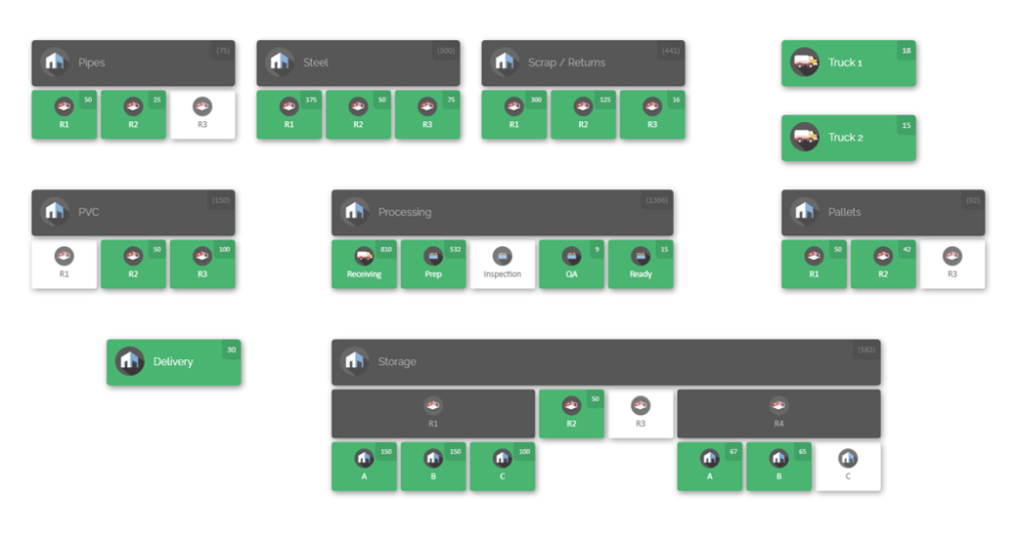
A visual inventory platform fits naturally into that model because transfer accuracy depends on physical context. People need to see not only the product record, but also the location, sub-location, staging position, and relationship between warehouse, yard, container, truck, and project area.
Why Site-to-site Material Transfer Breaks Down

Fragmented ownership creates inconsistent decisions
The most common reason transfers fail is that no one truly owns the end-to-end material flow. One team orders, another receives, another stores, another stages, another approves movement, and another discovers the shortage once work is due to start. A formal logistics model only works when responsibilities are assigned early and communicated clearly. The planning structure needs to identify who builds the material logistics plan, who enforces it, who manages quantities and delivery rules, who confirms receipt, and who reviews performance against the plan. Without that ownership, site to site material transfer construction tracking becomes a collection of local habits instead of one operating system.
That ownership question becomes more important when subcontractors are involved. On many projects, subcontractors order and handle large parts of the material flow, which means they also control a large share of the data quality. If they are not included in the logistics framework from the start, the business loses visibility into quantities, delivery timing, contingency allowances, packaging, handling requirements, labelling procedures, and proof of use or disposal routes. Internal transfers then become harder to plan because demand signals arrive late or arrive in inconsistent formats.
Weak location discipline makes stock records unreliable
A stock record is only as useful as the location model behind it. If one team says “north compound”, another says “Container 4”, and another says “yard overflow”, the business is not working with a coherent location hierarchy. It is working with local shorthand. Construction sites also change over time, so the risk grows as the project evolves. Storage areas must be selected deliberately, clearly defined from the start, and kept suitable for the material they hold. When that discipline is missing, overfilled zones, unclear storage boundaries, and ad hoc overflow areas make material traceability weaker with every hand-off.
Poor storage discipline is not only an efficiency problem. It is a safety and stock-integrity problem as well. Materials stored in tiers must be secured against sliding, falling, or collapse. Aisles and passageways must remain clear and in good repair, and stored materials must not obstruct exits. Operationally, that means an item may be recorded as available while being physically inaccessible, mixed with another lot, or unsafe to retrieve quickly. That gap between book stock and usable stock is one of the quietest causes of transfer failure.
Receiving and status control are often too casual
Many internal transfers still rely on visual checks, handwritten notes, or verbal confirmation. That is one of the fastest ways to lose accuracy. A dependable receipt and storage process should be defined once material requirements and timing are understood. Similar items should be grouped together, unloading and distribution should follow a planned flow to the point of use, and the receiving party should confirm receipt, either manually or electronically, when the material reaches its destination. If a transfer can leave one site and arrive at another without a disciplined receipt confirmation, discrepancies become almost impossible to isolate cleanly later.
The same principle applies to inspection and conditional availability. In manufacturing and industrial environments, inventory visibility depends on knowing not only quantity and location but also status and movement. Stock in inspection, work in progress, or quarantine is not equivalent to unrestricted stock in stores. When teams collapse those states into one generic on-hand number, they start promising material that is not genuinely ready to move. That produces false availability, rushed substitutions, and transfer requests that were avoidable if status had been visible earlier.
Transfers fail when they are disconnected from the program

Construction teams often over-order to feel safe, especially when lead times are long or delivery risk feels high. But that habit introduces its own waste. A just-in-time material strategy works by aligning the construction schedule with the inventory transportation schedule so that workers receive what they need at the last responsible moment instead of holding excess stock prematurely. When the schedule and the inventory plan drift apart, some projects accumulate slow-moving stock while others experience artificial shortages. Internal transfers rise, but not because the business lacks material overall. They rise because the wrong material is in the wrong place at the wrong time.
This is why site to site material transfer construction tracking should never be treated as a stand-alone warehouse SOP. It must be linked to workface readiness. If a material move is not connected to a defined scope need, reserve policy, or stage of work, the business starts moving stock for comfort rather than for production. That weakens planning, crowds sites, increases handling, and makes it harder to trust the next shortage signal because so much stock is already out of place.
Close-out and surplus recovery are frequently under-managed
A project may finish well from a construction point of view and still finish poorly from a stock-control point of view. Excess materials often remain in containers, laydown areas, site stores, fabrication corners, and supervisor-controlled zones because close-out focuses on defects, demobilization, and handover rather than on recovery. Yet the demobilization phase should include a controlled plan for how materials, plant, labour, facilities, and waste are removed, and how excess usable material can be deployed to another project. If surplus and returns are not managed with the same care as new receipts, hidden stock builds up across the portfolio and fresh buying becomes the default response.
That is one reason multi-site visibility matters so much. One project’s leftover cable gland packs, valves, brackets, or consumables may be another project’s urgent purchase request. Without a shared view of location, status, and ownership, that reuse opportunity stays invisible. The result is not only waste in the environmental sense. It is wasted capital, wasted warehouse space, and wasted labour spent searching for material that the business already owns.
Best-practice Operating Model for Multi-project Transfers
Start with a formal material logistics plan
A strong transfer process begins before the first transfer request. Waste and excess cost can be reduced significantly when the business manages materials through a formal material logistics plan that runs from project start to completion. In practice, that plan should define roles, training, communications, material quantities, delivery logic, storage rules, site mobilisation, subcontractor obligations, and close-out controls. It should not sit in a project folder as a one-time document. It should function as the rulebook for how stock enters, moves through, and exits the project network.
Best-practice direction: treat the material logistics plan as a control framework for site to site material transfer construction tracking, not as a waste-management appendix. The transfer workflow should be one chapter within that larger framework, because transfer reliability depends on the quality of upstream planning and downstream receipt.
Define roles and responsibilities early
The minimum ownership structure is straightforward. The client or sponsor defines broad project requirements and expectations. The main contractor or operational lead owns execution and ensures the supply chain follows the rules. A logistics manager or equivalent lead should be appointed as early as possible so logistics can influence planning and design before site conditions harden. Subcontractors must be engaged early, both because they often control significant material packages and because they need to provide accurate data on quantities, delivery details, and timescales. These responsibilities only work when they are made explicit and reinforced through regular meetings and training.
A practical lesson here is that accountability should sit as close as possible to the point of action. If a project supervisor can request transfers but not confirm receipt, or if a warehouse team can issue stock without visibility into project demand windows, the workflow develops blind spots. Roles should therefore be designed around decision rights as well as responsibilities: who can request, who can approve, who can load, who can receive, who can adjust counts, and who can release surplus back to common stock.
Build a location hierarchy before you automate transactions
The business should be able to name every place where material can be stored, staged, checked, or parked. That includes buildings, yards, rooms, containers, racks, shelves, bins, trucks, trailers, project stores, fabrication cells, quarantine cages, and returns zones. A standardised location identifier improves process visibility because it answers the “where” question consistently across the supply chain. Even if you do not formally implement an external coding standard, the internal logic should still follow the same principles: one unique name, one defined place, one agreed prefix structure, and one clear parent-child relationship between higher and lower levels.
The hierarchy should also reflect physical and operational reality. A meaningful structure might look like this: Region > Site > Area > Storage Type > Exact Position. For example: Bristol > Project North > Laydown Yard > Container C > Shelf 2. That level of detail matters because book accuracy is usually lost in the last few metres. Teams may know the right site and even the right area, but still lose time because the final bin, shelf, pallet, or container segment is not controlled.
Use barcoding for both items and locations
Construction inventory tracking improves sharply when teams scan not only products but also places. It is not enough to barcode an item if the destination is still entered freehand. Accurate site to site material transfer construction tracking depends on pairing the stock identity with the exact source and exact destination every time the material moves. Barcode-supported workflows reduce manual entry errors, accelerate transactions, and make receiving, picking, staging, and shipping more consistent. They also strengthen material traceability because every movement can be tied back to a scan event instead of a later memory-based update.

Barcoding is especially valuable when movement density is high, such as during mobilization, large workface releases, shutdown activity, or project close-out. In those periods, transfer volume rises, labour pressure rises, and manual record quality usually falls. The answer is not to record less. It is to make recording easier and faster.
Standardize the transfer record
A transfer should not exist as a vague instruction such as “move some cable tray from South Yard to Project B”. The minimum transfer record should include: item or part number, plain-language description, quantity, unit of measure, source location, destination location, status, requestor, approver, required-by date, actual move date, reason code, and receipt confirmation. Where applicable, the record should also capture batch, lot, serial, or condition details. This is basic control, but it is also the foundation of good material traceability. Without those fields, it becomes hard to audit shortages, analyse emergency demand, or defend stock accuracy.
A useful refinement is to categorise the reason for movement. Examples include planned issue to programme, surplus redeployment, shortage recovery, returns consolidation, quality hold relocation, or temporary staging move. Those reason codes turn transfer history into usable management data. They show whether the business is running on planned flow or on recovery work.
Separate planned transfers from emergency transfers
Not all transfers are equal. A planned transfer is tied to an expected work window, material requirement, or stock-balancing decision. It can be prepared, staged, cross-checked, and received properly. An emergency transfer happens because visibility, scheduling, replenishment, or discipline failed somewhere earlier. Emergency transfers will always exist in real projects, but they should be treated as exceptions, coded clearly, and reviewed for root causes. If the same commodity group repeatedly moves as an emergency between projects, the problem is usually not transport. It is weak forecasting, bad count accuracy, hidden stock, or poor cross-team communication.
A simple operating rule helps: every emergency transfer should trigger a short after-action review. What failed? Was the stock record wrong? Was the demand signal late? Did the project hold too much in unofficial staging? Did another department tie up the stock without visible status? The purpose is not to create blame. It is to stop emergency movement becoming normal.
Stage, verify, and confirm at both ends
A good transfer process uses controlled staging areas rather than direct ad hoc loading from general stock. Similar items should be stored together, and a dedicated unloading and distribution resource should be available so material reaches its point of use efficiently with less double handling. Once the material reaches the destination, the receiver should confirm that it was received properly. These practices sound basic, but they are precisely what prevent one of the most common failure modes in construction inventory tracking: the system says the transfer is complete while the destination still disputes what actually arrived.
The ideal workflow is: pick to a transfer staging location, verify against the request, load from staging, move, unload to a receiving or quarantine point, confirm quantity and condition, then release to final stock or workface issue location. That sequence gives the business clean breakpoints where discrepancies can be isolated and corrected.
Control stock status, not just quantity
Multi-project transfers fail when availability is overstated. Quantity alone is not a reliable decision tool. Stock must carry a usable status such as available, inspection, quality hold, staged, reserved, issued, returned, surplus pending review, or quarantine. Inventory visibility is defined by location, quantity, status, and movement, not by a single count field. This matters because material in work in progress, inspection, or reserved staging may look available in total while being operationally unavailable for transfer.
Status clarity is particularly important in manufacturing environments connected to construction projects. A part in the fabrication queue may technically exist on premises but should not be diverted casually to another project unless there is a controlled substitution or reallocation decision. Cross-department alignment is what prevents those conflicts from becoming invisible shortages later.
Use cycle counting to protect traceability without stopping operations
A full physical count once a year is too blunt for fast-moving environments. Cycle counting is more suitable because it checks targeted parts of inventory regularly while operations continue. It confirms whether physical counts still match the record and allows discrepancies to be corrected before they spread through multiple projects and departments. The most efficient plans focus count effort where transaction error risk is highest, not where counting is most convenient.
For a contractor or industrial operator, that means prioritising fast movers, high-value items, long-lead materials, critical spares, mobile locations, staging zones, and any area with frequent internal transfers. If these areas are only checked during annual counts, by the time the variance is found it may already have distorted purchasing, scheduling, and project performance.

Give surplus and returns their own control path
Surplus material should never disappear into a vague “leftovers” category. It needs defined locations, status codes, and release rules. The same is true of returns, damaged-but-reviewable items, and project close-out recovery. Demobilisation should be managed safely and deliberately so excess materials and other resources are removed under a controlled strategy, including a decision on whether usable material can serve another project. In practice, this means the returns process must be visible enough to support deliberate redeployment, not merely physical tidying.
This is one of the most profitable parts of site to site material transfer construction tracking. A business that can see and trust surplus stock across multiple projects often reduces new buying without reducing readiness. A business that cannot distinguish reusable surplus from scrap tends to buy new by default.
Train the whole chain, including subcontractors
Training should do more than explain which button to press or which field to fill in. The logistics framework should include a training and communications plan that covers site-specific logistics strategies, duties under the material plan, and the reason the controls exist. Regular meetings with staff and contractors reinforce why clean material data matters and keep subcontractors engaged in the process. This is especially important because subcontractors are often asked to supply material quantity data, purchase evidence, delivery times, packaging details, labelling procedures, and receipt discipline.
Shortcuts nearly always emerge under site pressure: items moved without being checked in, accepted substitutions that never get recorded, or materials parked in temporary zones that no one later reclassifies. Training works only when it makes the operational cost of those shortcuts obvious.


Extending Parts Visibility Across Departments

Treat visibility as a flow problem, not a warehouse problem
The title of this article is rooted in construction, but the operational reality expands into manufacturing and multi-department stores control very quickly. Many internal transfer problems are not created at the point of dispatch. They are created upstream when parts pass through receiving, inspection, stores, work in progress, manufacturing cells, maintenance stock, dispatch preparation, and departmental holdings without one shared view. Inventory management is fundamentally about tracking the flow of raw materials, work in progress, and finished goods across multiple locations and through every stage from purchase to use or sale. That same logic applies to industrial construction operations where parts and assemblies are prepared before they ever reach site.
When leaders only ask for warehouse accuracy, they miss the broader question of parts availability. A part that is somewhere in the business is not necessarily ready for transfer. If it is in inspection, committed to fabrication, staged for another job, or buried inside an uncontrolled departmental reserve, it is functionally invisible. That is why multi-site visibility must include departmental visibility.
Separate inventory by stage and status
A robust visibility model distinguishes between at least these categories: receiving, inspection, available stores stock, work in progress, departmental reserve, maintenance and operations stock, staged for issue, surplus, returns, and quarantine. Manufacturing inventory practice recognizes multiple inventory categories because each one affects planning differently. Raw materials, work in process, finished goods, and often maintenance-related stock all require distinct handling. The same principle should be applied to industrial construction materials and parts.
This does more than improve reporting. It changes operational decisions. Procurement sees what truly needs replenishment. Project teams see what is available to transfer. Supervisors stop promising stock that is still being inspected or processed. Finance benefits too, but the immediate gain is reduced confusion at the point of need.
Build one material language across departments
Cross-department alignment depends on naming discipline. The same part should carry the same core identifier in procurement, stores, fabrication, QA, maintenance, and project issue. Locations should follow one hierarchy. Status values should use one controlled list. If one area says “inspection cage”, another says “hold stock”, and another says “awaiting QA”, the business has already created friction before any transfer begins.
A shared material language is what turns construction inventory tracking into a portfolio-level capability. It reduces translation work between departments, improves searchability, simplifies onboarding, and makes reports genuinely comparable across the business. It also supports material traceability because the same part can be followed consistently as it moves between manufacturing, warehouse, and project environments.
Make work in progress visible enough to manage
Work in progress is one of the biggest blind spots in mixed construction and manufacturing environments. Once items are issued to a job, kit, pallet, trolley, or fabrication order, they often disappear from common visibility until someone starts chasing them. Yet work in process is a recognised inventory category precisely because it affects both production efficiency and stock accuracy. Businesses that ignore WIP in their location model usually compensate with emergency transfers and duplicate picking because they cannot see what has already been committed.
The answer is not to leave WIP in the general stock pool. It is to give WIP its own visible locations and own release rules. Teams should be able to tell whether a part is still transferable, whether it is reserved but not yet consumed, or whether it is no longer available to another project without specific approval.
Use multi-site visibility to reduce local hoarding
Multi-site visibility matters because scarcity often looks worse from inside one silo than it does across the wider network. A central warehouse may appear short while a remote project holds usable surplus. A project may raise an emergency requisition while a fabrication area still has the required part in a departmental staging zone. Visibility across locations, departments, and business units reduces those false shortages and improves the quality of transfer decisions. Shared visibility and coordination across forecasting, demand planning, operations planning, and inventory management are central to better supply performance.
This is also where behavioural change starts. When teams know that stock is visible across the network, they are less likely to create hidden buffers in unofficial shelves, cupboards, or containers. Hidden buffers are usually signs of mistrust in the system.
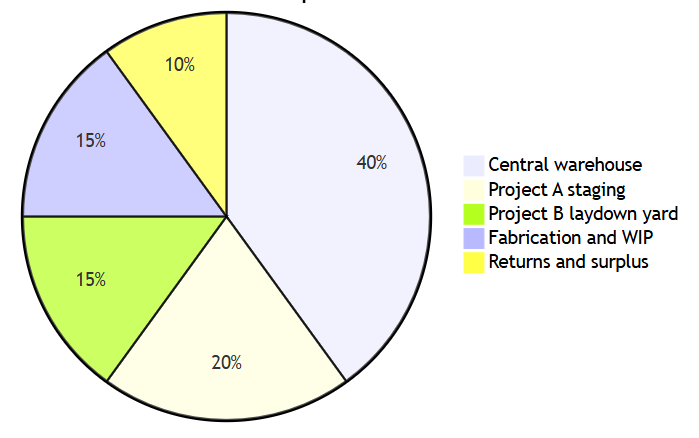
Example product distribution: Distribution of one critical part across the network
Turn visibility into coordinated action
Visibility is only valuable if it improves decisions. In practical terms, the question should always be: what decision does this stock picture support? Replenish, transfer, reserve, release, return, substitute, count, or stop buying. If the visibility layer does not drive one of those actions, it becomes static reporting.
For this reason, high-quality visibility work usually improves three outcomes at once. It improves operational efficiency because teams spend less time searching and expediting. It improves inventory accuracy because movement and status are clarified. It improves cross-team alignment because procurement, warehouse, manufacturing, maintenance, and project teams work from the same material truth. That is the real bridge between construction logistics and manufacturing parts visibility.
How CyberStockroom Supports Material Visibility and Transfer Control
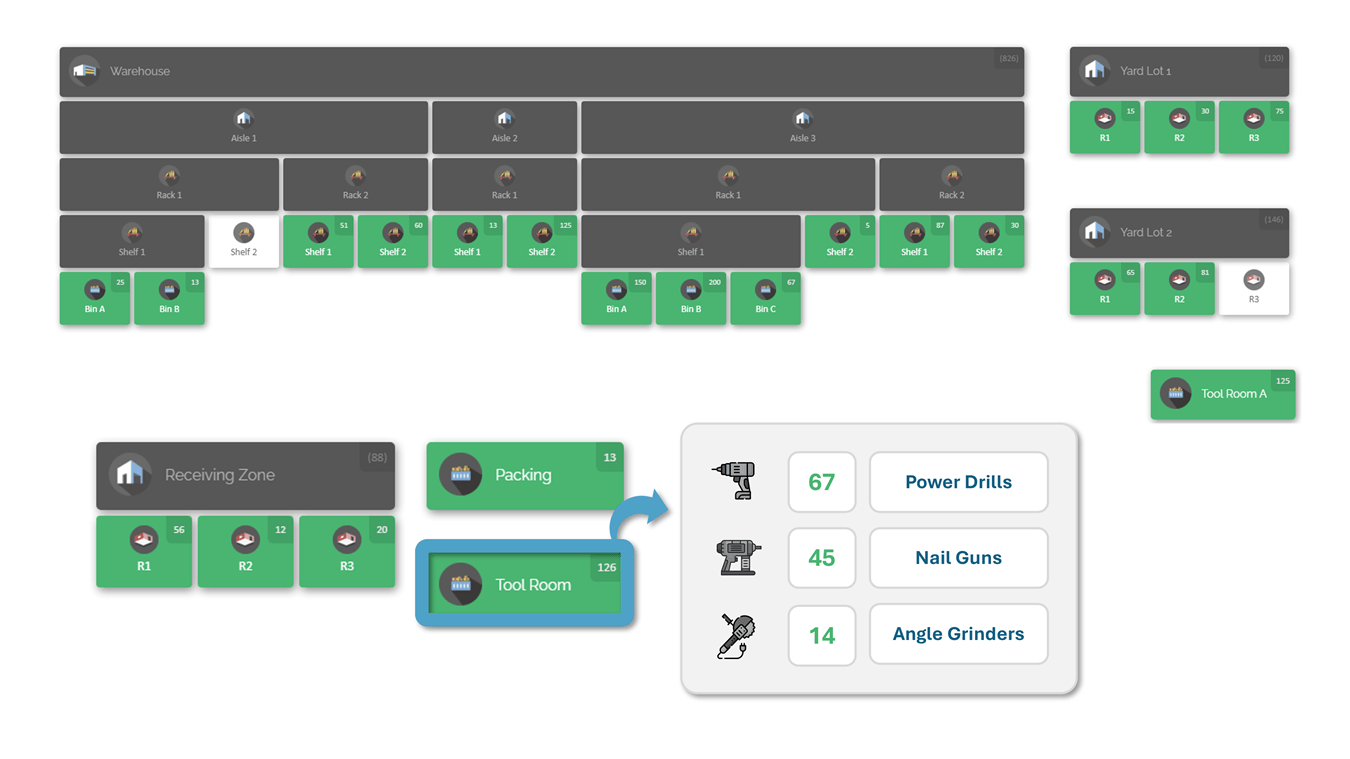
A visual map makes the operating model usable
CyberStockroom enables teams to represent inventory as a live map of the operation rather than as a flat list of stock records. That matters because site to site material transfer construction tracking is rooted in physical context: buildings, rooms, racks, bins, yard zones, containers, staging areas, trucks, and project spaces. With a visual map, teams can understand where stock sits and how it moves through the network much faster than they can through spreadsheets or memory-driven searching. CyberStockroom is designed to build an interactive map of the operation, from bins to buildings, and to extend that model across warehouses, yards, process stages, departments, and multiple sites.
This is particularly useful in industrial construction because inventory rarely sits in one tidy warehouse. Materials often move between central stores, receiving zones, QA areas, laydown yards, containers, site stores, and work areas. CyberStockroom allows teams to model those locations visually, which supports stronger multi-site visibility and clearer stock organisation across projects.
Multi-location and nested location mapping support exact placement
With CyberStockroom, you can break the business down into any number of locations and sub-locations and rearrange the layout to match the way you see the operation. That is important because location accuracy is often lost inside the final layer. It is one thing to know that a valve is somewhere in the laydown yard. It is another to know that it is in Yard B, Container 2, Pallet 4, Shelf A. CyberStockroom supports multi-location and multi-level mapping so that teams can mirror the real hierarchy of warehouses, rooms, shelves, bins, yards, process stages, and work areas.
That nested structure helps both construction inventory tracking and manufacturing parts visibility. It reduces the search gap between “we own it” and “we can put a hand on it now”. For fast-moving operations, that is often the single difference between planned flow and time lost to field chasing.

Drag-and-drop transfers keep movement tied to place
CyberStockroom enables teams to move inventory between locations or levels through drag-and-drop actions on the map. For a business managing internal transfers, that is more than a convenience feature. It means the movement is recorded in the same visual model that describes where the stock lives, which keeps the transfer workflow tied closely to the physical operation. That alignment is valuable when material moves frequently between containers, trucks, staging zones, warehouses, and job sites.
In practical terms, drag-and-drop transfers support a more intuitive way of working. Warehouse and project teams can update stock movement as part of the operational flow instead of treating transfer recording as a separate administrative task that gets postponed until the end of the shift.
Product distribution views strengthen multi-site visibility
A strong transfer decision starts with a simple question: where else do we have this item? CyberStockroom’s product distribution view helps answer that question by showing how a selected product is distributed across the network. Teams can scan or select an item, see its distribution, locate it quickly, assess product levels visually, and make adjustments. That supports both material traceability and faster stock balancing between projects, departments, and storage points.
For example, if one project raises an urgent request for a specific fitting, the distribution view makes it easier to identify whether the part is sitting in central stores, in another site’s surplus area, in a staging zone, or in a departmental reserve. That reduces guesswork and shortens the time from request to decision.
Barcoding and Quick Scan reduce friction at the point of action
CyberStockroom supports barcoding for products and locations, and it includes Quick Scan for rapid transaction handling. With Quick Scan, teams can perform large numbers of check-ins, check-outs, and transfers between multiple locations quickly. Items and locations can both be scanned, which is critical because reliable movement data depends on capturing the item identity and the place identity together. CyberStockroom also supports printing barcodes directly or using existing barcode labels on products.
Operationally, this is one of the strongest ways to improve construction inventory tracking. It reduces manual entry, speeds up field and warehouse transactions, and makes it more realistic for busy teams to keep records current under real job pressure.
Activity history and permissions improve accountability
CyberStockroom gives teams activity history so they can track inventory actions, movements, and changes through a detailed log. It also supports permissions, including read-only access, so managers can control who can view and who can change inventory data. Those two controls matter because visibility without accountability is fragile. If the business cannot see what moved, when it moved, and who moved it, then shrinkage, unexplained variance, and transfer disputes remain difficult to investigate.
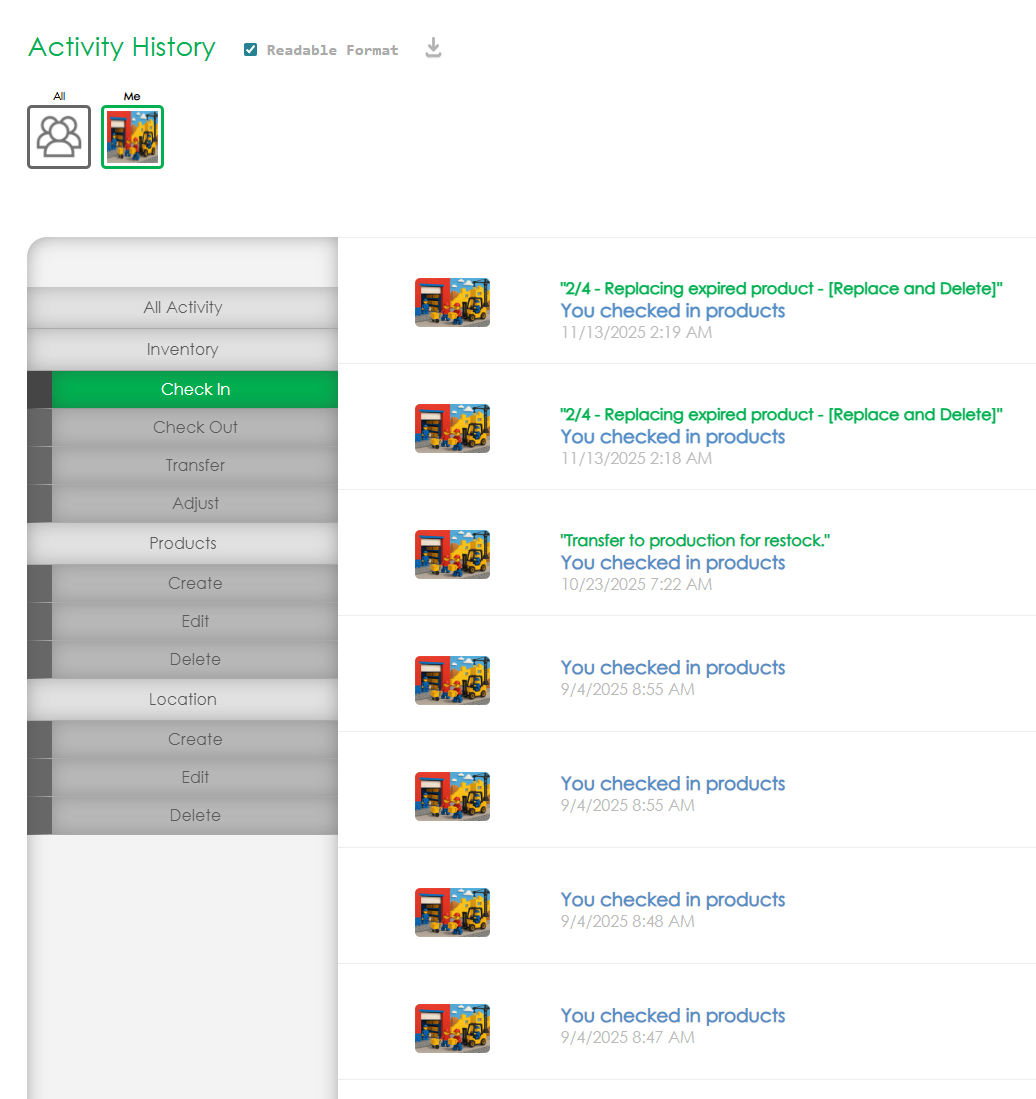
For multi-project operations, this creates better discipline around hand-offs. Supervisors can see whether a transfer was actually completed, warehouse teams can review movement history when a discrepancy emerges, and leadership can give stakeholders visibility without exposing the system to unnecessary editing.
Custom fields, imports, and reporting support cleaner stock organisation
CyberStockroom allows items to carry custom fields, barcodes, and images, which helps teams organise stock around the attributes that matter most to their operation. It also supports importing products from existing spreadsheets, which is useful for businesses moving away from static stock spreadsheets but not wanting to rebuild every product record from scratch. Spreadsheet imports can include fields such as product number, description, manufacturer, supplier, or other relevant item details.
On the reporting side, CyberStockroom enables teams to generate customisable reports from inventory map data, including inventory levels, product movements, check-ins and check-outs, stock counts, and overall warehouse performance. That reporting layer is important because it turns day-to-day transactions into management information. It helps leaders see not only where things are, but also how inventory is behaving over time.
Practical fit for construction and manufacturing environments
CyberStockroom is well suited to operations that need visibility across multiple job sites, departments, yards, containers, and storage points. It supports mapped jobsites, containers, trucks, teams, staging areas, warehouse coordination, and transfer control through a visual model that mirrors how the physical operation is actually arranged. With CyberStockroom, you can create maps by project, team, department, or process stage, which makes it easier to manage both jobsite material flow and multi-department parts visibility.
For the purpose of this article, features beyond inventory mapping, location tracking, stock organisation, barcoding, Quick Scan, thresholds, nested locations, activity history, product distribution view, drag-and-drop transfers, custom fields, imports, reporting, and permissions should be treated as unspecified.

KPIs, operating rhythm and rollout
A transfer process becomes sustainable when it is measured in a way that shows how the system behaves under pressure. The logistics plan should be reviewed at key stages, with periodic KPI reviews that help identify improvement areas early. Inventory accuracy is a core warehouse performance measure because gaps between physical stock and recorded stock lead to back orders, dissatisfaction, and cost. Cycle counting supports that measure by validating the record continuously instead of waiting for a full annual reset.
The most useful KPI mix combines core stock control, flow quality, and planning discipline. Public benchmarks for internal construction transfer metrics are often company-specific, so where no broadly applicable benchmark is available, the table below marks the benchmark as unspecified rather than inventing one. The target should be set against your operating model, material criticality, lead times, and risk appetite.
| KPI | Definition | Why it matters | Target or benchmark |
|---|---|---|---|
| Inventory record accuracy | Percentage of counted stock lines or quantities that match the system record | Shows whether receipts, issues, transfers, and adjustments can be trusted | Company-defined; broadly applicable construction benchmark unspecified |
| Transfer accuracy | Percentage of transfers received with the correct item, quantity, status, and destination | Measures hand-off quality between source and destination locations | Company-defined; benchmark unspecified |
| Emergency transfer rate | Share of all internal transfers raised outside the normal planning window | Reveals weak forecasting, hidden stock, or poor cross-team planning | Company-defined; lower is better; benchmark unspecified |
| Cycle count completion rate | Percentage of scheduled cycle counts completed on time | Protects material traceability without stopping operations | Company-defined; benchmark unspecified |
| Surplus redeployment rate | Share of usable surplus reissued to another project before new purchase | Shows how well the business converts hidden stock into working supply | Company-defined; benchmark unspecified |
| Material readiness for scheduled work | Percentage of planned work packages with required material available at the agreed release point | Connects inventory performance directly to programme reliability | Company-defined; benchmark unspecified |
In practice, most businesses should also watch search time, receiving discrepancy rate, days held in staging, and stockout frequency for critical items. Those measures reveal whether the visible inventory picture is actually supporting work or merely describing it after the fact.
Establish an operating rhythm that keeps the process honest
A strong rhythm usually runs on three levels.
- Daily control should focus on receipts, issues, staging, and transfer confirmation. Transactions should be updated on the same day, and unresolved discrepancies should not roll forward casually.
- Weekly control should bring together warehouse, procurement, project, and relevant departmental leads to review low-stock risk, emergency transfers, critical items, and surplus opportunities.
- Monthly control should step back to examine patterns, root causes, policy gaps, and whether the business is still relying on local workarounds instead of the standard process.
The value of this rhythm is not bureaucracy. It is short feedback loops. The earlier the organisation sees that one project is consuming material faster than planned, one department is holding invisible stock, or one transfer route produces repeated discrepancies, the easier it is to correct the process before the problem spreads.
Keep the role structure simple and active
For daily execution, the role set should remain lean.
- The logistics manager or operational owner governs the location logic, transfer rules, and review cadence.
- The warehouse or stores lead owns receipt accuracy, staging control, and cycle count completion.
- Project supervisors own demand visibility, receipt confirmation, and returns discipline at site level.
- Procurement owns replenishment logic and long-lead risk management.
- Subcontractors must supply clean quantity, timing, and receipt data where they control material packages.
That role structure is only effective when the authority boundaries are equally clear. A good rule is that every location should have an owner, every transfer should have a requestor and receiver, and every unresolved discrepancy should have one named person responsible for closure.
Roll out in phases, not all at once
Most organisations do not need a dramatic one-day cutover. They need a disciplined phased rollout. Begin by mapping the highest-value locations and the most critical item groups, then stabilise naming, receiving, and transfer rules before broadening coverage. After that, extend visibility into staging, work in progress, QA, trucks, teams, or remote project stores. Only once the underlying discipline is solid should you use the richer reporting and review patterns to drive broader optimisation. A phased sequence is more realistic because it lets the business prove control in high-risk areas first and refine the process before scaling.
Common rollout mistakes to avoid
The first mistake is importing poor data into a more visible system and assuming the visibility itself will fix the problem. It will not. If item names, location codes, and status logic are inconsistent, the tool will simply expose the inconsistency faster. The second mistake is mapping the warehouse and forgetting staging, QA, WIP, trucks, or project issue points. Those locations often create the most operational noise precisely because they sit outside the neatest part of the stores layout. The third mistake is launching the workflow without training the people who move the stock every day.
Another frequent mistake is treating project close-out as a separate matter from ongoing inventory visibility. In reality, surplus recovery is one of the strongest proofs that material traceability is working. If the business cannot reliably redeploy excess stock at demobilisation, it probably does not have full multi-site visibility during live execution either.
Conclusion
Site to site material transfer construction tracking is not a side process. It is a visible test of whether the organisation genuinely understands its stock. If materials can be requested, found, staged, moved, received, and reused with confidence across multiple projects, then the underlying system is working. If every transfer becomes a chase for location, quantity, condition, or ownership, then the business still has important blind spots in construction inventory tracking, material traceability, and multi-site visibility.
The most reliable path forward is clear. Build a material logistics plan that people actually use. Define roles early. Standardise the location hierarchy. Treat items and locations as equally important identifiers. Use barcode-supported transactions. Distinguish planned flow from emergency recovery. Control staging and receipt confirmation. Count continuously where risk is highest. Give surplus and returns the same visibility as new stock. Review the results on a fixed rhythm, and use those reviews to improve the operating model rather than merely reporting on it.
For organizations that need a practical way to make that model usable, CyberStockroom offers a strong fit because it centers the work on visual mapping, exact location tracking, stock organization, and clear movement control. CyberStockroom enables teams to map warehouses, yards, rooms, bins, trucks, job sites, departments, and process stages; move stock through drag-and-drop transfers; scan items and locations with Quick Scan; view product distribution across the network; set thresholds; review activity history; manage permissions; use custom fields; import existing stock data; and generate reports that show how inventory is behaving. Those capabilities directly support the best practices that multi-project construction and multi-department manufacturing environments need most: clarity, accountability, and speed without losing control.
The deeper lesson is that better transfer control is not really about moving more stock. It is about moving uncertainty out of the process. Once teams can trust what is where, what status it holds, and what can safely move, internal transfers stop feeling like emergency rescues and start functioning as part of a disciplined supply network. That is the foundation of more reliable project delivery, better stock productivity, and a stronger jobsite and warehouse management model across the entire portfolio.









Leave a comment