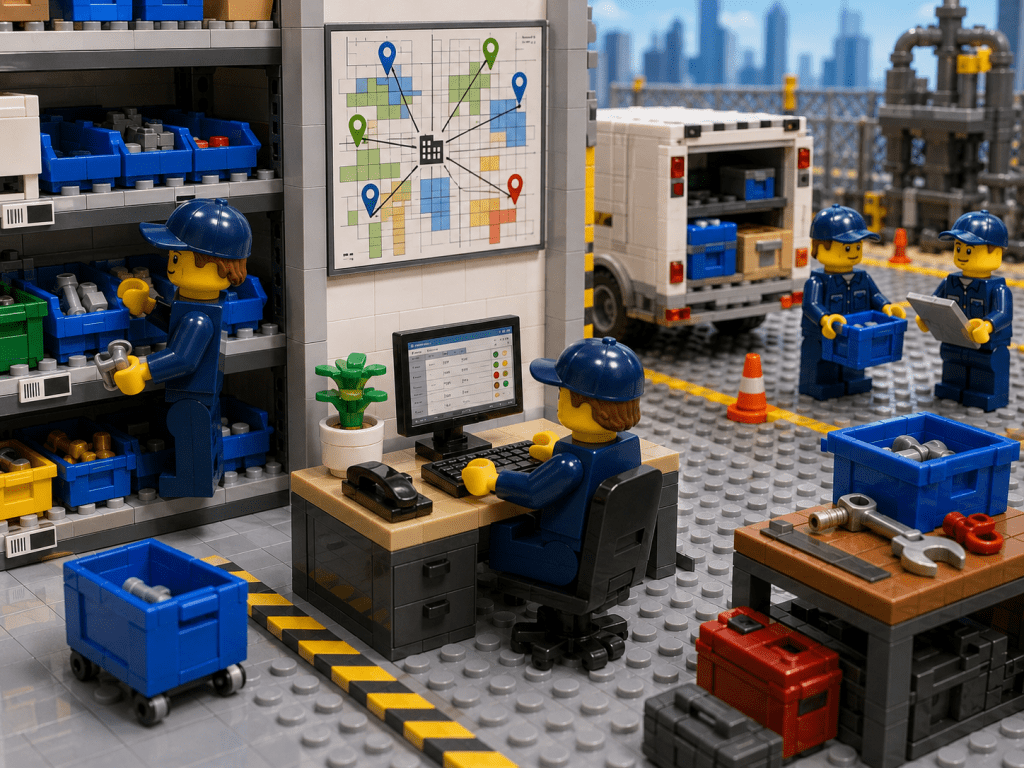
Complex industrial job sites rarely lose time because of one dramatic inventory failure. More often, they lose time in small, repeated ways. A pallet arrives but is left in the wrong zone. A critical fitting is booked into the warehouse but never assigned to the right subcontractor staging area. A crew lead knows the stock exists, but not whether it is in the fabrication shop, the laydown yard, a container on site, or already checked out to another team. When mechanical, electrical, controls, steel, civil, finishing, and commissioning teams all touch the same footprint, inventory stops being a back-office task and becomes a site-production discipline. That matters because materials and equipment account for a very large share of project cost, and the absence of the right material at the right moment has long been recognised as one of the most common causes of delay.
The pressure to tighten control is even sharper today because construction productivity has moved slowly for decades while costs and labour constraints have intensified. At the same time, poor data quality still creates delays, rework, change orders, and wasted effort across projects. In other words, a weak inventory process no longer causes only local inconvenience. It undermines schedule reliability, cost control, and confidence between trades. A strong subcontractor inventory management job site approach has to do more than tell you how much stock exists. It has to tell you where it is, who owns it, what status it is in, what moved today, what is short, what is on hold, and what can be transferred fast enough to protect tomorrow’s work.
That challenge does not sit only on the job site. On many complex projects, the site is fed by a central warehouse, a prefabrication shop, a fabrication yard, a maintenance stockroom, a quality hold area, and sometimes a manufacturing operation supplying raw materials, work in progress, and finished assemblies. The same parts visibility problem appears across all of them. If receiving, warehousing, fabrication, quality, dispatch, site logistics, and subcontractor supervisors cannot work from one shared picture, every team builds its own partial version of the truth. For that reason, the best practices in this article focus not only on field inventory, but also on improving parts visibility across multiple departments in a manufacturing environment that supports complex site delivery.
A practical goal is simple to state and hard to achieve: every part, tool, assembly, and spare should have a known location, a clear owner, a usable status, and a recent transaction history. Once that becomes normal, search time drops, hand-offs become cleaner, shortages are spotted earlier, and site teams spend more time installing and less time looking. That is what a mature subcontractor inventory management job site process is really trying to deliver.
Why Visibility Breaks Down on Complex Sites
The first reason visibility fails is fragmentation. Each subcontractor often has valid reasons for tracking stock in its own way. Electrical may organise by cable type and termination package. Mechanical may organise by spool, support, valve family, or skid. Controls may organise by panel, enclosure, or commissioning sequence. Site logistics may care about yard slot, container number, or delivery window. Procurement may care about purchase order status. Finance may care about cost code. None of those views is wrong, but if they are not linked in one coherent structure, the project loses a reliable picture of what is actually available and where it sits. Modern traceability guidance for manufacturing makes the same point from another angle: as supply chains become more complex, organisations need a structured way to organise, link, and search inventory and traceability data across stakeholders.
The second reason is bad data discipline. A part may be received under one description, stored under another, transferred with no location update, and requested later using a third name. The record then exists, but it is not practically usable. This is one of the quietest and most expensive failures in operations. Poor or unusable project data has been associated with enormous industry cost, while formal data strategies are linked to fewer delays, fewer budget overruns, less rework, fewer change orders, and fewer safety incidents. Inventory visibility suffers for exactly the same reasons: inaccurate, incomplete, inaccessible, inconsistent, or untimely data produces slow decisions and repeated labour waste.
The third reason is location ambiguity. Many sites still rely on broad references such as “north yard”, “container by the crane”, “warehouse mezzanine”, or “with the piping crew”. Those descriptions may work for the person who said them and fail for everyone else. Good inventory control needs far more precision. Workplace-organisation methods built around visual cues, labelled storage locations, set locations for tools and materials, and task-specific kits are designed to reduce exactly this kind of waste. When everything has an obvious place, fewer minutes are lost in searching, fewer duplicate picks occur, and fewer materials become invisible simply because they are not formally placed.
The fourth reason is that receiving often acts as a blind spot rather than a control point. If material arrives and is temporarily parked “until someone has time to sort it”, the project has already created unlocated stock. If an item fails inspection and is left physically mixed with usable material, the project has created status confusion. If incoming material is not tied to a location immediately, crews start to believe the record cannot be trusted, and then they respond by building their own side lists, notebook counts, or personal caches. From there, inventory accuracy falls quickly. A centralised system that tracks quantities on hand, material locations, and alignment with the project timeline only works if the first hand-off is disciplined.
The fifth reason is that the warehouse, the manufacturing side, and the field side usually speak different operating languages. Manufacturing inventory management has to track and control stock through raw materials, work in progress, and finished goods, while balancing cost, availability, and flow across the wider business. Construction inventory management adds stakeholder complexity, sequencing pressure, and the reality that materials have to show up in the right order as work advances. If those two worlds are not aligned, the result is familiar: the plant shows stock on hand, the project shows shortage, and site crews are stuck in the middle waiting for someone to reconcile the difference.
The sixth reason is that uncertainty changes the correct answer from week to week. A long-lead item may justify early warehousing on one package and become excess inventory on another after design change, scope movement, or schedule slippage. Supply chain leaders are being pushed to combine efficiency with resilience, strengthen supplier management, and improve visibility so they can make faster decisions in uncertainty. For contractors, that means inventory cannot be managed as a static record. It has to be managed as a live operating system that can absorb disruption without losing control of ownership, status, and location.
Finally, poor visibility turns into a safety and housekeeping problem as well as a planning problem. Storage areas have to be stacked securely, load limits have to be respected, aisles and passageways have to remain clear, incompatible materials have to be segregated, and scaffolds or runways should not be overloaded with stock beyond immediate operations. Manual handling risks also rise as teams spend more time shifting, searching, and re-handling material that should have been correctly stored the first time. Better visibility is therefore not just about stock accuracy. It supports a cleaner, safer, more disciplined site.
Best Practices for Parts Visibility Across Departments and Job Sites

The most effective way to improve visibility is to stop treating inventory as a collection of part counts and start treating it as a map of operational intent. In practice, that means every inventory decision should answer four questions clearly: what is it, where is it, what status is it in, and who is responsible for it now. If your process cannot answer those questions quickly, the apparent quantity on hand is less useful than it seems. High-performing operations tend to work from shared data, shared definitions, and shared visibility rather than isolated spreadsheets and local knowledge.
Create one location language for the entire operation.
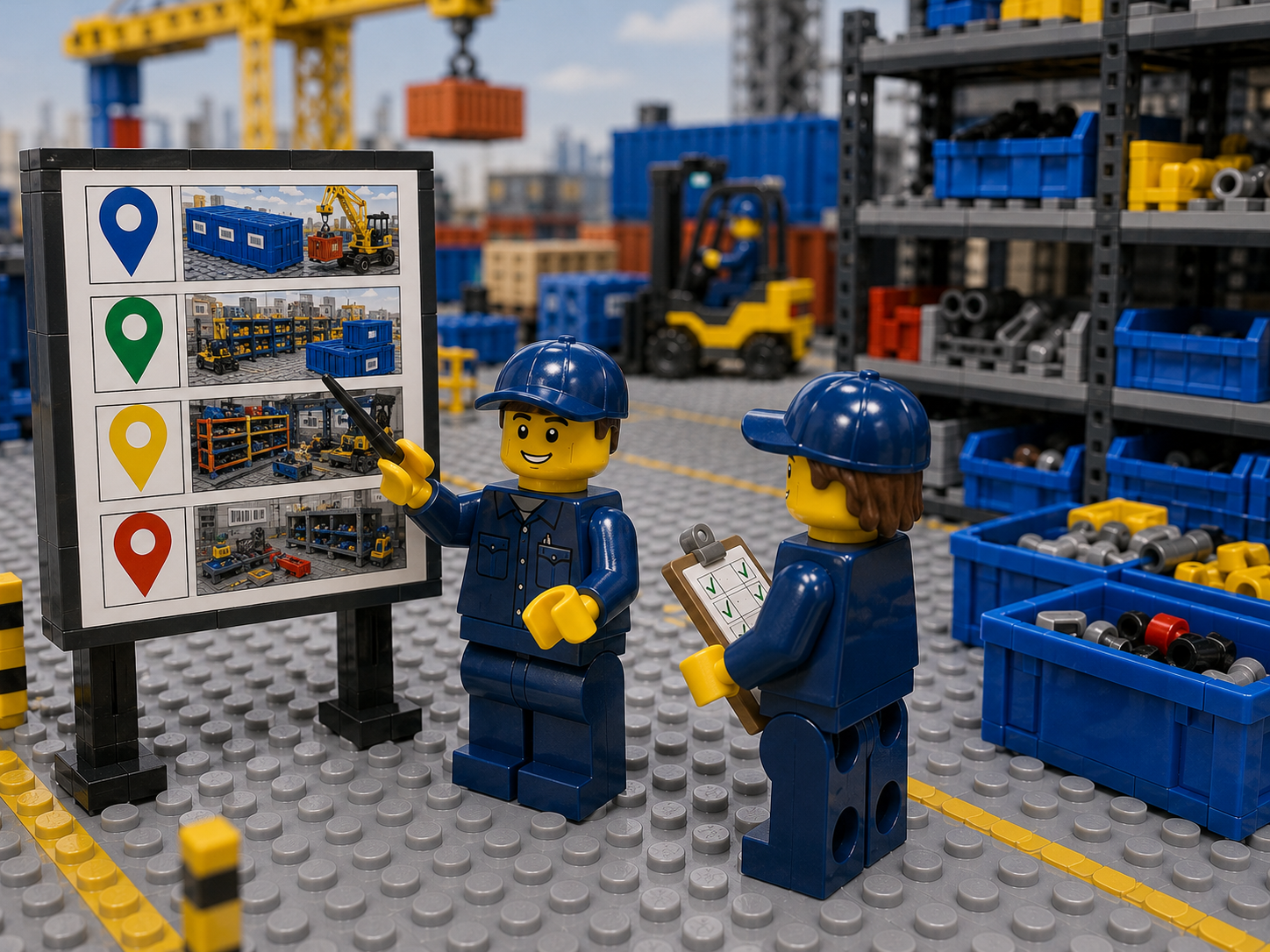
Start by defining a single location hierarchy that covers the warehouse, the laydown yard, fabrication or production areas, trade storage, quarantine, returns, quality hold, site containers, and mobile inventory points such as trucks, trailers, or crew allocations. The exact hierarchy will vary, but it often works best as site or project, then area, then zone, then storage type, then exact slot, rack, shelf, or bin.
The important point is consistency. A location should be specific enough that a new supervisor or relief storekeeper can find it without tribal knowledge. This same logic should extend across departments so the job site, warehouse, and manufacturing areas all use the same naming structure. Modern map-based systems support this by allowing operations to define locations and sub-locations down to detailed storage points, process stages, teams, and vehicles.
Separate ownership from visibility
One of the biggest sources of confusion on contractor-heavy sites is the assumption that location and ownership are the same thing. They are not. A valve may be physically stored in a shared yard while still belonging to a mechanical subcontractor. A commissioning spare may sit in the same room as active install stock but require different issue authority.
A central warehouse may hold project stock, common consumables, and trade-specific material at the same time. The solution is to define ownership, custodian, and location as separate fields in the operating model. Everyone should be able to see the stock. Only the relevant people should be able to issue, transfer, or dispose of it. That improves collaboration without blurring accountability. Shared visibility works best when paired with clearly defined responsibilities across the supply chain and with explicit user roles and permissions in the system supporting the work.
Standardise the item record before you chase advanced reporting
Many inventory teams try to fix visibility with dashboards before they fix the item master. That is backwards. Start with essential fields that site, warehouse, and departmental users genuinely need: part number, plain-language description, unit of measure, project or department assignment, storage status, approved substitute if relevant, and any handling notes that affect storage or use.
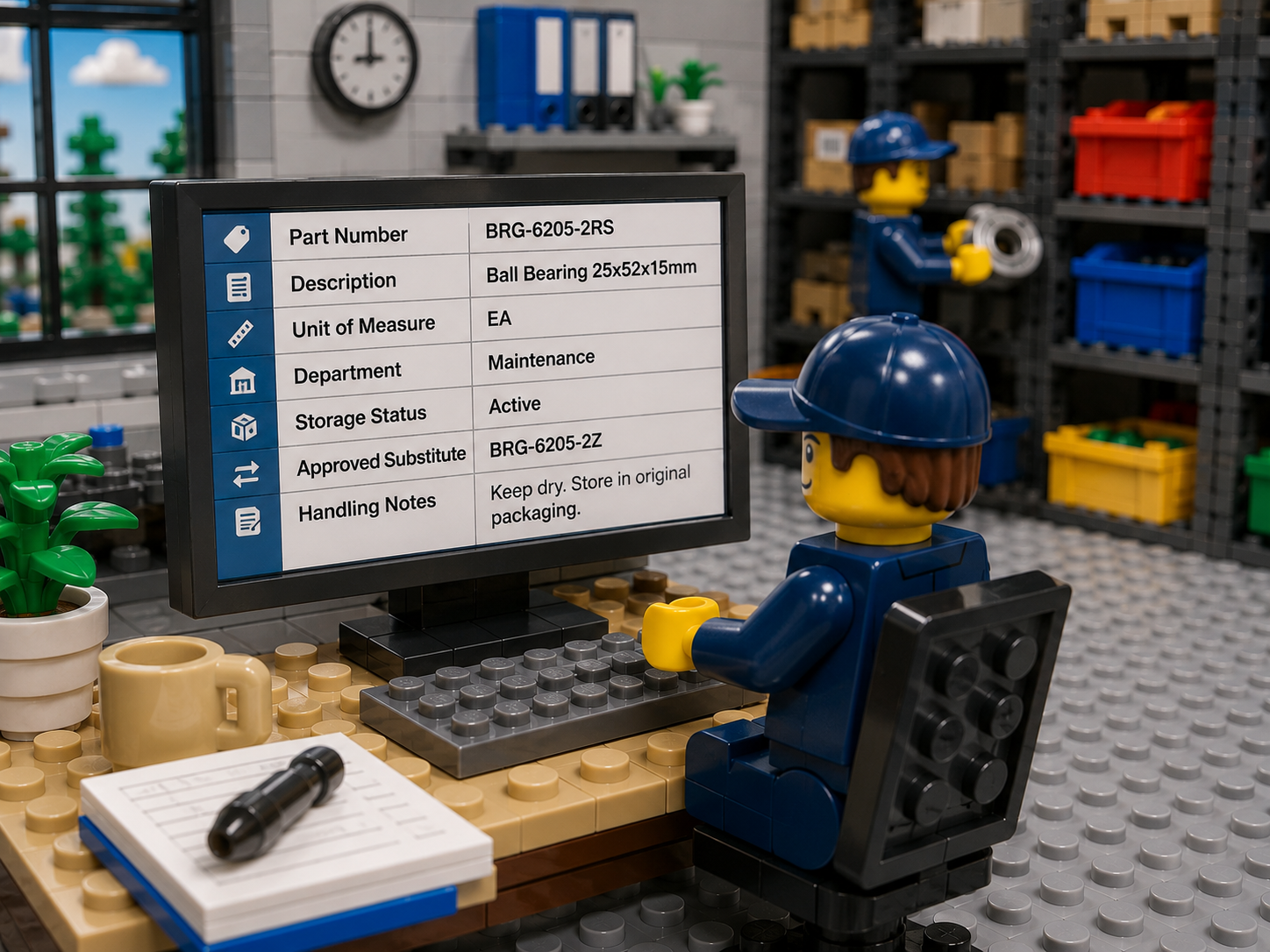
For manufacturing-linked environments, it also helps to distinguish whether an item is raw material, work in progress, finished good, spare, tool, consumable, or returnable. The point is not to make the record longer. The point is to make it dependable enough that a record can be searched, transferred, counted, and understood the same way by receiving, warehousing, fabrication, and field installation teams. Structured, searchable traceability data is what turns inventory from a list into a control system.
Turn receiving into the strongest control point on the site
No delivered item should remain in limbo. When material arrives, the process should require confirm, inspect, classify, locate. Confirm the item and quantity against what was expected. Inspect for condition and suitability. Classify its immediate status, such as usable, hold, damaged, incomplete, or awaiting review. Then assign it a precise location before the receiving transaction is considered complete.
If material cannot yet be released, send it to a designated quarantine or hold location rather than leaving it mixed with good stock. Once teams accept “temporary” unlocated stock, inventory accuracy starts drifting on day one. A disciplined receiving process also helps keep the site cleaner because materials move into planned storage lanes instead of accumulating in random staging pockets.
Design storage around workflow, not around convenience
On complex sites, storage layouts should mirror how work moves. That usually means distinct areas for receiving, inspection or quarantine, reserve stock, ready-to-issue stock, kitted material, returns, damaged stock, trade-specific staging, and closeout or commissioning spares.
In manufacturing-connected environments, it also means reflecting production or fabrication stages so teams can see where inventory sits as it moves through work centres, quality control, and dispatch. The stronger the visual separation between these states, the less likely teams are to pull the wrong material or overlook usable stock. Workplace-organisation methods based on “a place for everything and everything in its place” support this directly by using labelled locations, visual controls, and kits to reduce motion, wasted space, and ambiguity.
Use trade and phase-based storage deliberately, not casually
It is tempting to create shared “overflow” areas when the site gets busy, but those usually become black holes. A better method is to create explicit locations for different trades or project phases, then keep those locations aligned with the real workface. If electrical is entering a fit-out phase while mechanical is in testing, their storage needs are different and should be mapped differently. The same goes for pre-assembled skids, quality-cleared assemblies, and hold stock awaiting revision or approval. This approach lets teams see not only where material is stored, but how that storage supports the sequence of work. It also improves accountability because at any point, the operation can tell whether an item is in common stock, trade staging, phase staging, quality hold, or already assigned to a person or crew.
Make transfer discipline easy enough that people actually follow it
Inventory accuracy usually fails not because teams reject the principle of updates, but because updates feel slow in the middle of active work. A foreman moves a box to solve an immediate problem and plans to tell the storekeeper later. Later never happens. Good subcontractor inventory management job site practice therefore depends on low-friction transactions. Every move between warehouse, yard, fabrication, truck, container, crew, and workface should be simple to record.
The easiest systems win because they reduce the temptation to bypass the process. When transfers are recorded consistently, visibility improves across departments, cycle counts accelerate because the baseline is cleaner, and shortage decisions become much faster because everyone trusts the location history.
Run cycle counts continuously, not as a rescue mission
A full physical inventory may still be needed occasionally, but it is a poor substitute for routine accuracy control. Cycle counting works because it checks smaller portions of stock regularly without shutting down operations. On a complex site, that means counting high-value, fast-moving, or high-risk items more frequently than slow-moving reserve stock. It also means treating discrepancies as process signals, not just adjustment entries. If one area or trade repeatedly shows unexplained differences, the answer is rarely “count better”. It is usually “fix receiving, issuing, transfers, returns, or labelling in that area”. Continuous cycle counts keep the data close to reality and stop small record errors from becoming site-wide confusion.
Classify inventory by purpose so strategy matches risk
Not all stock should be managed the same way. Common consumables, long-lead equipment, project-specific materials, commissioning spares, maintenance items, returnable tools, and fabrication inputs all deserve different controls. This matters because the right answer for one category is the wrong answer for another. Carrying extra common consumables may reduce disruption with little downside. Carrying too much project-specific engineered equipment can tie up cash, consume space, and create exposure if design or schedule changes. Shorter lead times for critical-path materials can be a competitive advantage, but warehousing inventory also brings carrying cost and risk. The practical response is to classify stock by criticality, lead time, and substitution risk, then set rules that fit each category rather than applying one blanket policy.
Use thresholds on the items that can actually stop work
Teams often set broad reorder rules and then act surprised when a small but critical shortage halts progress. Thresholds are most useful when applied selectively to the materials and parts that protect continuity, especially fast-moving spares, trade consumables, maintenance-critical parts, and standard items that support daily work. When thresholds are visible, low stock becomes a planned action instead of a late surprise. This is particularly important in operations that span departments because one area’s overflow may be another area’s shortage. Strong visibility lets teams spot that imbalance early and move stock before procurement becomes urgent. Sharing inventory information in real time or near real time is one of the clearest planning habits associated with stronger performance.
Hold a short, cross-functional materials review every day
On complex sites, inventory problems are rarely solved inside one function. A practical daily review should include site logistics, warehouse control, receiving, fabrication or production if applicable, quality, procurement, and the trade leads for the most active crews. The meeting does not need to be long. It needs to be specific.
- What is short today.
- What is on hold.
- What is arriving.
- What can be transferred.
- What is blocking tomorrow’s work package.
- What needs escalation.
High-quality data visibility matters because it supports faster decisions in uncertainty, but the meeting cadence matters just as much because it turns visibility into action. Without that cross-team rhythm, the operation sees the problem and still reacts too late.

Treat substitutions and change orders as inventory events, not just engineering events
A design substitution changes more than the drawing. It changes what should be ordered, what should be held, what can still be issued, and what must be isolated to avoid accidental use. The same is true for revision changes, package resequencing, or quality rejection. Whenever a project changes the item logic, the inventory system has to reflect that change quickly and visibly. Otherwise, teams end up with superseded stock mixed with current stock, engineering-approved substitutes hidden inside informal notes, and field crews using material that is technically “on hand” but operationally wrong. A structured traceability approach helps because it links item identity, movement, and status instead of assuming one part number always tells the full story.
Build returns and closeout into the workflow from the start
Many sites are disciplined when stock enters and careless when stock comes back. That is how containers fill up with mixed leftovers, commissioning spares disappear into miscellaneous shelves, and surplus cannot be distinguished from active install stock. Every return should go through a deliberate decision: return to usable stock, quarantine for inspection, allocate to closeout, assign to maintenance reserve, or dispose according to site rules. On project-driven operations, this matters financially as well as operationally because clear return handling supports cleaner cost tracking and smoother handover. It also gives estimators and planners better feedback for future jobs because they can see what was genuinely consumed versus what was merely moved.
Use accountability to clarify behaviour, not to create fear
Strong inventory control needs a visible chain of responsibility, but it should not depend on blame-driven culture. The best systems make actions traceable so teams can learn where breakdowns happen. If counts drift, ask whether the movement process was too slow, the location structure too vague, the storage plan too crowded, or the training too thin. If one team repeatedly bypasses the process, ask whether the process fits the pace of work.
Management support, worker involvement, training, and regular evaluation are all part of reducing handling risk and improving operational consistency. Inventory accuracy improves most sustainably when the process helps people succeed under pressure instead of asking them to be perfect in spite of bad workflow.
Protect safety and housekeeping as part of inventory control
Good storage and good visibility reinforce each other. Secure stacking reduces damage and loss. Clear aisles reduce search congestion. Segregated incompatible materials reduce risk. Clean, well-defined storage lanes make it easier to see what belongs where and what is out of place. Organised workspaces built on visual control are designed to reduce waste and support more consistent results, while ergonomic practices reduce the strain created by poor handling and repeated rework. If the warehouse or laydown area feels chaotic, that is not merely a tidiness issue. It is usually evidence that the inventory model is no longer matching the pace of the operation.
Taken together, these practices create something far more valuable than a clean stock ledger. They create operational trust. When receiving trusts the locations, warehouse trusts the counts, fabrication trusts the status, and subcontractor supervisors trust the availability picture, the entire project moves with less hesitation. That is the foundation of durable subcontractor inventory management job site performance, especially when the site is fed by multiple departments and a manufacturing-style flow of parts.
How CyberStockroom Supports Multi-Department Parts Visibility
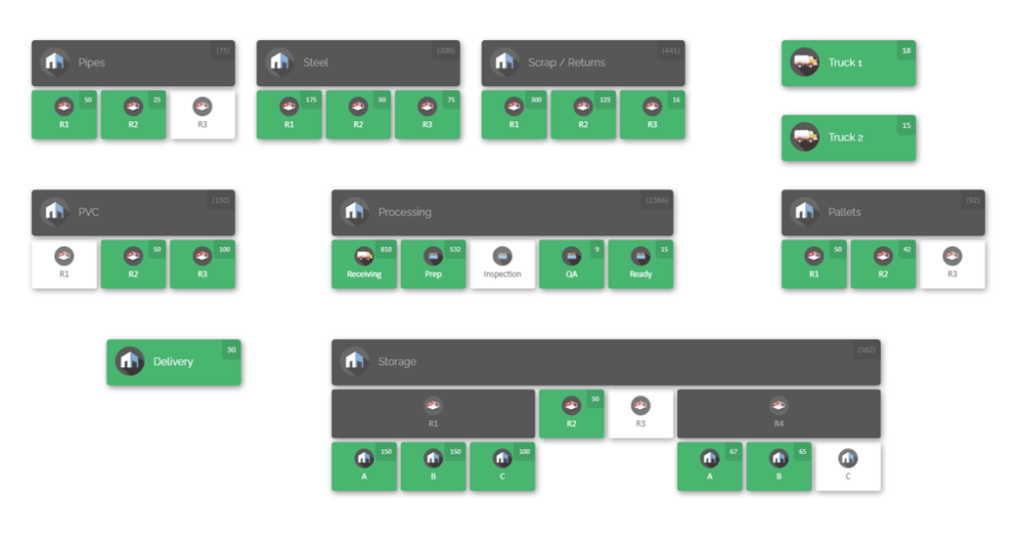
A map-based operating model becomes far more practical when the software is built around location clarity instead of forcing teams to translate everything through static lists. CyberStockroom supports that model by letting you build a live, interactive map of the operation and use that map as the primary interface for inventory control. Instead of asking people to imagine the physical layout from codes alone, it represents warehouses, rooms, shelves, bins, yards, staging areas, processes, teams, and departments visually. For a complex site, that matters because the operational problem is rarely “how many”. It is usually “where exactly, under whose control, and in what state”. CyberStockroom is designed to answer those questions directly on the map.
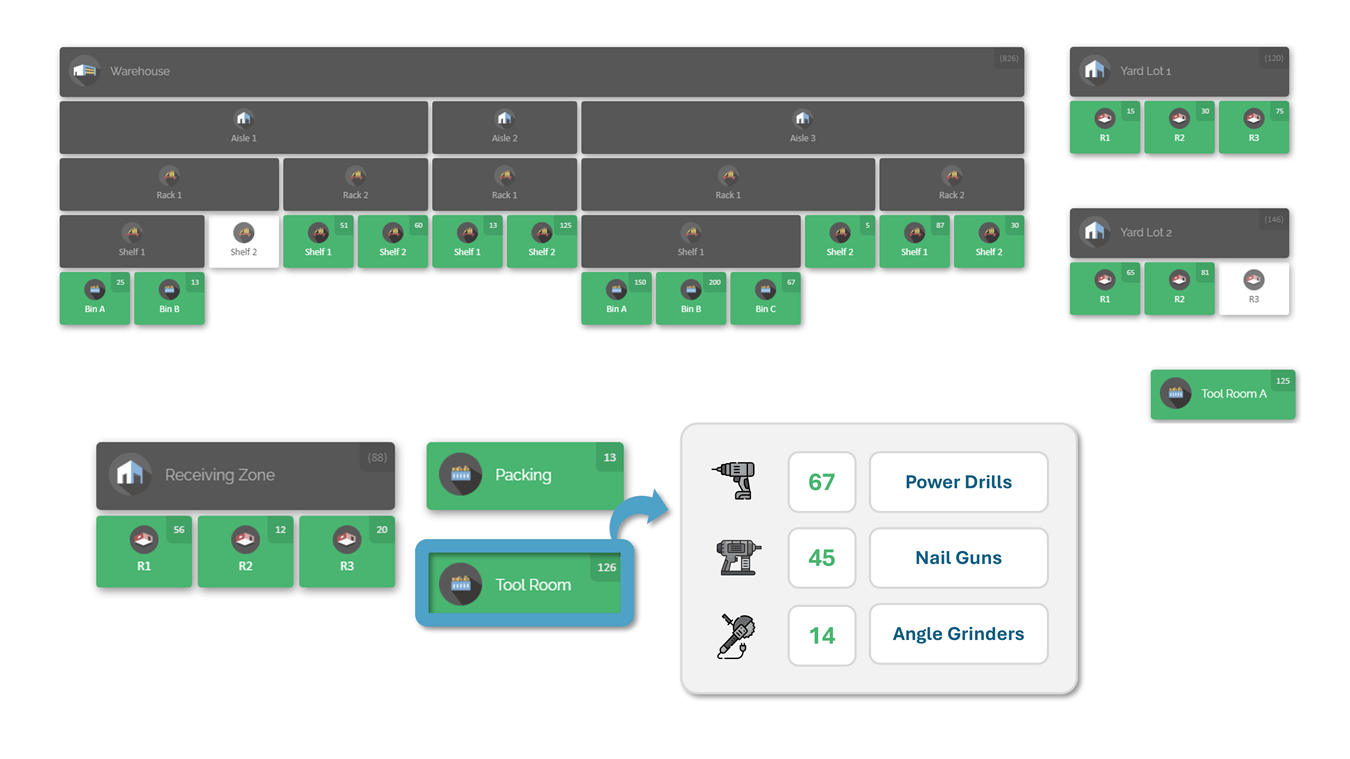
That approach is particularly useful when parts visibility must span multiple departments. CyberStockroom explicitly supports mapping manufacturing workflows and production stages, tracking inventory by project, team, or department, and monitoring raw materials, parts, and finished goods in one visual environment. In practical terms, that means the same system can reflect receiving, reserve storage, fabrication or production, quality control, dispatch, site staging, and trade allocation without forcing each function to maintain its own separate inventory universe. For operations trying to align the warehouse with the manufacturing side and the job site at the same time, that shared visual structure is one of the most valuable advantages.
CyberStockroom also supports the level of location detail that complex operations usually need. You can break the business down into locations and sub-locations, then mirror the physical structure from buildings to rooms to shelves to bins. You can also treat teams, departments, trucks, trailers, and field crews as inventory locations, which is especially useful on distributed or fast-moving sites where stock frequently shifts between fixed and mobile storage points. This is important because many “missing” items are not actually missing. They have simply been moved into a location the formal system never represented clearly enough. A detailed map closes that gap.
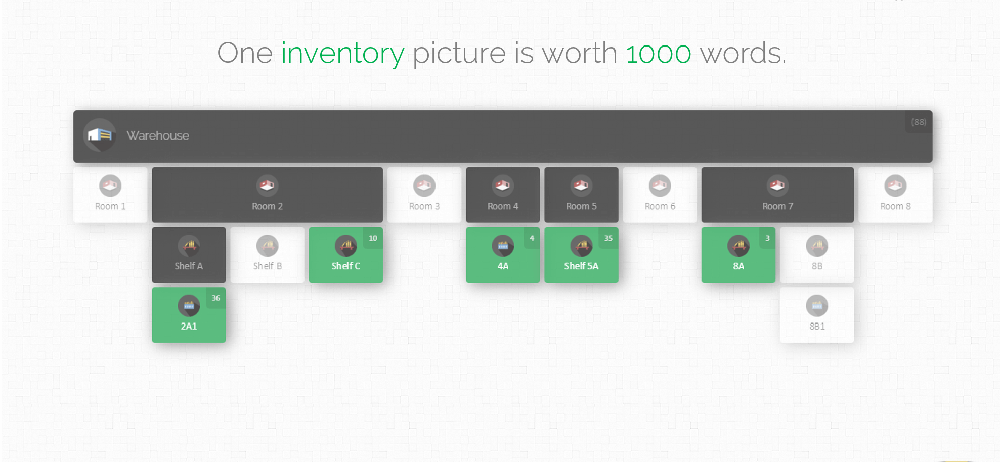
For day-to-day control, CyberStockroom’s bird’s-eye view and product-distribution view help teams understand stock position much faster than a long table of records. The platform lets users scan or select a product and see its distribution, quickly locate items, make adjustments, and assess product levels visually. That matters when multiple departments may be holding the same item family in different places. Instead of asking each area separately whether they have spare quantity, planners and supervisors can see where the stock sits across the mapped environment and make a quicker decision about transfer, issue, or replenishment.
Transfers are another area where CyberStockroom aligns well with the best practices discussed earlier. The platform supports drag-and-drop inventory movement between locations and sub-locations, which is useful because small movement transactions are often the point where real-world stock and system stock drift apart. When the update method is simple, people are more likely to record movements as they happen. CyberStockroom also supports quick cycle counts and adjustments from the same map-based workflow, which helps keep the visible picture aligned with physical reality without forcing staff into separate, slow reconciliation steps.
Accountability is also built into the way CyberStockroom handles activity. The system tracks inventory movements, stock updates, location changes, and user interactions through activity history, giving teams a detailed log of who moved what, when, and where. It also supports access permissions so organisations can share the map widely while still controlling what specific users or collaborators are allowed to do. On complex sites, that combination matters. It gives project teams the transparency needed for coordination without sacrificing ownership control. It also strengthens loss prevention because the operation is no longer relying on memory to reconstruct the history of an item that has gone missing or turned up in the wrong place.

Another advantage is that CyberStockroom’s layout options match the realities of mixed warehouse and site operations. It is designed not only for classic aisle-and-rack warehouse layouts, but also for laydown yards, staging areas, job sites, storage rooms, department maps, and process-flow views. That flexibility matters because industrial contractors and manufacturing-linked businesses rarely operate in clean, single-purpose buildings. They operate across mixed footprints where stock may sit in racks one day, in a yard zone the next, and in a trade-specific staging lane the day after. A tool that can represent that diversity visually makes cross-team coordination much easier than a system built only around fixed warehouse assumptions.
In the context of multi-department parts visibility, the practical value is straightforward. CyberStockroom enables teams to create one shared map of the operation, place every item in a meaningful location, assign accountability by team or department, move stock with less friction, monitor activity history, and see product distribution across the business at a glance. That is exactly the combination required when the goal is to improve parts visibility across receiving, warehousing, fabrication, production, quality, and field installation without losing sight of what is happening on the active job site.

Implementation Roadmap
The right way to implement stronger inventory control is to begin with process design, not software enthusiasm. Start by mapping the physical reality exactly as people work it today. Walk the warehouse. Walk the yard. Walk the receiving path. Walk the fabrication or production flow. Walk the route from reserve stock to the active workface. Identify where material changes hands, where it waits, where it gets mixed, and where people rely on memory rather than visible location control. Then define the future-state location structure and transaction rules around those real hand-offs. Workplace-organisation methods emphasise visual order, labelled locations, and sustained routines for a reason: they make improvement visible and repeatable. CyberStockroom’s own guidance also points back to the same starting point, which is to map the full operation and include all relevant locations and workflows.
Once the physical map is understood, pilot the process on a limited but meaningful scope. The best pilots are not the easiest items. They are the items and zones that expose the real failure points. For example, you might choose one long-lead material family, one set of fast-moving subcontractor consumables, or one critical path workflow linking receiving, fabrication, and site issue. This gives the project a clean place to test location naming, ownership rules, trade-specific staging, issue and return behaviour, and count frequency. It also produces baseline measures quickly, which is important because good planning begins with understanding current performance rather than guessing.
At that stage, define a short set of operational rules that everyone can remember. Useful examples include: every item must have a location before receiving is complete; every move must be recorded before the end of the shift; every hold item must sit in a hold location, not in usable stock; every return must receive a status decision; every critical item class must have a review threshold; every count variance must trigger root-cause review for a period long enough to see the pattern. The wording can vary, but the principle should be firm. Simplicity is what makes the process stick under pressure. Strong systems do not depend on long manuals in the middle of a busy shift. They depend on clear rules, short workflows, and visible feedback.
Then establish the measures that will tell you whether control is improving. Inventory record accuracy is essential, but it is not enough on its own. Also track search time for common items, transfer turnaround between departments, frequency of stockouts on critical items, aged unallocated stock, stock sitting in temporary or miscellaneous locations, return processing time, and the percentage of material issues that are fully traceable to a location and custodian. Planning research consistently points to the importance of baselines and balanced measurement, while operational guidance on visibility emphasises that accurate location data supports better decisions, lower carrying costs, and fewer delays. If you do not measure the behaviours that cause accuracy, you will end up measuring only the symptoms.
Training needs to be practical and role-based. Receivers need to know how to confirm, inspect, classify, and locate. Warehouse and stockroom staff need to know how to transfer, count, and investigate discrepancies. Trade supervisors need to know how to request, accept, return, and protect assigned stock. Management needs to know how to review exceptions and reinforce the policy consistently. Improvement programmes in handling-intensive environments work better when management support is visible, workers are involved in assessments and solutions, training is explicit, early reporting is encouraged, and progress is reviewed rather than assumed. That applies to inventory discipline just as much as it applies to ergonomic risk.
As the process matures, scale by expanding the map and the governance rhythm at the same time. Add more departments, more trades, more site zones, more mobile locations, and more stock classes only when the core behaviours are holding. Revisit the just-in-time versus just-in-case balance regularly, especially for long-lead and critical-path items, because carrying inventory can protect schedule in some cases and create unnecessary risk in others. Use daily or near-daily visibility to support those decisions, not monthly hindsight. The long-term goal is not merely to own a better inventory tool. It is to run a calmer, faster, more aligned operation where subcontractors, warehouse teams, and manufacturing departments all work from one dependable picture.
Conclusion
Managing multiple subcontractors and their inventory on complex job sites is not primarily a counting challenge. It is a visibility challenge. The projects that perform best are the ones that make location, ownership, status, and movement obvious across the whole operating footprint, from receiving and reserve storage to manufacturing or fabrication, from the laydown yard to the workface, and from shared site stock to trade-controlled material. When that picture is clear, parts visibility improves across departments, operational efficiency rises, inventory accuracy becomes sustainable, and cross-team alignment stops depending on follow-up calls and guesswork.
The practical path is clear. Build one location language. Separate ownership from visibility. Treat receiving as a control point. Organise storage around workflow. Record every movement. Count continuously. Use thresholds selectively. Review shortages and exceptions daily. Protect housekeeping and handling discipline as part of inventory control, not after it. Those are the habits that turn subcontractor inventory management job site performance from a reactive firefight into a predictable operating capability.
For teams that need a workable way to put those habits into practice across warehouses, laydown yards, departments, and active sites, CyberStockroom offers a practical model: a live visual map of the operation, precise location tracking, clear product distribution, faster transfers, activity history, user permissions, and stock organisation that matches the way industrial work actually moves. When every subcontractor, warehouse team, and department can see the same map and work from the same inventory picture, the result is not only better control of stock. It is better control of the job itself.









Leave a Reply