
Imagine a busy construction site where crews are ready to work, but a critical tool or batch of materials is nowhere to be found. The team scrambles to locate it, only to discover it was never ordered, or perhaps it was misplaced on another site. These scenarios are all too common when inventory records don’t match reality. In the construction industry, inventory accuracy – ensuring that what your records show matches what’s actually on hand – can make the difference between a smooth project and costly delays. Every missing drill, mislabeled steel beam, or unaccounted box of fittings can throw a wrench in your schedule and budget.
Maintaining high inventory accuracy on construction projects is notoriously challenging. Materials and equipment are constantly moving between the main warehouse, job site trailers, laydown yards, and various crews. Traditional methods like pen-and-paper logs or spreadsheets often fall behind the pace of real-world activity. Mistakes creep in: a shipment gets recorded twice, or not at all; a tool is lent to another crew and not checked out properly. Over time, these small errors snowball into big problems – unexpected stockouts, surplus materials piling up, and hours of productivity lost hunting for things that should have been there.
The good news is that a simple technology we’ve all seen at the grocery store can bring order to this chaos: barcodes. By tagging materials and assets with barcode labels and scanning them whenever they move, construction companies can dramatically improve their inventory accuracy. Barcode systems provide a real-time, accurate picture of all your tools and supplies across locations. This technology guide will explore how barcoding works in a construction context, the benefits it offers (from reducing errors to deterring theft), and practical steps to implement a barcode inventory system on your job sites.
Why Inventory Accuracy Matters in Construction

In construction, materials and equipment are money. If your inventory records are off, you can face a cascade of issues:
- Project Delays: When the system says an item is available but it’s actually missing, crews may be left waiting idle. For instance, an inaccurate count of concrete form ties could halt a pour while someone rushes to procure more. Such delays can push back project timelines and incur penalty costs.
- Cost Overruns: Inaccurate inventory often leads to over-ordering or under-ordering materials. Ordering too little (due to thinking you have more than you do) results in last-minute purchases, overnight shipping fees, or work stoppages. Ordering too much “just in case” ties up capital and can lead to waste, especially if materials spoil or become obsolete. Both scenarios hurt the project’s bottom line.
- Wasted Labor: Time spent searching for misplaced items or double-checking stock could be spent on productive work. When carpenters or electricians have to turn into detectives, flipping through tool cribs and storage containers to find a specific part, that’s lost labor hours. Over a large project, these hours add up significantly.
- Reduced Trust and Morale: If your team frequently encounters missing tools or materials that were supposed to be on-site, frustration grows. Site managers lose trust in the inventory data, meaning they might start overstocking “just to be safe.” Workers become demoralized if they’re blamed for losses that are really system errors. High accuracy builds confidence – everyone knows the inventory list can be relied on.
- Theft and Losses: Construction sites are unfortunately prone to theft. Equipment and materials worth billions of dollars are stolen from sites globally each year. Inaccurate inventory makes it easier for theft to go unnoticed – you might not realize something is gone until weeks later during an audit. And it’s not just outsiders; insider theft accounts for roughly a quarter of these losses. When inventory is tracked diligently (every item scanned in and out), it creates a digital paper trail that discourages “casual” theft and quickly flags missing items.
In short, poor inventory accuracy is more than just an administrative headache – it directly impacts productivity, costs, and even safety (imagine running out of critical safety gear because of a counting error!). Construction projects operate on tight schedules and margins, so there’s little room for error in managing resources. This is why leading construction firms are investing in technologies and processes to achieve high inventory accuracy, often aiming for 95%+ alignment between reported stock and actual stock. Achieving that kind of precision might sound ambitious, but that’s where barcodes come in.
Barcodes: A Simple Solution to a Big Challenge
Barcodes are the black-and-white striped labels (or nowadays, sometimes square QR codes) that you see on practically every product in a store. In an inventory context, a barcode is simply a visual encoding of information – typically a unique ID number for an item or batch of items. When you scan a barcode with a reader or a smartphone camera, that ID is captured instantly and can be used to look up the item in a database.

Implementing barcodes for inventory in construction is straightforward and cost-effective. Here’s how it works:
- You assign each item or SKU (stock-keeping unit) a unique code. For example, you might have a code for “3/4-inch galvanized pipe, 6 ft length” and another code for “Cordless Drill Model XYZ.”
- You print barcode labels (or use pre-printed ones) and stick them on the physical items, their packaging, or storage bins. Durable barcode labels are available that can withstand outdoor conditions, dirt, and rough handling – crucial for a construction environment.
- Whenever an item is received, moved, or used, the barcode is scanned and the system updates accordingly. If 50 pipes arrive at the site, scanning their barcodes (either each pipe or just the pallet if a single code represents the batch) will immediately add that quantity to your inventory records. If a drill is checked out to a crew leader, scanning it and that person’s ID can assign responsibility in the system.
- The barcode scanner can be a dedicated rugged device (common on many job sites and warehouses) or simply a smartphone/tablet with an app. Modern inventory software often lets you use the camera on a mobile device to scan items, meaning you don’t necessarily need expensive hardware to get started.
By automating data capture in this way, barcodes eliminate a huge portion of human error. There’s no more scribbling numbers on paper (which someone might misread later) or typing entries into a spreadsheet (where a slip of the finger can cause a big discrepancy). Each scan is a precise transaction: item X moved from Location A to Location B at this time, handled by User Y.
Barcodes have been a game-changer in retail and manufacturing for decades, boosting inventory accuracy from middling percentages into the high 90s. The construction industry has unique challenges, but it stands to gain just as much – if not more – from this technology. Unlike some high-tech solutions, barcodes are relatively inexpensive and easy to adopt. A pack of labels and a smartphone app can get you started. Yet the impact is significant: studies in other sectors have shown that switching from manual tracking to automated identification (like barcodes or RFID) can raise inventory accuracy from around 60-70% up to 95% or more. Think about that – going from three errors in every ten items to maybe one error in a hundred. That level of improvement can virtually eliminate those nasty surprises when you discover something critical is missing.
Beyond accuracy, barcode systems also give you speed and visibility. Scanning is much faster than writing or typing, so every inventory transaction (receiving deliveries, issuing materials to crews, transferring equipment between sites) takes less time. All the data goes into a centralized system, often cloud-based, which means a project manager at HQ and a foreman on site are looking at the same updated numbers. If someone scans out the last box of electrical fittings from the central store, anyone checking the inventory system will see that it’s gone and can reorder or reallocate from elsewhere immediately.
Benefits of Barcoding Your Construction Inventory

Adopting barcodes as part of your inventory management brings a wide range of benefits to construction operations. Here are some of the key advantages:
- Improved Accuracy & Fewer Errors: Manual data entry mistakes are one of the biggest causes of inventory discrepancies. Barcoding virtually eliminates those errors. Each item has a unique identifier, and scanning it ensures the right item and quantity are recorded. You no longer get transposed numbers or illegible handwriting causing chaos. The result is inventory records you can trust, day in and day out.
- Real-Time Visibility: With barcodes, your inventory system updates in real time as things are scanned. You gain up-to-the-minute visibility into stock levels and locations. For example, if a delivery of lumber arrives and is scanned into the system, everyone from the purchasing department to the site supervisor can see those new pieces are available immediately. Real-time data means no lag between the field and your records, allowing for quick decision-making.
- Faster Counts and Audits: Remember the dread of doing a full inventory count with clipboards? Barcodes speed this up dramatically. Cycle counting (regular small counts of portions of inventory) becomes far more feasible when staff can wander the yard with a scanner and finish a count in minutes. Even a full audit of all inventory is faster and more accurate – just scan everything and let the system compare against expected counts. This means you can verify inventory more often with less effort, nipping discrepancies in the bud.
- Time Savings & Efficiency: Every scan is a time saver compared to writing things down. When issuing materials to a subcontractor, a quick beep of the scanner logs it, versus filling out a form. Over a week, these minutes saved on each transaction add up to hours that your team can spend on actual construction work instead of paperwork. Plus, automated data capture means your inventory clerk (if you have one) isn’t tied up entering data for half the day. This efficiency helps keep projects on schedule.
- Accountability & Loss Prevention: A barcode system can be set up to track who handled an item, not just what and where. For instance, a tool crib manager might scan their ID badge and then the tools being checked out to a crew member. This creates a clear record of custody. When everyone knows that every movement is being logged, there’s less temptation for tools to “walk away.” And if something does go missing, you can quickly trace who last had it or where it was last stored. In essence, barcoding introduces accountability at the individual item level, which greatly deters theft and unauthorized use.
- Optimized Stock Levels: Accurate, timely data lets you fine-tune your inventory levels. Barcodes help ensure that counts are correct, which in turn helps your purchasing team avoid knee-jerk orders. You can set up alerts or automatic reorders when scanned counts drop below a threshold. Instead of guessing and overstocking, you’ll know exactly when to order more concrete mix or rebar because the numbers are reliable. This just-in-time approach reduces waste and storage costs. It also avoids the opposite problem: running out of something because you thought you had more. Essentially, barcodes lead to smarter inventory control – you carry just what you need, when you need it.
- Better Project Management & Scheduling: When materials and equipment are in the right place at the right time, work can proceed without interruptions. By improving inventory accuracy and visibility, barcodes help ensure that crews aren’t waiting around or doing rework due to missing parts. Project managers can plan with confidence, knowing the inventory data in their Gantt chart or materials list is accurate. The net effect is fewer schedule slips caused by inventory issues.
- Data-Driven Insights: Once you’re scanning and centralizing all this data, you unlock a treasure trove of information. Over a few months, you might discover trends: e.g., “We go through 500 units of lumber on a typical mid-rise project per month” or “Our electricians tend to request new drill bits every two weeks.” With accurate data, you can analyze usage rates, identify bottlenecks, and even negotiate with suppliers better (because you have hard numbers on how fast you consume materials). You can generate reports at the click of a button, rather than cobbling together notes from multiple log books. All this helps in making informed decisions, budgeting for future projects, and continuously improving your operations.
By now, it’s clear that barcoding your inventory isn’t just about having fancy scanners – it’s about transforming the way you manage resources on site. Accuracy, speed, savings, and control all improve markedly. But to realize these benefits, you need to implement your barcode system thoughtfully. Let’s look at how you can set up a barcoding system in a construction setting, step by step.
Implementing a Barcode Inventory System on the Job Site

Rolling out a barcode-based inventory system may seem daunting, but with careful planning it can be done smoothly. Here are the steps to get your construction inventory barcoded and under control:
- Assess Your Needs and Processes: Begin by evaluating what inventory you have and how it’s currently tracked. Are you mainly concerned with tools and equipment? Bulk materials? Small consumables like fasteners? Identify the pain points – perhaps tools frequently go missing, or maybe you run out of certain materials often. Map out your current workflow for receiving items, storing them, issuing them to the field, and returning or discarding unused stock. This assessment will help you design a barcode system that fits your operations. For example, you might decide that every power tool and piece of heavy equipment gets an individual barcode, while bulk materials like bricks get barcoded by the pallet or crate.
- Choose the Right Software and System: A barcode is only as useful as the system behind it. You’ll need inventory management software to store and process the data from scans. Look for a solution that suits the construction industry – it should handle multiple locations (sites, warehouses), offline capabilities (for when internet is spotty on-site), and easy entry of new items. Many construction teams use cloud-based inventory software that can be accessed via phone, tablet, or computer. CyberStockroom, for instance, is one platform tailored for visual inventory tracking in construction (more on that soon). The key is to pick a system that is user-friendly for your team and integrates well with how you work. Some companies integrate their inventory scanning with their project management or accounting software, so consider those needs as well.
- Label Your Inventory: Once you have a system in place, start generating unique IDs and barcodes for your assets and materials. Decide on a labeling scheme: you may use simple numeric codes or something descriptive (like TOOL-001 for drills, MAT-001 for concrete bags, etc.). Print out high-quality barcode labels. For construction, durability is crucial – use weatherproof, scratch-resistant labels or even metal tags for equipment that sees rough use. Label everything that matters: tools, machinery, supply pallets, even storage locations like containers or shelves can have barcodes. This way, you can scan not just the item, but where it’s being placed (for example, scan the “Shelf A” code then the item code to log that the item is on Shelf A).
- Equip Your Team with Scanning Devices: Decide what scanning method fits best. If you have a large warehouse or many items to scan quickly, handheld barcode scanners or mobile computers might be worth investing in. They are fast and often built to survive drops or dirt. On the other hand, if your inventory transactions are a bit less frequent, using a smartphone or tablet with a scanning app could be perfectly sufficient – and it has the advantage of familiarity. Many inventory software options (including those aimed at construction) offer mobile apps that turn a phone camera into a scanner. Test out the devices in the actual work environment. For example, a bright sunny day or a dusty area can affect scanning, so make sure the devices and barcode sizes you chose work in real site conditions.
- Train Your Crew and Set Procedures: Technology is only as good as its users. Take the time to train everyone involved in the inventory process on how to use the new barcode system. This includes warehouse managers, site foremen, tool crib attendants, and even crew leads who might be scanning things in the field. Emphasize that the barcode system is there to make their lives easier – not to spy on them. Show how quick and simple it is to scan items compared to writing stuff down. Create clear, simple procedures: e.g., “All materials delivered to site must be scanned into the system before they get stored or used,” or “Tools must be scanned out when taken and scanned back in when returned.” When everyone follows the same process, the data in the system will remain reliable.
- Integrate with Daily Workflow: Initially, there might be a learning curve or a slight slowdown as people adapt to scanning. To ease this, integrate scanning into existing routines. For example, when receiving a delivery, the receiver already checks items against a purchase order – now they simply add the step of scanning each barcode or the pallet barcode as they check. When a crew member comes to pick up tools in the morning, scanning them out can be done as part of the sign-out form they would fill anyway. The goal is to build habits so that scanning becomes second nature on the job site. It might help to have one champion or supervisor who ensures compliance in the early days.
- Monitor, Audit, and Improve: After implementation, keep an eye on the system’s outputs. Run a few random inventory audits by scanning items on the shelf and comparing to the system count – this will quickly show if something’s off (and if perhaps someone forgot to scan a transaction). Solicit feedback from the team: are there steps that are cumbersome? Maybe you need an extra mobile scanner at the far end of the site, or perhaps some barcodes need to be larger for easy scanning. Continuous improvement will help you fine-tune the system. You should also start tracking your inventory accuracy metric now – e.g., “We were 75% accurate last quarter, now we’re at 93%. Our goal is 98% by year-end.” Celebrating improvements can motivate the team to keep diligent with the new process.
By following these steps, you’ll gradually transition from a manual or semi-manual inventory process to a highly automated one. It’s often wise to start with a pilot on a smaller project or a subset of items to iron out any issues, then roll out broadly. Remember that the cultural change (getting people used to scanning and trusting the system) is just as important as the technical setup.

Now that we’ve covered the general how-to, let’s talk about one specific solution that embodies many of these best practices and is designed with construction in mind.
CyberStockroom: A Map-Based Inventory System Made for Construction
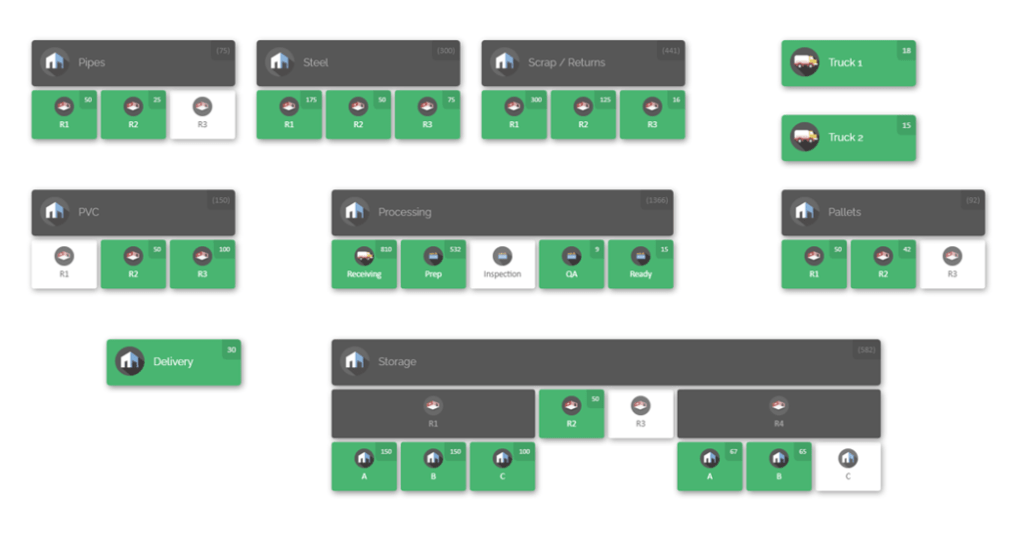
While there are many inventory software options, CyberStockroom offers a unique approach that resonates well with construction site managers and tech decision-makers. It combines the power of barcode tracking with an intuitive visual map of your inventory, giving you a bird’s-eye view of everything across all your sites.
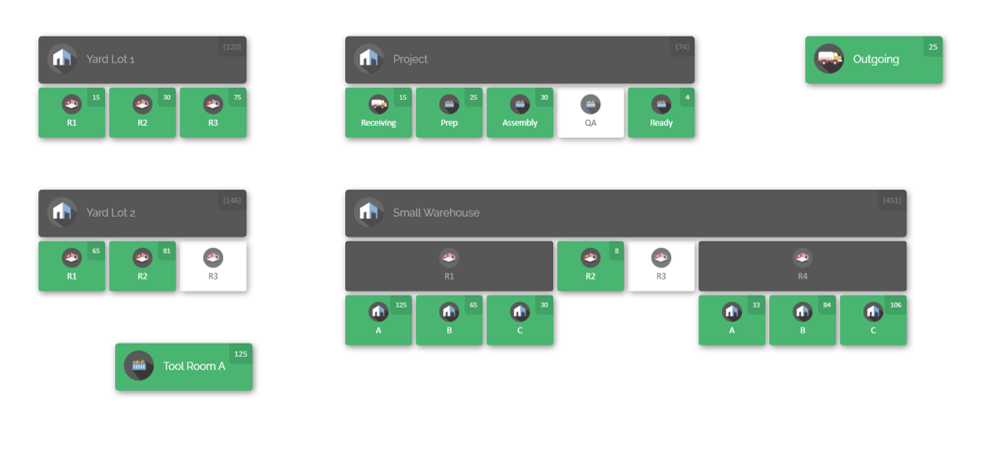
Imagine opening an app and seeing a map of your construction project – not a geographic map, but a logical layout of your storage areas, floors, zones, and even vehicles. CyberStockroom lets you build a digital twin of your operations. For example, you can create zones for “Main Storage Yard,” “Floor 1 – Electrical,” “Truck #5,” “Tool Crib,” or any other location category that matters. Each of these locations on the map displays icons or lists of items currently there, updated in real time.
Now tie that with barcoding: as items are scanned and moved, the map updates instantly. Did a pallet of tiles move from the staging area to the 3rd floor? Scan it, and on the map you’ll see the quantity of tiles decrease in staging and pop up in the 3rd floor zone. Has a generator been loaded onto Truck #5 for transport to another site? Scan the generator’s barcode and the truck’s location code – the system will now show that generator icon sitting with Truck #5’s inventory. This visual approach makes it incredibly easy to grasp the state of your inventory at a glance. No more combing through rows in a spreadsheet or text-based lists trying to figure out where something went.
Key features of CyberStockroom that help improve inventory accuracy and control include:
- Real-Time Inventory Visibility: Every item scanned is logged with time and location, reflected immediately on the inventory map. A site manager can open the dashboard and literally see where all critical assets are. This visual confirmation reduces miscommunication. For instance, if a team lead claims “we don’t have any more rebar on site,” the manager can check the map and confirm how many bundles are in the laydown yard or if they were moved elsewhere.
- Drag-and-Drop Simplicity: CyberStockroom’s interface is designed to be user-friendly. You can drag and drop items on the map to move inventory virtually, which can be paired with a quick barcode scan in the field. It’s a bit like moving pieces on a game board – except each piece represents real equipment or material. This intuitive design means even staff who aren’t tech-savvy can learn the system quickly. It’s far easier to adopt than complex ERP screens or giant spreadsheets.
- Barcode Integration: Of course, CyberStockroom supports barcode scanning fully (even QR codes). Each item entry in the system can have an associated barcode. The platform allows you to use mobile devices to scan items in and out, bridging the physical and digital. This synergy between barcodes and the map means you maintain accuracy (through scanning) and get the benefit of visualization. In practice, when your crew scans items, they don’t need to also go manually update a map or record – it’s handled automatically, removing another chance for error.
- Multi-Site Coordination: Construction companies often juggle multiple projects and warehouses at once. CyberStockroom is built for that reality. You can have maps for each site, and even a higher-level view combining them if needed. Inventory can be transferred from Site A to Site B in the system, with each scan leaving a trail. This ensures nothing “vanishes” during inter-site transfers (a common time when things get lost). You’ll know if that expensive laser level was moved to another project or is still in the main warehouse.
- Theft Prevention and Audit Trails: Every movement in CyberStockroom is recorded – who moved it, when, and where. If something goes missing, you can quickly pull up the history. For example, you might find that a generator was checked out by a subcontractor two weeks ago and never returned. With this info, you can follow up immediately. The system can also generate reports of discrepancies (e.g., if someone manually reports a count that doesn’t match the system, you can investigate why). Knowing that there’s a transparent log deters would-be thieves. It’s hard for tools to disappear without a trace when the system is always watching.
- Assigning Inventory to People or Teams: Beyond just locations, CyberStockroom allows assigning items to specific people or crews. In a construction context, this is useful for accountability. If Joe from Crew A has the concrete mixer, the system can note that. When Joe returns it and it’s scanned back into the equipment yard, the assignment is cleared. This way, responsibilities are clear, and lost items can be traced back to the last known responsible party.
- Cloud Access Anywhere: Since CyberStockroom is cloud-based, managers and stakeholders can access the inventory data from the site, the main office, or even on the road. This is great for an international or widely distributed team. An executive or project director can quickly check inventory status without making a call to the site. It also means that even if you have remote sites with patchy internet, the data from when they were online syncs up and becomes visible to all when a connection is available.
- Ease of Use for Field Teams: Perhaps one of the biggest advantages is that a visual map coupled with scanning reduces the learning curve. Field teams typically don’t have the time or inclination to fiddle with complicated software during a hectic day. But scanning a barcode and glancing at a map for confirmation is straightforward. CyberStockroom was essentially built to be field-friendly – no lengthy training seminars needed. This is crucial, because if the system is easy, the crew will actually use it, and consistent use is what drives high inventory accuracy.
By leveraging a tool like CyberStockroom, construction companies get the best of both worlds: the precision of barcode tracking and a clear visual overview of their operations. It directly addresses the chaos we described at the start: instead of uncertainty and scrambling, you get clarity and control. For example, one CyberStockroom user (a construction project manager) could open up his inventory map in the morning and immediately see that all PPE (personal protective equipment) counts are sufficient on each floor, that Crew B still has the laser level they borrowed, and that the generator moved yesterday is now at the location “Site Storage – West Yard”. All this without a single phone call or walking the site – it’s all documented and displayed.

In summary, CyberStockroom showcases how modern technology can simplify inventory management even in complex, moving environments like construction. It takes the principles we’ve discussed (accuracy, real-time data, accountability) and packages them into a tool tailor-made for the industry. If you’re considering a barcode system, it’s worth looking at solutions like this that go beyond just scanning and truly map out your inventory in an intuitive way.
Bringing It All Together
Construction inventory might have a reputation for being difficult to manage, but with the right approach and tools, it doesn’t have to remain a source of chaos. Inventory accuracy is achievable – many industries have reached near 99% accuracy with automation, and construction can do the same by adapting those technologies to its needs. Barcodes offer a proven, accessible starting point. They provide the accuracy, speed, and traceability that paper-based systems lack. When combined with a robust inventory management platform (whether it’s a map-based system like CyberStockroom or another solution suited to your operation), barcodes become even more powerful, acting as the linchpin of a well-oiled inventory control process.
For site managers and tech decision-makers, the message is clear: improving inventory accuracy isn’t just about avoiding mistakes – it’s about running better projects. When you know exactly what you have and where it is, you can schedule work with confidence, respond quickly to issues, and eliminate a lot of wasteful spending. Crews stay productive, projects stay on budget, and clients stay happy because there are fewer hiccups.
The journey from “chaos to control” starts with that first label or scan. It might be a bit of work setting up a new system and training your team, but the payoff is a more professional, efficient operation. You’ll wonder how you ever tolerated the old ways of lost tools and mystery stock discrepancies.
As the construction industry continues to modernize, embracing technologies like barcode inventory tracking is becoming not just an advantage but a standard practice. Those who implement it now will have a head start in productivity and profitability over those who stick with outdated methods. So, whether you’re overseeing a single job site or an international portfolio of projects, consider taking the leap. Swap the clipboards for scanners, the guesswork for accurate data, and the cluttered spreadsheets for an interactive inventory map. In doing so, you’ll build a foundation of inventory accuracy that supports every other aspect of your construction business – truly moving your inventory management from chaos to control.







 CyberStockroom
Leave a comment