
Inventory management in construction projects can make or break a project. If you’ve ever been on a jobsite scrambling to find a missing tool or waiting on materials that should have arrived yesterday, you know how critical good inventory control is. Construction companies often operate on tight schedules and budgets, so when inventory goes awry – whether it’s a shortage of rebar delaying a concrete pour or stacks of unused lumber piling up – the whole project can suffer. These issues aren’t just minor annoyances; they significantly impact timelines, costs, productivity, and even safety on site.
Construction project managers, site supervisors, warehouse managers, and procurement officers alike face a range of inventory challenges in construction. Materials and equipment are constantly moving between warehouses and ever-changing jobsites. Things get lost, stolen, or damaged. Plans change, making yesterday’s accurate material estimate today’s surplus. It’s a lot to keep track of.
In fact, studies have found that construction workers spend around 10 minutes every day just looking for tools or equipment that aren’t where they should be – adding up to a full work week of lost time each year per worker! Clearly, there’s plenty of room for improvement.In this blog, we’ll dive into the most common inventory management challenges that construction projects face and discuss how to solve them. From missing materials and inaccurate stock counts to theft, supply chain delays, and beyond, we’ll explore practical strategies to tackle each problem head-on. The goal is to help you achieve smoother, more efficient jobsite and warehouse management so your projects stay on schedule and on budget.
Key Inventory Management Challenges (and Solutions) in Construction
Effective inventory control in construction involves many moving parts. Below are some of the biggest challenges that construction teams face with inventory management, along with strategies and solutions to solve them.
Challenge 1: Inaccurate Inventory Tracking and Data

One of the most pervasive issues is simply knowing what you actually have on hand. In construction, it’s all too common to have a mismatch between what the records say and what’s actually in the yard or on the shelf. Maybe your spreadsheet shows 500 bricks in stock, but only 300 can be found on site. Or an item that was marked as “used” in a purchase order never got deducted from the inventory list. These discrepancies happen for a variety of reasons: human error in logging, lack of real-time updates, or using outdated manual tracking methods like paper forms and Excel lists.
Why it’s a problem: When inventory data is wrong, you risk both overstocking and stockouts. You might order materials you already have (wasting money and storage space) or not order something critical because you thought it was still in stock. Inaccurate tracking leads to delays, increased costs, and frustration. For instance, imagine ordering extra gallons of paint because records showed none left, only to find a stash hidden in a corner of the site – now you have excess that might never be used. On the flip side, if your records mistakenly showed plenty of copper wire in storage and you didn’t buy more in time, your electricians could be left twiddling their thumbs on install day, waiting for an emergency delivery.
How to solve it: The key is to maintain accurate, up-to-date inventory records through regular audits and technology. Here are some strategies:
- Conduct regular counts and reconciliations: Don’t wait for a yearly stock count to discover errors. Implement cycle counting, where you count small sections of inventory on a rotating schedule (e.g. check a different category or storage area each week). Regular audits help catch and correct discrepancies early, so your records stay reliable.
- Use real-time tracking tools: Replace pen-and-paper or spreadsheet tracking with a digital inventory management system that updates counts in real time. Barcoding or RFID tagging your materials can automate the tracking – each time an item is received, moved, or used, a quick scan updates the central database. This greatly reduces human error.
- Train your team on data entry and check-outs: Even with good software, ensure your staff follows procedures to record inventory transactions. For example, enforce a simple check-in/check-out process for tools and equipment: whenever a power drill is taken from the tool crib or returned, it must be logged (manually in the system or by scanning a code). This creates accountability and an accurate usage trail.
- Keep systems in sync: If you have separate systems for procurement and inventory (or multiple crews keeping their own logs), integrate them or move to a unified platform. All stakeholders – from the warehouse manager to the site supervisor – should be looking at the same data. A cloud-based inventory system accessible to everyone ensures that when materials are consumed or delivered, everyone sees the update.
By prioritizing accurate tracking through routine counts and modern tools, you can drastically reduce data mismatches. The payoff is huge: you’ll trust your inventory data to make decisions, and avoid those nasty surprises of missing or over-ordered materials. As a bonus, accurate inventory records also help in other areas like accounting (knowing the value of assets on hand) and safety (knowing exactly where hazardous materials are stored, for example).
Challenge 2: Unpredictable Demand and Forecasting Difficulties

Construction projects live and die by planning – and that includes planning the right amount of materials and equipment. However, demand in construction can be very unpredictable. Project scope can change mid-stream, weather can alter schedules (and material usage rates), or design modifications can render some materials unnecessary and require new ones. Forecasting inventory needs accurately is easier said than done.
The result of poor forecasting is usually either understocking (not having enough of something when you need it) or overstocking (buying too much and having leftovers). Understocking a critical item leads to work stoppages and last-minute scrambling. For example, if you underestimated how many cinder blocks a project phase requires and you run out, construction might halt while waiting for a new shipment – potentially putting the project behind schedule.
On the other hand, overstocking leads to dead stock and waste. Those excess materials sitting idle tie up capital and take up space. They might even deteriorate over time or become obsolete if specifications change. An unused stack of drywall or surplus tiles gathering dust is essentially money left on the table (or rather, on the warehouse floor). And if you eventually have to throw them out, that’s wasted money and added disposal costs.
How to solve it: Solving the forecasting challenge involves using data and being flexible. Here are a few best practices:
- Leverage historical data: Past projects are a goldmine of information. Analyze records from similar projects – how much of each material was actually used? Look for patterns. Maybe you notice that electrical fittings usage was consistently about 5% higher than initially estimated on past jobs, indicating that adding a buffer next time is wise. By grounding your estimates in real data rather than guesswork, you get closer to the mark.
- Use demand forecasting techniques: Tools like time-series analysis or software algorithms can help predict future needs by accounting for trends and seasonality. For example, if you know construction activity typically slows in winter months or during the rainy season in your region, you can forecast lower material consumption during those periods and avoid over-ordering. Conversely, ramp up orders for peak season well in advance.
- Regularly update your projections: A construction project schedule isn’t static – your inventory plan shouldn’t be either. Set intervals (weekly or at major milestone completions) to review your inventory usage versus plan. If certain materials are being used faster or slower than expected, adjust your forecasts and orders for the coming phases accordingly. Being proactive can prevent a looming shortfall or cut off excess orders before they arrive.
- Just-in-Time (JIT) ordering (with caution): Many construction firms aim for a just-in-time inventory approach – scheduling material deliveries to arrive right when needed, rather than far ahead. This can minimize on-site storage needs and reduce leftover inventory. However, JIT only works well if you have reliable suppliers and relatively predictable demand. Use it for items where timing can be accurately planned and suppliers are dependable. For critical materials with long lead times or uncertain availability, it might be safer to keep a small buffer stock.
- Collaborate between procurement and site teams: Often, procurement officers may not be fully aware of rapid changes in site requirements. Establish a clear communication channel: if a project manager or site supervisor foresees a design change or an unexpected spike in material usage, that info should quickly reach procurement so they can adjust orders. Some companies hold brief weekly cross-department meetings to align on inventory needs, which can catch changes early.
Better forecasting is a mix of art and science. You may never predict everything perfectly (surprises happen), but by using data and staying agile, you can avoid most of the pain of shortages and surpluses. This means fewer costly rush orders, less money tied up in unused inventory, and smoother project progress.
Challenge 3: Managing Inventory Across Multiple Locations

Most construction companies juggle inventory across various locations – central warehouses, storage yards, multiple active jobsites, maybe even equipment yards or laydown areas. Unlike a single store or warehouse, construction inventory is distributed and mobile. Materials might be delivered to the main warehouse then sent out to sites; tools might be checked out from a tool crib and end up in a worker’s truck or a job box on site. Keeping track of who has what and where is a monumental task when operations span several places.
Why it’s a problem: Lack of visibility across locations can lead to a lot of inefficiency. One site might be sitting on a surplus of 100 spare pipes while another site across town is in urgent need of those same pipes and unknowingly reorders them, simply because nobody realized they were available within the company. Or consider the scenario where a particular expensive tool (say a laser level or a heavy-duty drill) is purchased for Site A, but once work there is done, it could be used in Site B – if only someone knew it was free and sitting in the warehouse. Without a clear view of inventory across all projects and storage locations, companies often end up duplicating purchases, experiencing delays (“I thought the warehouse was sending those materials…”), and wasting time. Crew members might drive back to the warehouse to get an item that was actually at a closer site all along. Or worse, they simply can’t find a needed item at all because it was misplaced during a transfer between locations.
Remote and temporary job sites add to the complexity. Construction sites are not as controlled as a warehouse environment – things are more likely to be moved without notice, or even misplaced in the chaos of a busy workday. When a project wraps up at a temporary site, materials and small tools can get left behind or forgotten. Tracking inventory on the move (from warehouse to site, or site to site) is tough if you rely on manual logs or memory.
How to solve it: The solution here is to centralize visibility and standardize tracking across all locations. A few approaches can help:
- Implement a centralized inventory management system: Rather than each site or warehouse keeping its own spreadsheet, use a unified software platform (cloud-based) that all locations connect to. This way, when Site A issues 20 beams to their crew, everyone else in the company can see that those 20 beams are now at Site A. If Site B later needs beams, they can check the system and see if Site A has extra or if the main warehouse has stock, before creating a new purchase request.
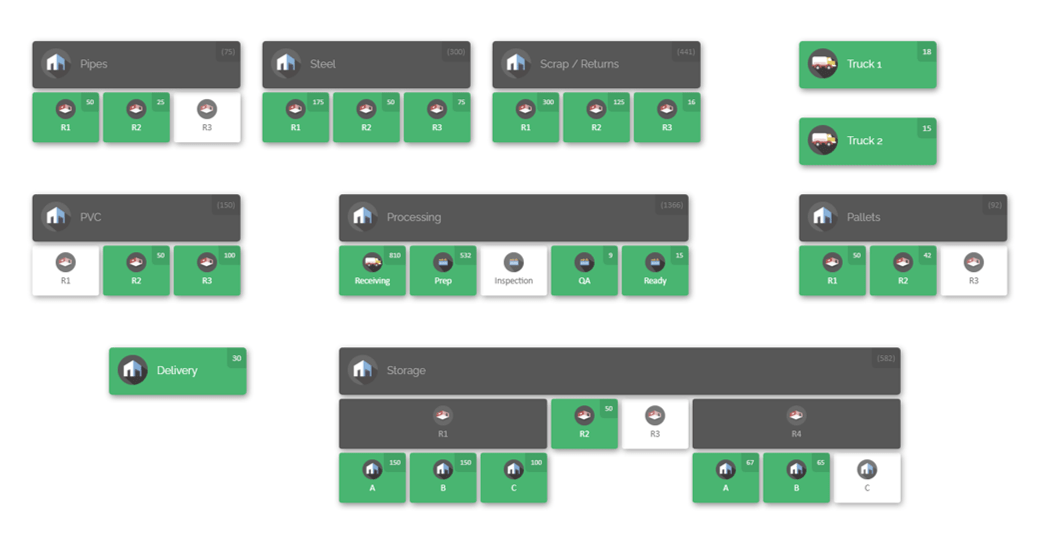
- Use location tagging in your system: Modern inventory software often allows you to assign items to specific locations (and even sub-locations). For example, CyberStockroom’s map-based system does exactly that – you can place inventory icons on the location where they physically reside (Warehouse, Jobsite 1, Jobsite 2, Truck #5, etc.). This visual approach makes it immediately clear where everything is. Even without a fancy map interface, ensure your system has fields for “current location” that are always updated when items move.
- Establish transfer and check-out procedures: When moving inventory between locations, treat it with the same rigor as if you were receiving new inventory. For instance, if a pallet of cement is sent from the warehouse to Site B, have the warehouse mark it as “dispatched to Site B” and require Site B to acknowledge receipt. This can be as simple as an email confirmation or a quick scan in the inventory app on delivery. For tools and equipment, use check-out/check-in logs by person or by crew, so if a generator was taken to Site C by Team X, it’s recorded and not forgotten.
- Appoint inventory coordinators for each site: It helps to have a point person responsible for inventory tracking in each location. They can conduct weekly spot checks, ensure updates are entered, and communicate needs or excesses to the rest of the company. This role could be part of a site supervisor’s duties or a dedicated storekeeper at larger sites.
- Leverage mobile technology: People on the ground at sites should be able to update inventory data on the fly. Mobile inventory apps or even just shared spreadsheets accessible via tablets can enable site teams to log usage or transfers in real time, rather than waiting to “do the paperwork” later (which often gets forgotten). Real-time updates ensure the central view stays accurate.
- Coordinate between warehouse and sites: Encourage a culture of communication. If a site finishes a phase and has leftover materials, the project manager should inform the warehouse or other project managers that these items are available for redeployment. Conversely, before ordering new materials, site teams should always check the central inventory or ask if any other site has surplus. A quick internal email or chat group for inventory availability can save a lot of money by reallocating resources you already own.
By improving multi-location inventory management, construction firms can drastically cut down on waste and duplication. It ensures that every item you own is utilized to the fullest across projects. Plus, it reduces downtime – the crew at one site won’t be waiting around for materials that are unknowingly sitting idle at another site. Instead, that inventory gets moved to where it’s needed, keeping projects running smoothly.
Challenge 4: Theft and Loss of Materials/Equipment

Unfortunately, theft and loss are persistent challenges in the construction industry. Construction sites can be prime targets for thieves after hours – they often contain valuable equipment, power tools, and materials that can be easily sold. Even during work hours, with so many people coming and going, tools can “walk off” if not carefully monitored. And it’s not just malicious theft; sometimes tools or materials are simply misplaced, left behind, or accidentally discarded in the flurry of activity.
The scale of this problem is bigger than many realize. In the United States alone, estimates put construction site theft at over $1 billion in losses annually (when accounting for stolen equipment, tools, and materials). Think about heavy machinery like backhoes and skid steers, which can cost tens or hundreds of thousands of dollars each – if one “disappears,” it’s a huge hit. Even smaller losses add up: a few missing drills here, a pile of copper pipes there. Aside from the direct cost of replacement, theft causes project delays (waiting for new equipment to arrive) and higher insurance premiums.
Why it’s a problem: Beyond the obvious financial loss, theft and loss create uncertainty. If you show up one morning and the site has been robbed of critical equipment or supplies, work might halt for days or weeks. Even minor pilfering can erode your inventory accuracy and trust. Workers might hoard materials “just in case” because they fear things will go missing, which in turn can cause artificial shortages elsewhere. There’s also the safety aspect: a missing piece of safety equipment or a tool might lead workers to improvise unsafely, or use a wrong tool because the right one vanished.
How to solve it: Combating theft and loss requires a combination of physical security measures and strong inventory controls:
- Improve on-site security: This is the first line of defense. Fencing the site perimeter, installing proper lighting, and using surveillance cameras can deter casual thieves. Secure storage containers (like lockable tool cribs, conex boxes, or shipping containers) should be used for valuable items overnight. Consider deploying security guards for large projects or in high-theft areas. Even signage about surveillance or marking equipment with identifiable engravings/paint can dissuade theft by making items harder to resell.
- Implement check-in/check-out systems: As mentioned earlier, have a clear process for issuing tools and equipment to workers and getting them back. If every tool is signed out to someone (or scanned out with their ID), there’s accountability – people are more likely to return what they borrowed. And if something isn’t returned, you know exactly who last had it and can follow up. Modern inventory software often includes asset tracking modules for this purpose, so you can see, for example, that John from Crew A currently has the laser level, and he’s responsible for it until checked back in.
- Frequent inventory audits (especially of high-value items): Regularly audit your inventory, focusing on the expensive and commonly stolen items. If you catch something missing early, you can investigate promptly (maybe it was just misplaced on site). Also, knowing that audits happen can discourage inside theft. Some companies do a quick tool crib inventory daily or weekly, which might sound laborious but can literally be a 5-10 minute scan if well-organized – and it immediately flags if anything major disappeared since yesterday.
- Use technology for tracking expensive assets: Consider GPS trackers or Bluetooth tags on heavy equipment and valuable tools. There are affordable tracking devices now that can be attached to generators, skid loaders, etc. If a piece of equipment goes missing, you can locate it or be alerted if it leaves a geofenced area. Some construction companies have recovered stolen equipment worth hundreds of thousands because they outfitted them with GPS trackers and quickly involved law enforcement when the tracker signaled movement off-site.
- Leverage inventory management software alerts: Good inventory systems let you set up alerts for various triggers. For instance, CyberStockroom (and similar tools) can maintain an audit trail of item movements. If an item is moved or if inventory counts drop unexpectedly, you can be notified. If, say, you expected 10 units of a costly item in stock but the count suddenly goes to 5 outside of normal usage, that could raise a red flag to investigate immediately.
- Promote a culture of accountability: Make it clear that everyone is responsible for helping prevent loss. Encourage workers to speak up if they notice suspicious activity or if something is missing. Sometimes just letting the team know that management is actively monitoring tools and materials (and that missing items will be noticed) can discourage would-be pilferers on the inside. You can even incentivize good practices – for example, a monthly reward for the crew with the best track record of tool accountability.
Dealing with theft and loss is partly about prevention and partly about quick detection. By securing your sites and using inventory controls to quickly note when something’s gone, you reduce the window of opportunity for thieves. And if theft does occur, having logs and possibly trackers improves your chances of recovery or at least insurance claims with evidence of what was lost. Over time, a well-secured and well-monitored inventory will save you a lot of money and headaches, and it gives peace of mind to project managers that their materials will be there when they need them.
Challenge 5: Supply Chain Delays and Lead Time Uncertainty

In recent years, the construction industry has faced significant supply chain disruptions – from global material shortages (remember the lumber price spikes?) to shipping delays and factory backlogs. Even in normal times, many construction materials have long lead times or are sourced from distant suppliers, which means any hiccup along the way can delay delivery. For project-based work like construction, timing is everything; if a critical material gets delayed, the whole schedule might slip.
Why it’s a problem: A construction project is like a giant puzzle where pieces need to come together at the right time. If the delivery of steel beams or custom-fabricated components is delayed, you might have crews idling or other work that can’t proceed. Project managers often pad schedules anticipating some delays, but extended or unexpected disruptions can still throw things off course and blow the schedule. This was starkly seen during global events when suddenly lead times doubled or tripled for many items. But even on a smaller scale, a local supplier running out of stock or a transport delay due to weather can affect you.
Moreover, to hedge against delays, some contractors resort to over-ordering or hoarding materials (e.g., “let’s order extra now in case we can’t get it later”). While understandable, this can lead to the overstock issues we discussed earlier, tying up cash in inventory that might not be used for months – if at all. It’s a tricky balance.
How to solve it: While you can’t control global supply chains, you can mitigate their impact on your projects with smart strategies:
- Plan and order early for critical items: Identify which materials have long lead times or could jeopardize the schedule if late (for example, specialized fixtures, structural steel, HVAC equipment, etc.). Prioritize ordering those well in advance. It’s often worth securing these critical path items early, even if it means storing them for a while, especially when market conditions hint at possible shortages.
- Build relationships with reliable suppliers: Having trustworthy suppliers can make a huge difference. Suppliers who understand your business may give you heads-up about potential delays or even allocate stock for you in tight markets. Strong relationships might also get you priority when others are waiting. It’s not just about price; reliability and communication are gold. In practice, this means communicate your project forecasts to suppliers early, pay on time, and be a valued customer – they’ll be more likely to go the extra mile for you.
- Diversify your supplier base: Relying on a single supplier or source for key materials is risky. Where feasible, have secondary suppliers or backup options. For example, if you typically get lumber from Supplier A, know an alternate Supplier B who can step in if A runs dry. This applies especially to imported items – maybe have a local source as a backup, even if slightly more expensive, to use in a pinch. Diversification in your supply chain creates resilience.
- Keep an eye on market trends: Stay informed about industry trends and forecasts for material availability. If analysts predict a cement shortage or a spike in copper prices in six months, you might adjust your procurement strategy (buy early, find alternatives, etc.). Industry publications, supplier newsletters, and construction associations often provide such insights. Being forewarned is forearmed.
- Maintain a buffer stock for essentials: For frequently used materials or mission-critical supplies, keep a small buffer inventory if possible. This doesn’t mean hoarding tons of stuff, but a cushion can save you if deliveries slip. For instance, if your current project needs 100 units of something per month, you might keep an extra 20-30 units on hand as safety stock. If supply flows normally, you can reduce it later, but if a shipment is late, that buffer keeps work going. Just be strategic: buffer the things that would truly stop work if unavailable.
- Use scheduling software and integrate inventory: Modern project management software can be linked with inventory systems to flag when materials are needed and whether they’ve arrived. Utilizing these tools, you can get alerts like “Material X needed for Task Y next week is not yet in inventory.” This prompt allows you to expedite an order or adjust the schedule proactively rather than reactively. The earlier you know about a potential delay, the more options you have (rerouting crews to other tasks, finding a quick local purchase, etc.).
- Communicate with the field: If a delay does happen despite best efforts, communicate quickly to the site teams and adjust the plan. Sometimes contractors hesitate to admit a delay and hope it arrives “any day now,” but that just leaves crews in limbo. It’s better to regroup and reschedule tasks if you know something will be a week late. Maybe use that time to do another part of the project out of sequence if possible, or grant a brief schedule pause instead of having everyone waiting around unproductively.
The supply chain challenge teaches us that flexibility and planning go hand in hand. By anticipating potential delays and having contingency plans, you can cushion your projects from shocks. The goal is to avoid those dreaded phone calls that start with “Um, we have a problem – the shipment is delayed and we have no materials on site.” With foresight, you’ll handle such issues in stride, keeping your projects on track.
Challenge 6: Lack of Real-Time Communication and Visibility

Ever sent an email to the procurement office from the field and waited days for a response about whether a part was ordered? Or perhaps the warehouse received a batch of materials but the site supervisor wasn’t notified promptly, so the crew assumed the materials were still unavailable. These are examples of communication breakdowns that plague construction inventory management. In essence, if information doesn’t flow quickly and transparently between teams, things fall through the cracks.
A related issue is when systems are siloed. Maybe the warehouse has its own inventory list, the purchasing department has purchase orders in another system, and the site foremen rely on phone calls. When data isn’t centralized, no one has the full picture in real time. This can lead to mistakes like double-ordering (because Site A and Site B both asked procurement for the same item unaware the other did too), or items sitting idle (because they arrived but the team that needs them didn’t know).
Why it’s a problem: Construction is fast-paced and constantly changing. If your communication about inventory status is lagging or if people don’t have visibility into the latest data, decisions are made on old or incorrect information. That inevitably leads to waste and delay. For example, suppose a critical replacement part for a machinery breakdown was procured by the office, but the field team didn’t realize it arrived at the warehouse yesterday – they might go and buy another locally at a premium, or delay work thinking it’s not available, all due to a simple lapse in communication. Similarly, without real-time visibility, management can’t respond swiftly to issues. You could have a crew waiting on materials that are actually available somewhere in your organization, but because that info wasn’t visible, the crew remains idle.
How to solve it: The solution is to integrate systems and foster a culture of open, timely communication about inventory. A few tips:
- Adopt a cloud-based inventory management system: This is one of the best ways to ensure everyone is on the same page. A cloud system means whether you’re in the office, at the warehouse, or on the jobsite with a tablet or smartphone, you’re accessing the same live data. When someone updates a stock level or logs a material usage, everyone else sees it. For example, if an item’s status changes to “delivered on site,” the project manager sees that instantly and can inform the crew to start using it. Cloud systems eliminate the version-control nightmare of spreadsheets or the delay of waiting for end-of-day emails.
- Link your inventory system with procurement and project schedules: Integration means when a purchase order is issued, the inventory system is aware of incoming items and can alert the site team with an ETA. Some systems allow automatic notifications – e.g., “50 pieces of lumber from PO #1234 have been checked into the warehouse” – which could trigger a notification to the site supervisor’s phone. When inventory is low, the system could notify procurement to reorder before a stockout occurs. By linking these functions, you reduce gaps where information might fall through.
- Use collaborative tools for communication: In addition to formal systems, utilize communication channels like a dedicated inventory Slack channel or a WhatsApp group for quick updates (“Warehouse: We just received the valves for Project X”). Some companies even set up simple dashboards or group chats for daily check-ins about critical item statuses. The idea is to keep everyone looped in without requiring constant phone tag.
- Standardize reporting routines: Implement a daily or weekly inventory update routine. For instance, warehouse managers might send an end-of-day summary of what came in and went out to relevant project teams, or site supervisors send a weekly list of anticipated needs. Regular cadence ensures people aren’t waiting to hear back on ad-hoc queries – they know an update is coming.
- Promote a no-silos culture: Encourage your teams to think beyond their immediate scope. A project manager should feel free to check the inventory system for themselves rather than always asking procurement. A site foreman should update the system when they use the last of an item, not assume “someone else will handle it.” When everyone sees inventory management as a shared responsibility, transparency improves. Management can facilitate this by training all roles on how to use inventory tools and making it part of the job expectations.
- Real-time tracking tech: Using technologies like QR codes on materials that can be quickly scanned with a phone to update status helps bridge communication. For example, when a pallet of tiles is delivered to Site Y, a quick scan of the QR code label could mark it “arrived at Site Y” in the system. No need for back-and-forth calls; anyone checking the system sees that update. Similarly, IoT sensors could automatically log when certain equipment moves location or when inventory bins are running low and trigger alerts.
In short, integration and communication ensure that there are no unpleasant surprises. Everyone from the procurement officer to the site laborer can trust the information they have, and they’re empowered to act on it quickly. By breaking down silos and sharing real-time data, construction firms can dramatically reduce misunderstandings and the inefficiencies that come with them. The right hand always knows what the left hand is doing, and that’s a recipe for efficiency.
Challenge 7: Material Waste and Lack of Inventory Optimization

Walk onto many construction sites at the end of a project, and you’ll often see piles of unused materials or dumpsters full of off-cuts and discarded supplies. While some waste is inevitable (you can’t usually use every last brick or drop of paint), poor inventory management can significantly worsen material waste. Ordering too much “just in case,” not reusing or reallocating leftovers, or improper storage leading to damage can all contribute to inventory waste. Apart from being environmentally unfriendly, this inefficiency directly eats into the project’s profit.
Why it’s a problem: Wasted materials are essentially wasted money. Every sheet of drywall or gallon of fuel tossed out is an expense with no return. Excess materials also create clutter on the jobsite and in warehouses, which can pose safety hazards or make it harder to find the things you do need (not to mention the cost of disposing of junk). Moreover, in construction you often deal with materials that have shelf lives or require certain storage conditions. Cement, for example, can go bad if it gets moist; paints and chemicals can expire. If you overbuy and these materials sit around too long, they might degrade to the point of being unusable when you finally get to them – resulting in double cost (the cost to dispose and then the cost to buy fresh material later).
Lack of optimization can also mean not using cheaper or better alternatives because your inventory process isn’t nimble. For instance, maybe a project ended with surplus high-grade lumber; if no one is tracking that for reuse, another project might unnecessarily purchase new lumber while the surplus sits idle.
How to solve it: Tackling waste requires both better planning (to avoid large excess) and a system for managing usable leftovers:
- Refine your takeoff and ordering process: Accurate project takeoffs (the process of estimating how much material is needed) can reduce over-ordering. Utilize digital tools or estimating software which often have features to optimize material calculations and factor in typical waste percentages. By ordering closer to actual need (with a small contingency rather than a huge one), you’ll reduce leftovers. It also helps to order in phases if possible – get materials as needed per phase rather than all upfront, so if plans change you’re not stuck with stuff.
- Implement inventory rotation (FIFO): In warehouses, practice FIFO (First In, First Out) especially for materials with shelf life or that are part of multiple projects. This means using up older stock before newer deliveries. For example, if you have cement bags from last month and you just got a fresh batch, ensure the older ones get used first. Label materials with the date received, and train staff to retrieve the oldest stock first. This prevents scenarios where something expires at the back of the shed because new deliveries kept getting used first.
- Proper storage and handling: A lot of waste happens because materials get ruined. Store materials per their requirements – keep lumber and drywall dry and flat, secure loose materials from wind, store liquids in temperature-appropriate environments, etc. Use racks, bins, and weather protection as needed. Also, enforce careful handling: one cracked glass window pane due to rough handling is one too many. Investing in storage solutions (like pipe containers, chemical lockers, sturdy tarps) can pay off by preserving the quality of your inventory.
- Redistribute and reuse leftovers: Make a plan for surplus materials at the end of a project. Some companies maintain an “excess inventory list” for all those half pallets of bricks, partial rolls of wire, extra tiles, etc., and then check that list when starting new projects. If Project A finished with 100 extra concrete blocks, maybe Project B can use them instead of buying new (assuming specs match). Encourage project managers to report usable leftovers to a central coordinator or put them back into the inventory system rather than throwing them away or forgetting them on site. Some firms even have a small internal “store” where leftover materials are kept and any project can draw from it if needed.
- Recycle and donate when possible: For materials truly not needed, consider recycling or donating rather than landfilling. Metal off-cuts can often be recycled for scrap value, and organizations like Habitat for Humanity accept certain unused building materials for reuse. While this isn’t solving inventory per se, it’s a good practice that can save disposal costs, get you possible tax benefits for donations, and is better for the environment.
- Analyze and learn: After each project, do a brief review: what items were over-estimated? What ended up as waste? Feed that back into future planning so the same mistakes aren’t repeated. If you notice consistently that you order 10% too much of something, you can adjust future orders down by, say, 5-10%. Continuously improving your estimating accuracy will directly reduce waste.
- Use inventory data to optimize stock levels: If you track inventory, analyze usage rates. For example, if you see that a certain type of pipe fitting is rarely used and has been sitting in inventory for a year, you might avoid bulk-ordering it next time and just get it as needed. Conversely, if another material is always leftover, maybe your estimates are high or there’s an opportunity to cut initial orders. Data-driven stock control (sometimes called inventory optimization) can align your purchasing with actual consumption patterns.
By treating material waste as an avoidable inefficiency rather than an inevitability, construction companies can save a lot of money and improve sustainability. A little bit of extra effort in planning and end-of-project wrap-up – like finding a home for that spare box of tiles – can collectively make a big difference. Plus, a lean approach to inventory means a cleaner, safer site and warehouse, where everything present is either in use or earmarked for use, not just junk taking up space.
Challenge 8: Adopting New Technology and Training Staff

We’d be remiss not to mention that one underlying challenge in improving inventory management is the human factor – getting teams to adopt new systems and processes. Construction has traditionally been a pen-and-paper or phone-call-driven industry, and not everyone on the crew may be tech-savvy or eager to change the way they do things. Implementing an inventory management software or a new process (like scanning tools in and out) can face resistance or inconsistent use if not handled well.
Why it’s a problem: Even the best inventory system is useless if people don’t use it. If half the team diligently updates the inventory and others ignore it, you’ll still have inaccurate data and confusion. Change can be intimidating – a site supervisor might think, “I don’t have time to fiddle with an app, I need to be out in the field,” or a warehouse clerk might be nervous that a new system will be too complicated. Without proper training and a culture shift, new tools might get underutilized or misused, leading to frustration and potentially causing more errors (for example, if someone clicks the wrong item in a system due to lack of training, it could create a data error).
How to solve it: Successfully rolling out better inventory management involves people management as much as tech management:
- Choose user-friendly solutions: When selecting technology like an inventory management software, opt for one that is intuitive and designed for field use. Construction crews often don’t have time for clunky systems. A clean interface, mobile accessibility, and simple features (like drag-and-drop or one-tap updates) will increase the likelihood of adoption. For instance, CyberStockroom uses visual maps which can be more intuitive for spatial thinkers than spreadsheets of numbers.
- Provide comprehensive training: Don’t just hand out logins and expect everyone to figure it out. Run training sessions that are hands-on. Show real scenarios – like “Here’s how you’d receive materials in the system” or “This is how to find where a tool is on the map.” Consider peer training too: maybe have a tech-savvy crew member or an “inventory champion” on each site who can help their teammates on the spot. Training should be ongoing as well – refresher sessions a few weeks in, and as new features or updates roll out.
- Explain the why, not just the how: People are more willing to embrace a new process if they understand the benefits to them. Explain to the team how using the inventory system will make their jobs easier – fewer trips hunting for stuff, no more blame games over missing items, the convenience of knowing stock levels without leaving the site, etc. When workers realize “hey, this will actually save me time and hassle,” they’ll be more motivated to use it properly.
- Start with a pilot project: It can be useful to implement new tools on one project or one department first, iron out kinks, gather feedback, and then expand. Early successes create word-of-mouth: if the crew on Project A raves that the new app helped them finish faster or reduced headaches, the crew on Project B will be more inclined to try it. Use the pilot to develop best practices that you can standardize across the company.
- Simplify procedures and integrate into daily routine: If updating inventory is seen as a separate chore, people might skip it when busy. Instead, integrate it into existing workflows so it becomes second nature. For example, make it standard that when a delivery truck arrives, the foreman uses their phone to check-off the delivery in the system as they already count items – it’s just part of receiving. Or when a crew member returns a tool at day’s end, scanning it in is as routine as hanging it back on the rack. The less extra effort it feels, the better.
- Listen and iterate: Gather feedback from the field on the new process. Maybe workers find the interface confusing in parts, or they keep forgetting steps. Use that feedback to make adjustments – perhaps additional training on those points, or if possible, customizing the software layout to be more straightforward. Also identify any reluctance reasons: if someone is not using it, have a conversation to see why. Sometimes it’s a simple fix like they didn’t get their login working or they’re unsure of a step.
- Lead by example: Company leadership and managers should visibly use and endorse the new system. If a project manager always refers to the live inventory dashboard in meetings (“I see we have X and Y in stock according to the system”), it signals to everyone that they should trust and use it too. Likewise, celebrate successes: share stories like “We avoided a delay last week because the inventory system alerted us to a low stock and we reordered in time – great job team in keeping it updated!”
Change management is often the hardest part of introducing better inventory practices. But once people get over the initial learning curve and see positive results, what was resistance can turn into enthusiasm. Many crews, after adopting say a barcode tool tracking system, wonder how they ever lived without it. The key is to support your team through the transition. Remember, the best processes are the ones that people actually follow. So, invest in your team’s buy-in and skills, and the returns will be a smooth-running inventory operation across all projects.
CyberStockroom: A Modern Solution for Construction Inventory Challenges
In discussing these challenges and solutions, we’ve frequently touched on the role of technology and good systems. One such modern solution worth highlighting is CyberStockroom – an inventory management platform designed with many of these construction-specific hurdles in mind.

Let’s take a moment to see how a tool like CyberStockroom can directly address the challenges we listed:
- Visual Inventory Map for Visibility: CyberStockroom’s signature feature is its interactive inventory map. As described earlier, it allows you to create a customized map of all your locations – jobsites, warehouses, yards, even individual trucks or storage containers – and visually place inventory items within those spaces. This tackles Challenge 3 (multi-location management) head-on by giving you a bird’s-eye view of where everything is. If you have multiple sites, you can quickly toggle the map to see inventory at each, ensuring nothing gets lost in the shuffle. This map-driven approach also improves real-time visibility (Challenge 6), as anyone in the team can open the map and see updates live, rather than calling around.
- Real-Time Tracking and Updates: CyberStockroom is cloud-based and updates instantly as inventory moves. Using barcoding or QR codes, team members can check items in and out or transfer them between locations with a quick scan, and the map updates accordingly. This greatly helps solve Challenge 1 (inaccurate tracking) because every transaction is recorded in the moment, reducing reliance on memory or end-of-day data entry. The audit trail of who moved what, when, and where also means improved accountability, feeding into Challenge 4 (theft/loss) – if something is missing, you can trace its last known location and user.
- Loss & Theft Prevention Features: CyberStockroom includes features specifically aimed at preventing loss, such as the ability to assign items to people or teams. For example, you can mark that Crew B currently has the concrete mixer or John Doe checked out the laser level. The system will log that until it’s returned, so you always know who is responsible for an asset. This discourages misplacement and internal theft because there’s a record. Combined with the map’s location tracking, it becomes much harder for items to simply vanish without notice – addressing Challenge 4 directly. Some companies use CyberStockroom’s reporting to do quick inventory spot-checks; if the system says 5 power drills are in the tool crib and only 4 are physically there, you know to investigate right away.
- Jobsite & Warehouse Coordination: With CyberStockroom, warehouse managers and site supervisors are literally on the same page (or screen). Inventory levels at the central warehouse are visible to the site, and vice versa. Need something from the warehouse? The site supervisor can see if it’s in stock and even mark it for transfer on the map. This eliminates a lot of back-and-forth and solves many communication issues (Challenge 6). Plus, since it’s cloud-based, whether someone is in the office or out in the field with a smartphone, they have access to current data.
- Mobile Crew and Tool Management: Construction inventory isn’t just about stationary warehouses; CyberStockroom accounts for mobile inventory too. You can assign inventory to a person, crew, or vehicle. For instance, if a contractor has a bunch of tools in Truck #7, the map will show those items in Truck #7’s “location.” This dynamic tracking ensures that even roaming assets are accounted for, mitigating the chance that something gets left on a truck or jobsite and forgotten. It addresses that scenario where tools vanish during moves between sites – a contributor to Challenge 3 and 4.
- Inventory Optimization and Alerts: CyberStockroom can help with Challenge 2 (forecasting) and Challenge 5 (supply chain) by providing data and alerts. You can set minimum and maximum levels for items; the system can notify you when stock is running low or when something hasn’t moved in a while. These insights help you avoid overstocking (if an item isn’t being used as anticipated, you’ll see it sitting) and understocking (get alerts to reorder before you run out). Over time, the usage data collected can be analyzed to refine your ordering quantities – tackling Challenge 7 (waste) by aligning inventory with actual consumption.
- Ease of Use for Adoption: In terms of Challenge 8 (adoption and training), CyberStockroom’s visual and intuitive interface is a big plus. Field crews often find the map interface more engaging and straightforward than complex tables or forms. Drag-and-drop functionality (for moving items on the map) makes sense to anyone who can use a smartphone. CyberStockroom also offers onboarding and support to help train your team. Essentially, it’s designed so that even non-technical staff can quickly grasp how to use it – which is crucial in a construction environment where not everyone is a computer expert.
- Real-Life Impact: Imagine a typical day using CyberStockroom: In the morning meeting, the site supervisor pulls up the inventory map on a tablet to verify they have all materials needed for the day’s tasks. They notice on the map that stock of a certain fitting is low and flags procurement right away via the system to reorder – avoiding a stockout that would have occurred by end of week. Later, a crew member needs a specific drill, checks the map and sees it’s currently assigned to another crew at a different part of the site – they radio over rather than spending 30 minutes searching. In the evening, as tools are returned, each item is dragged on the map back into the locked storage container area, so the system reflects they’re all accounted for. Meanwhile, the warehouse manager sees that Site X has surplus rebar coils on the map (from a finished part of the project) and coordinates via CyberStockroom to have those moved to Site Y where they will be needed next week – preventing a redundant purchase. This kind of coordination and visibility simply wasn’t possible before.
While CyberStockroom is one solution (and the one we’ve featured as an example), the broader point is that the right inventory management software can be a game-changer for construction projects. It brings together all the best practices we’ve discussed – real-time data, visibility, accountability, forecasting, and ease of use – into one coherent system.
For construction professionals who are tired of the chaos of missing materials and constant surprises, leveraging a tool like this can transform inventory management from a constant headache into a streamlined process. It’s about working smarter, not harder: letting technology handle the heavy lifting of tracking so you can focus on building.

Conclusion
Inventory management may not be the most glamorous part of construction, but it is absolutely foundational to project success. As we’ve explored, the challenges are numerous: from simply keeping accurate counts, to forecasting needs in a volatile environment, to juggling inventory across multiple sites, guarding against theft, coping with supply chain hiccups, reducing waste, and getting everyone on board with better practices. These issues are common pain points that project managers, site supervisors, warehouse managers, and procurement officers deal with worldwide on a daily basis. The good news is that each challenge can be met with smart solutions – a combination of process improvements and modern tools.
A few themes emerged repeatedly in solving these challenges: visibility, proactivity, and communication. Gaining visibility (through maps, centralized systems, or regular audits) lets you know what you have and where it is, so you can make informed decisions. Being proactive – whether in planning inventory needs, securing your site, or updating records in real time – prevents small issues from snowballing into big problems. And open communication ensures that everyone from the field to the office is aligned and working off the same information, avoiding costly misunderstandings.
The section on CyberStockroom highlighted how technology is often the enabler that ties these themes together. In today’s construction industry, relying on gut feeling or scattered spreadsheets is no longer sufficient (and it’s liable to put you at a competitive disadvantage). Embracing inventory management software and digital tracking methods can yield substantial benefits: less downtime, lower costs from lost or excess materials, and more confidence that your project will finish on schedule. But technology alone isn’t a silver bullet – it works best when combined with a culture that values organization and accountability.
For global construction projects, where margins can be thin and timelines tight, optimizing inventory management is one of the surest ways to improve efficiency. Consider what happens when inventory is well-managed: crews always have what they need when they need it, projects avoid delays waiting on parts, there’s minimal waste at the end of the job, and everyone spends less time hunting for things and more time building. Essentially, the project runs like a well-oiled machine. Achieving that may take an upfront effort – implementing new systems, training staff, refining processes – but the payoff is huge in the long run.
In conclusion, by recognizing these inventory challenges and actively applying the solutions we discussed, construction professionals can transform inventory management from a persistent headache into a powerful asset. With clear visibility, better planning, and the right tools (like that handy inventory map at the top of this post), you can ensure that materials and equipment are an enabler of construction success, not a hindrance. The result? Projects that finish on time, within budget, with far fewer surprises along the way – and a lot less stress for everyone involved in keeping the supply wheels turning on site.








 CyberStockroom
Leave a comment