
When you think of construction site safety, you might picture hard hats, high-visibility vests, and heavy machinery protocols. But there’s another critical factor that often flies under the radar: inventory management. In the rush of industrial construction projects – with materials arriving, equipment being moved, and supplies constantly in flux – how you organize and control inventory can make the difference between a safe jobsite and an accident waiting to happen.
Safety isn’t just about personal protective equipment or worker training; it’s also about the environment and organization in which work takes place. A cluttered laydown area or disorganized tool crib isn’t merely an efficiency problem – it’s a safety hazard. Imagine a scenario where electrical cables are buried under a heap of spare parts, or where a pallet of steel beams is stored haphazardly near a busy walkway. These situations set the stage for trips, falls, and “struck-by” accidents that can injure workers and halt projects. In fact, many construction site accidents have a root cause in poor housekeeping and material mismanagement.

The stakes are high. Industrial construction sites are dynamic and inherently risky environments; adding inventory chaos to the mix only amplifies those risks. Global site managers and supply chain professionals are increasingly recognizing that “inventory and jobsite safety” are two sides of the same coin. Effective inventory control isn’t just about keeping projects on budget – it’s about keeping people safe and projects on track.
The Safety Risks of Poor Inventory Management
Failing to manage inventory on a construction site isn’t just a logistical or financial issue – it directly creates safety hazards. Poor inventory management often translates to poor housekeeping, and the link between an untidy site and accidents is well documented.
Studies have shown that a significant portion of jobsite accidents involve some form of clutter or disorganization as a contributing factor. Put simply, when materials, tools, and equipment aren’t where they should be (or extraneous items are where they shouldn’t), the entire site becomes more dangerous.

It’s all interconnected: clutter leads to accidents, missing information leads to mistakes, and lack of control leads to unforeseen risks.
Some of the ways inadequate inventory control can endanger safety include:
- Cluttered Walkways and Trip Hazards: Tools, debris, and surplus materials left strewn about can turn a construction zone into an obstacle course. Workers rushing to meet deadlines might trip over lumber off-cuts, pipes, or misplaced equipment. Slips, trips, and falls are among the most common construction accidents, and many are caused by tripping over objects that shouldn’t have been there in the first place. Keeping aisles, stairways, and work areas clear is a basic safety rule – one that’s impossible to uphold without disciplined inventory and materials management.
- Falling Objects and Unstable Stacks: Improper storage of inventory can lead to heavy items or equipment falling and striking workers. Overstocking a shelf or stacking materials too high and poorly can cause a collapse, especially if inventory is not rotated or arranged safely. For example, storing too many concrete blocks on a scaffold or rack could exceed load capacities and send materials crashing down. Every site manager fears the call of a “struck-by” incident – often these stem from materials not secured or stored correctly. Good inventory management means knowing how much of something is on hand and ensuring it’s stored in a stable, designated location (with weight limits and securing mechanisms as needed).
- Hazardous Materials Mishandling: Many industrial construction sites deal with hazardous substances – fuel, chemicals, solvents, pressurized gases, etc. If these items aren’t inventoried and stored according to safety guidelines, the risks are severe. Improperly stored flammable liquids might be too close to a heat source, or incompatible chemicals might end up side by side. Poor inventory practices can also mean missing labels or lost Safety Data Sheets, leaving workers unaware of dangers. The result can be fires, toxic exposures, or environmental incidents. Safe inventory management for hazardous materials involves clearly labeling them, tracking quantities, and keeping them in appropriate, secure storage areas.
- Equipment Maintenance Failures: Inventory management isn’t only about consumables – it also covers tools and machinery. If there’s no clear system to track when equipment was last inspected or where it’s been used, things can fall through the cracks. A poorly managed inventory may mean a critical piece of equipment (say, a crane hook or a harness) misses its scheduled maintenance or replacement date, leading to a failure in the field. Similarly, if tools are not returned to a designated storage point, they might be exposed to damage (imagine power tools left out in the rain) and then malfunction when next used. Such failures can obviously injure workers. Effective inventory control includes logging equipment check-ins/check-outs and maintenance records, so nothing slips by in unsafe condition.
- Missing or Insufficient Safety Gear: Ever been on a jobsite that ran out of earplugs or safety glasses? Inventory mismanagement can result in stockouts of critical personal protective equipment (PPE) or first-aid supplies. When crews can’t easily find the right safety gear, they might take shortcuts – using a tool without the proper gloves, or entering a noisy area without hearing protection just this once. Those “just once” exceptions sometimes lead to injuries. Maintaining an inventory of safety supplies with proper minimum levels (and alerts when stock is low) is a direct way to protect workers. It ensures that no one has an excuse to work unprotected due to a missing item.
- Unsafe Workarounds and Delays: Poor inventory management often means people can’t find what they need when they need it. In construction, that can lead to dangerous improvisation. For instance, if the specified ladder isn’t on site because of a tracking error, a worker might grab “whatever is available,” even if it’s not the right height or type. Or if proper bolts are missing, a crew might use subpar substitutes. These improvisations can undermine structural integrity and safety. Additionally, when critical materials or parts are lost in the shuffle, projects face delays, which in turn puts schedule pressure on everyone. Rushed workers under tight deadlines are likelier to overlook safety protocols. In this way, inventory disarray indirectly increases the likelihood of accidents by fueling stress and chaos.
- Theft, Loss, and Security Risks: An unorganized inventory system makes it easier for items to go missing – whether through misplacement or theft. Beyond the financial loss, missing equipment can create safety issues. For example, if a required tool has “walked away” and isn’t available, crews might attempt a task without it or with a less suitable tool. Moreover, lost or unsecured tools might be picked up by unqualified workers or even curious non-workers on site, leading to misuse and injury. Proper inventory control, with check-out systems and restricted access to certain items, helps ensure that only authorized, trained personnel handle dangerous equipment.
- Regulatory Compliance Problems: Construction safety regulations worldwide (such as OSHA guidelines in the US or similar standards elsewhere) include numerous rules on material storage, site housekeeping, and equipment maintenance. If your inventory is haphazard, chances are you’re violating some of these rules – like failing to keep “materials storage areas free of debris” or not securing gas cylinders upright, to name a couple of examples. Non-compliance not only increases accident risk but can lead to costly penalties and shutdowns. From a safety perspective, regulations exist because ignoring those practices has proven to cause harm. So if poor inventory management has your site failing compliance checks, it’s a clear indicator of heightened safety risk.
The good news is that the opposite is also true – by getting your inventory under control, you remove a whole swath of potential hazards. The next section will discuss how to turn this around with proactive strategies for safe inventory control on construction sites.

Best Practices for Safe Inventory Control
Preventing the safety pitfalls above requires a proactive approach to inventory control. By treating organization and inventory tracking as core parts of your safety program, you can create a work environment where everything is in its proper place and every worker knows it. Here are some best practices and strategies to enhance safety through better inventory management:
- Implement a “5S” Organization System: Many construction and industrial firms borrow the 5S methodology from manufacturing to improve jobsite and warehouse management. The 5S principles – Sort, Set in Order, Shine, Standardize, and Sustain – all contribute to safety. Essentially, it means cleaning out unneeded items, giving everything a designated place, keeping areas tidy, setting standard procedures, and sustaining the discipline long-term. For example, Sort through tools and scrap regularly to remove junk; Set in Order by arranging materials in logical, labeled locations (heavy items on lower racks, frequently used items near the front, etc.); Shine by cleaning up messes and spills immediately; Standardize by establishing routine checklists (like end-of-day cleanup duties); and Sustain by making it part of the work culture. A well-implemented 5S not only reduces clutter (and therefore hazards), but also makes abnormalities stand out – if something is out of place, everyone notices.
- Design Safe Storage Layouts: Plan your storage areas with safety in mind. This means keeping aisles and emergency exits clear, storing incompatible materials separately (paint and fuel should not mingle), and using proper storage equipment for different materials (racks, bins, cages, Conex containers, etc.). Heavy and bulky materials should be stored low to the ground and secured to prevent tipping. Pipes and rods might need racks with restraining straps, while pallets of cement bags might be limited in stack height to prevent collapse. Mark storage zones with signage or floor markings (for instance, a painted outline on the floor for where the generator should go). By mapping out and clearly marking where each type of item belongs, you both speed up retrieval and reduce the chance of an unsafe pileup in some random corner.
- Leverage Inventory Management Technology: Modern inventory management systems – barcoding or QR code scanners, RFID tags, and cloud-based software – can dramatically improve both the accuracy and safety of material handling. Instead of relying on memory or scribbled notes, site teams can scan items as they are received, moved, or issued to crews. Real-time inventory data means you always know what’s on site and where it’s located, without having to physically search high and low. This visibility prevents situations where crews dig through dangerous piles looking for a part. Some systems even have mobile apps that allow workers to check availability or request items from their phones, reducing unnecessary trips across a busy site. Digital inventory maps (like the CyberStockroom approach we’ll discuss soon) give a visual representation of storage locations, which can be incredibly helpful for planning safe material movements. The key is to choose tools that are easy for your team to use so that inventory tasks are consistently performed – technology is only a benefit if it’s actually adopted on the ground.
- Maintain Optimal Inventory Levels (and Avoid Overstocking): Keeping just the right amount of material on hand is a balancing act. Overstocking “just in case” can backfire by creating storage overflow and clutter (increasing fire loads and trip hazards), while understocking might tempt teams to improvise when something runs out. The solution is to implement inventory planning that aligns with project schedules and safety needs. For critical materials and safety supplies, set minimum stock levels and reorder points so you never run out of essentials like fasteners or PPE. Conversely, try using just-in-time delivery or more frequent smaller shipments for bulky materials that would otherwise pile up on site for months unused. This reduces the volume of stuff that needs to be stored (and secured). It’s also wise to schedule deliveries during off-peak hours if possible, to safely handle and stow incoming materials without weaving through active work crews.
- Regular Audits and Inspections: Incorporate inventory audits into your routine – not solely to catch accounting errors, but to spot safety issues. A weekly walk-through of the site or warehouse with an inventory checklist can help identify, for example, that a certain type of solvent is being stored outside the containment cabinet, or that there are more propane tanks on site than the fire code allows. Cycle counting (periodic counting of subsets of inventory) can be paired with safety inspections: while someone checks that the tally of lumber or rebar is correct, they can simultaneously check that those stacks are stable and not blocking anything. These audits keep data accurate, but they also reinforce standards, as crews know that clutter and disorganization will be noticed and addressed regularly.
- Integrate Maintenance and Asset Tracking: Safe inventory control extends to managing the life cycle of tools and equipment. Use your inventory system (or a linked maintenance management system) to keep track of maintenance schedules, inspections, and certifications for each piece of equipment. Many inventory platforms allow adding custom fields or notes – for instance, you could log the last service date of each power tool or keep digital copies of instruction manuals and safety guidelines attached to an equipment entry. By doing so, you ensure that nothing goes out to the field that is past due for service or unsafe to use. It also helps coordinate with maintenance teams to pull items out of service proactively rather than reacting to a failure. A well-maintained fleet of tools and machines is far less likely to cause injuries.
- Enforce Check-Out/Check-In and Accountability: A sign-out system for tools and equipment does wonders for both inventory accuracy and safety accountability. Whether it’s a digital check-out via an app or a simple board by the tool crib, require that every tool taken is assigned to someone and every tool returned is noted. This practice creates personal responsibility – workers are more likely to treat equipment carefully and return it to its proper place. It also means at any given time, you know who has the laser level or the key to the forklift, which improves response if something is needed urgently or if a safety issue arises with that item. At the end of the shift or day, a quick review of checked-out items can reveal if anything was left on the jobsite floor. Supervisors can then prompt those items to be retrieved and stored correctly rather than forgotten overnight (when they could create hazards or get damaged).
- Train and Involve the Crew: Even the best system won’t work if people ignore it. Make inventory management and site organization a part of your safety training for all workers. Emphasize why it matters – share examples of accidents caused by stray materials or the frustration of losing time on scavenger hunts for a tool. When crews understand that “a safe site is an organized site,” they are more likely to take ownership of tidiness. You can designate specific individuals or teams as “inventory champions” or have a rotation for housekeeping duty, but ultimately every worker should see keeping the site organized as part of their job. Also, train workers on how to use any new inventory technology or processes (e.g., how to scan items or request material replenishment). When everyone is fluent in the system, compliance goes up and safety risks go down.
- Coordinate Safety and Inventory Policies: Align your safety plan with your inventory control procedures. For example, your safety policy might mandate that all materials at height must be secured – your inventory practice then should include using bins or netting for any stock stored on scaffolds or higher levels. If your safety rules say “no debris in walkways,” your inventory plan should designate specific scrap collection points and times for removal. Essentially, build a culture where it’s standard that you plan the job with inventory and safety together – before a project phase starts, think about where materials will be stored and how they will be moved safely to the work area. By integrating these considerations, you eliminate the common scenario of safety being an afterthought. Instead, crews will begin to operate with an instinct that managing materials carefully is just part of doing the job right.
Following these best practices creates a robust framework where inventory management supports a safer, more efficient construction site.
CyberStockroom: A Safety-First Approach to Inventory Management
Technology can be a powerful ally in implementing the best practices we just covered. CyberStockroom is one such tool designed with an understanding of both operational and safety needs on the jobsite.
At its core, CyberStockroom provides a visual, map-based inventory management platform – basically a digital twin of your storage locations and assets. This system aligns closely with a safety-centric inventory approach.
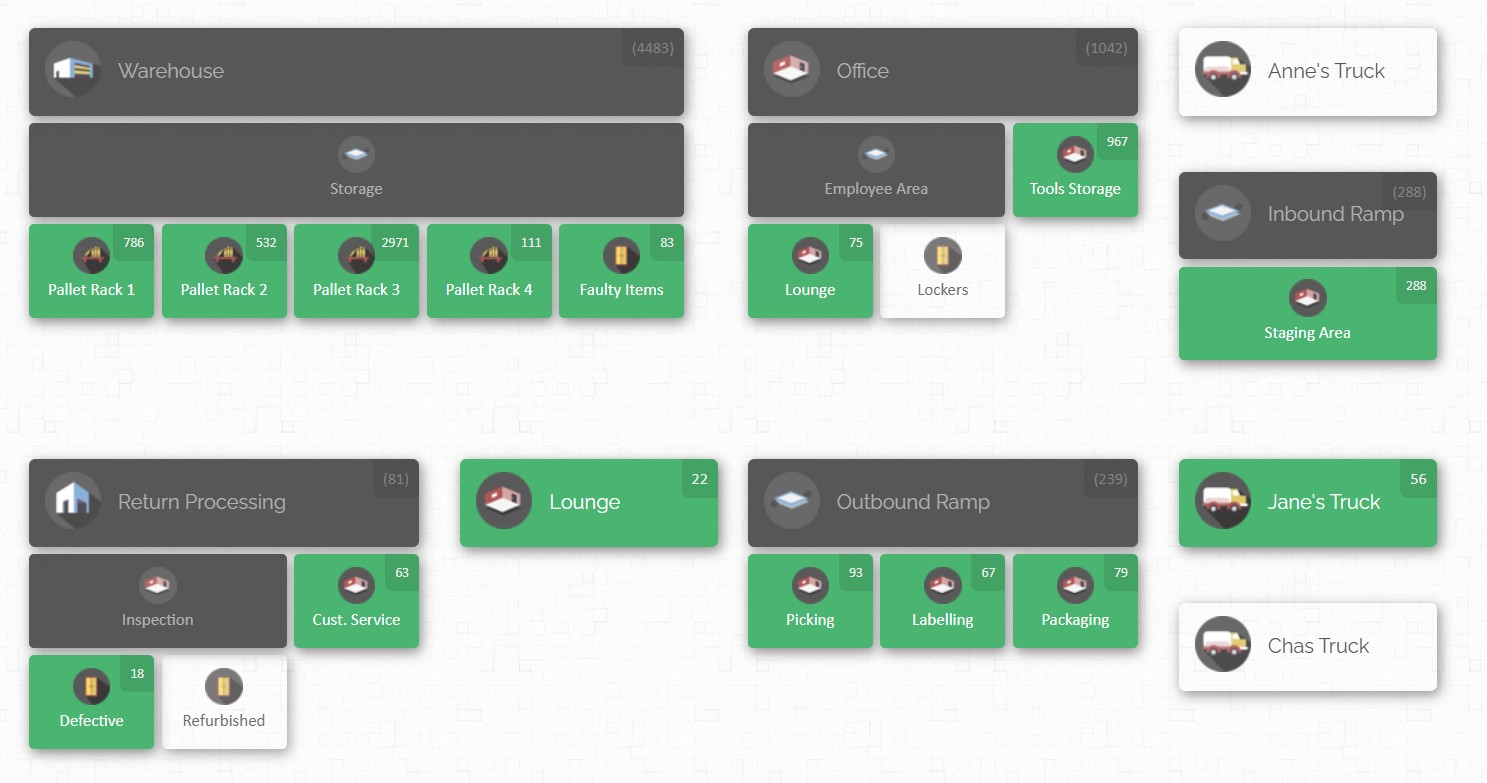
Here’s how CyberStockroom’s features and philosophy support safer inventory management:
- Visual Inventory Map for Clear Organization: CyberStockroom’s signature feature is an interactive inventory map. Think of it as a birds-eye view of your entire operation – you can see a floorplan or site map with every warehouse, laydown yard, zone, or container, and what’s stored in each. This visual clarity means no more guesswork or wandering around to find materials. From a safety standpoint, it enforces the principle that everything has a “home.” When you can literally see on a screen that all the welding equipment should be in Area B, it becomes immediately apparent if something is out of place. An organized site (mirrored by an organized digital map) is inherently safer and easier to navigate. Managers can also use the map to plan safe material movements (e.g., avoiding moving heavy items through high-traffic zones) by simply visualizing where things are and need to go.
- Real-Time Tracking and Updates: CyberStockroom allows real-time updates to inventory counts and locations. Whether via barcode scans or a quick manual update, any time an item is moved or used, the system reflects it. The benefit is you won’t accidentally create unsafe situations due to out-of-date information. For example, if a bundle of pipes is relocated from the main yard to the second-floor deck, the map updates and everyone knows its new location – preventing the scenario of someone searching the wrong area (which can be hazardous on large sites). Real-time data also helps prevent overstocking: the system can show current quantities at each site, so you know not to send 100 extra pieces that would clutter the site. Essentially, live inventory visibility helps you catch potential issues (like “why are those two generators still sitting in the hallway?”) and address them before they become safety problems.
- Drag-and-Drop Simplicity: A unique aspect of CyberStockroom is the ease of moving items within the digital map. If you transfer materials from the warehouse to the jobsite, you can literally drag the item icon from one location to another on the map. This instant update mirrors the physical move. The simplicity here is key – it encourages teams to actually record inventory moves (because it’s not a cumbersome process). When inventory tracking is easy and even visual, compliance with inventory procedures tends to improve. And when your inventory records are accurate, the safety benefits follow (no more relying on someone’s memory or a scribbled note about where the spare propane tanks ended up). The drag-and-drop approach also makes it easy during planning to allocate where incoming materials will go safely on the site map before they arrive, reducing the last-minute scrambling (and blocking of passages) that often occurs with deliveries.
- Tool Assignment and User Accountability: CyberStockroom supports assigning tools and equipment to specific people or teams when they’re checked out. This directly fosters accountability – if John from crew A has the concrete saw assigned to him, everyone knows who to contact regarding that tool’s use and return. From a safety view, this means there’s clear responsibility for equipment. Workers are less likely to leave a tool lying around if it’s tied to their name in the system. Moreover, user permissions in the software can restrict access so only authorized individuals can, say, check out certain high-risk equipment. This ties back to the earlier point about preventing unauthorized use: CyberStockroom can be configured so that only certified operators are allowed to log out a particular item (like a laser scanner or heavy drill), creating an extra layer of safety control.
- Integrated Notes, Photos, and Documents: The platform allows adding custom fields or attachments to inventory items – an excellent way to integrate safety information directly into your inventory system. For example, you can attach a PDF of the safety data sheet (SDS) to each chemical product entry, so any worker viewing that item on the map can access handling precautions on the spot. Or attach inspection checklists and maintenance records to a piece of equipment’s profile, so you know its condition and service history before assigning it out. Some companies use CyberStockroom to note the certified user or expiration date for safety gear. By having these details in one place, you ensure that safety checks aren’t separate from inventory checks – they become one and the same. It’s much harder to overlook a safety step when your inventory system actively reminds or informs you as you manage the item.
- Cloud-Based Access Anywhere: Because CyberStockroom is cloud-based, managers and even clients can access the inventory status from anywhere. In terms of safety, this means supervisors don’t have to be physically present in a risky area to verify if something is there – they can check on their tablet first. It also supports coordination if you have multiple sites or a central warehouse feeding several projects. A safety manager at headquarters could, for instance, verify that each site has the required safety stock of certain items by simply checking the system, rather than making phone calls or site visits. During safety audits or incident investigations, having a cloud record of “who had what and where” is invaluable. It provides a clear chain of custody and timeline for materials and equipment.
These features illustrate how CyberStockroom isn’t just about tracking widgets on shelves – it’s enabling a safer way to manage those widgets in the real world. By promoting organization, accountability, and real-time awareness, the software aligns inventory management with the overarching safety goals of a project. Many of the best practices we outlined earlier (from clear labeling and designated places, to maintenance tracking and access control) are inherently supported or simplified by this kind of system.
Of course, CyberStockroom is one example of the broader trend: the construction industry is adopting more sophisticated tools to merge safety and inventory workflows. The result is that site managers and supply chain professionals can make decisions with fuller context – not only “do we have item X?” but also “is item X stored and handled in the safest possible way?”. In the next section, we’ll look at some real-world scenarios to see how these principles play out in practice.

Conclusion: Prioritizing Safety in Every Stock Count
In the world of industrial construction, success isn’t measured only by budgets and schedules – it’s equally measured by the wellbeing of the people on site and the absence of injuries. Inventory management might once have been seen as a mundane back-office task, but as we’ve explored, it has a direct line to safety outcomes on the jobsite. The key takeaway is simple: an organized site is a safer site. When materials and equipment are properly tracked, stored, and maintained, workers can focus on their jobs without tripping over hazards or making do with substandard resources.
For site managers and supply chain professionals, the message is to broaden your perspective on inventory control. It’s not just about counting bricks and beams – it’s about creating an environment where every brick and beam is in a safe place and accounted for. By implementing the strategies discussed (from housekeeping routines to high-tech inventory maps), you build safety into the very framework of project operations. You also foster a culture where everyone understands that safety isn’t just the safety officer’s job; it’s embedded in how we manage every tool and every material.
Looking ahead, the integration of inventory management and safety will only deepen. We’re entering an era of “smart” construction sites: imagine sensor-equipped pallets that alert you if they’re stacked unsafely, or AI that predicts when an overstock situation might create a risk. Even today, tools like CyberStockroom are giving us a glimpse of that future, where information is transparent and instant, and decisions can be made proactively. The companies that embrace these innovations and prioritize tidy, well-monitored jobsites are positioning themselves not just for fewer accidents, but for greater efficiency and reputation as well.In closing, inventory and jobsite safety should be thought of as one cohesive goal.
By treating inventory management as a fundamental safety practice, you protect your workforce and optimize your operations at the same time. The next time you walk your site, take a look around through this new lens: every cable neatly coiled, every container labeled, every tool in its rightful place is more than good management – it’s safety in action. And that is the kind of diligent, forward-thinking approach that will carry the construction industry into a safer, smarter future.







 CyberStockroom
Leave a comment