
Why is construction inventory site safety a single problem?
Construction sites do not fail in neat categories. A delayed delivery becomes a rushed install. A rushed install becomes shortcuts. Shortcuts become incidents, rework, and, in the worst cases, serious injuries. Inventory management and site safety are tied together because the same root causes tend to sit underneath both: poor housekeeping, unclear storage zones, uncontrolled material movement, and weak accountability for tools and consumables.
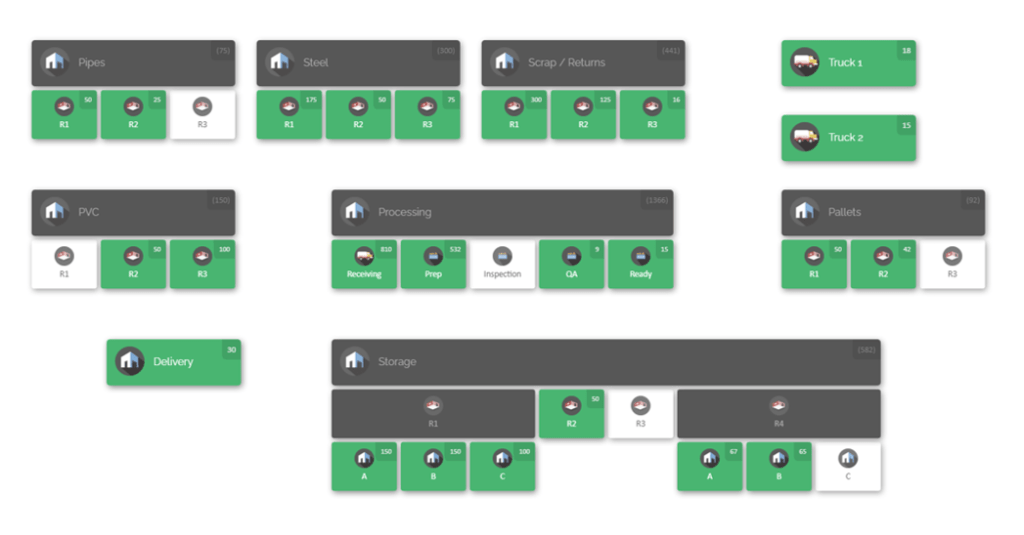
Safety regulators are direct about the basics. In the UK, Health and Safety Executive explains that the objective is a good standard of housekeeping across the site, and it explicitly connects safe sites with effective materials storage and waste management. In the US, Occupational Safety and Health Administration requires construction work areas, passageways, and stairs to be kept clear of debris, including scrap lumber with protruding nails, and it requires regular removal of combustible scrap and debris.
That might sound like basic “clean up after yourselves” advice, but there is a deeper operational point hiding in plain sight:
When inventory is not controlled, materials become obstacles.
- Materials arrive too early and pile up because the site has no realistic storage plan.
- Materials are stored “temporarily” in walkways, near access routes, or in front of emergency kit because nobody owns the location plan.
- Waste builds up because trades are not aligned on removal responsibilities, skip placement, or how often collections happen.
- High-turn consumables (fixings, abrasives, adhesives, tapes) get scattered because there is no defined issuing and replenishment rhythm.
- Tools go missing, so crews stash spares “just in case”, and the site slowly fills up with duplicate stock and clutter.
All of that creates hazards that people then normalise as “just part of site life”. Regulators and safety bodies repeatedly link poor housekeeping and uncontrolled storage with slip and trip injuries, blocked access routes, and fire risk.
The hazards that grow out of unmanaged inventory
Slips, trips, and blocked routes
Trips and slips are often triggered by ordinary site conditions: uneven surfaces, obstacles, trailing cables, and wet or slippery surfaces. When a site is overstocked, the probability of obstacles multiplies. Walkways narrow, corners become blind, and people carry loads around piles instead of along planned pedestrian routes. Guidance emphasises that keeping sites clean and orderly reduces the chance of such injuries, and it points to housekeeping, delivery planning (minimising materials on site), and clear waste arrangements as central controls.Falling objects and collapses from unstable stacking
Storage hazards are not limited to small items on the ground. Unstable stacking, poorly blocked cylindrical materials (pipe, poles, bar stock), and overloaded temporary platforms can turn inventory into a falling object problem. US construction rules cover secure storage requirements: materials stored in tiers must be stacked, racked, blocked, interlocked, or otherwise secured to prevent sliding, falling, or collapse.Manual handling and strain injuries
Handling and storing materials involves everything from hoisting steel to carrying bags manually. Guidance notes that improper handling and storing often results in injuries, and it highlights risks such as strains and sprains, fractures and bruises, and cuts and bruises caused by falling materials that were improperly stored. There is a practical inventory lesson here: if your storage layout forces extra handling, extra distance, or frequent re-stacking, you are increasing exposure to manual handling risk, not just wasting time.Fire load and ignition risk
Fire risk is influenced by quantity of combustibles in the work area, storage decisions (especially for volatile materials), and housekeeping that prevents emergency routes being obstructed. Guidance highlights reducing fire risk by controlling the amount of combustible material until needed, planning internal storage so it does not put workers at risk, and keeping rubbish under control. If your site frequently stocks excessive packaging, timber offcuts, or mixed waste in work zones, you are no longer dealing with a purely “logistics” matter.
The delays that follow the hazards
Inventory-related hazards do not just harm people, they slow the job down in very predictable ways:
- Work stops while crews search for materials, tools, or safety kit.
- Work slows because access is constrained and handling takes longer.
- Rework increases when materials are damaged by poor storage (weather exposure, crushing, contamination) or when the wrong items are issued.
- Trades collide because staging areas are not defined, so deliveries and internal movements interfere with each other.
- Inspections get harder because documentation and traceability are scattered.
Construction inventory management is widely described as the discipline of tracking, controlling, and managing the flow of materials, tools, and equipment so projects stay on schedule and on budget. When you connect that to safety guidance on keeping sites in good order and controlling storage, you get a single operational theme: a well-run inventory system is a safety control, and a well-run safety system reduces schedule risk.
Building an inventory system that prevents delays

The most effective construction inventory management systems are boring in the best way. They reduce surprises. They make demand predictable, storage intentional, and replenishment routine. They also aim to keep materials on site only when they are needed, because excess stock is both a cost and a hazard.
A practical way to build this is to treat inventory as a site workflow, not a back-office record.
Start with a site inventory plan that matches the schedule
Inventory planning is easiest when it is linked to the programme:
- What needs to arrive for each phase?
- Where will it be staged?
- Who signs for it?
- How will it be moved to point-of-use?
- What is the “no earlier than” date to avoid stockpiles?
- What is the “no later than” date to avoid downtime?
Guidance on planning construction work includes planning material deliveries and considering storage needs as part of organising safe work. Separately, storage and housekeeping guidance highlights delivery planning as a control, specifically planning deliveries to keep the amount of materials on site to a minimum.
This is where construction inventory site safety becomes operational: if you reduce early deliveries, you reduce clutter. If you reduce clutter, you reduce slip and trip exposure and reduce the chance that materials “spread” into pedestrian routes.
Define what you are tracking
A common reason inventory systems fail on job sites is scope creep. Teams try to track everything, then abandon it when the admin feels unrealistic. A better approach is to define tiers of control:
- Tier one: safety-critical items
PPE stocks, first aid supplies, fire extinguishers where applicable, spill kits, temporary lighting spares, and any items that stop work if missing. Safety guidance repeatedly stresses access routes, emergency equipment, and housekeeping; safety-critical stock management supports those outcomes. - Tier two: schedule-critical items
Long lead, high cost, or high dependency items (items that block follow-on trades if late). Construction inventory management guidance emphasises that timely availability of materials and equipment affects productivity and schedule. - Tier three: high-churn consumables and shared tools
Fixings, adhesives, cutting discs, blades, and shared tools that get borrowed across crews. When those items are unmanaged, work slows in small, constant ways.
By focusing on tiers, you can build a system that teams will actually maintain.
Make location the centre of the system
Most job site arguments about inventory are not really about quantities. They are about location.
- “We have it somewhere.”
- “It was by the container yesterday.”
- “I think the other crew has it.”
- “It must be in the laydown yard.”
Location confusion drives searching, double-handling, and clutter. Safety rules and guidance also consistently focus on keeping aisles and passageways clear and maintaining safe movement through sites and storage areas.
So the question becomes: how do you make “where is it?” easy to answer?
You do it by treating storage zones as part of the site design:
- Laydown yard zones by trade, by package, or by phase.
- A defined tool crib, with check-out and return expectations.
- A hazardous storage zone separated from general materials.
- A waste zone (with skips/bins) that does not encroach on pedestrian routes.
- A quarantine/hold area for damaged or nonconforming deliveries.
Guidance specifically recommends designating areas for plant, materials, waste, flammables, and hazardous substances, and it warns against storage spreading onto footpaths and walkways or obstructing emergency escape routes.
Put replenishment on a rhythm
Delays are often created by small missing items: the right fixing, the right blade, the right sealant, the right component. These are rarely “big purchasing mistakes”. They are replenishment failures.
A practical replenishment rhythm looks like this:
- Daily: quick visual check for safety-critical and high-churn items in site stores and work faces.
- Weekly: planned restock orders based on usage and upcoming work.
- Per delivery: immediate putaway to assigned zones, with packaging and waste removed quickly.
- Per shift or end of day: tidy, return, isolate damaged items, and clear debris from access routes.
Safety rules for housekeeping require regular removal of combustible scrap and debris and maintaining clear work areas and passageways. Replenishment discipline supports that because stock is stored intentionally, not abandoned in whichever space is free.

Build in accountability without slowing the work
The best inventory controls are the ones that reduce friction. If a process feels like it is “for the office”, crews will bypass it. But accountability also matters for preventing loss and ensuring tools and safety kit are serviceable.
A workable approach is:
- Define who can issue, transfer, and adjust.
- Define what can be self-issued (low risk consumables) versus what needs sign-out (high value tools, safety-critical equipment).
- Keep records simple and consistent.
- Use cycle counts rather than painful full counts that never happen.
Inventory management tools and guidance frequently discuss the value of visibility and structured processes to prevent delays and reduce operational chaos.
Designing storage and laydown areas for hazard control
A good inventory process needs a physical environment that supports it. This is where many sites struggle: they attempt to fix inventory problems with purchasing rules while leaving the site layout unchanged.
Your site layout is a safety system. It determines whether inventory becomes a hazard or stays under control.

Treat access routes as non-negotiable “no storage” areas
Both guidance and standards repeatedly come back to this: people must be able to move safely. That means:
- Clear walkways.
- Clear stairs and corridors.
- Clear emergency routes.
- Clear access to fire equipment, first aid, and emergency wash stations where present.
HSE guidance warns against storage spreading onto pedestrian routes and obstructing access routes or emergency escape. Workplace housekeeping guidance similarly states stored materials should not obstruct aisles, stairs, exits, fire equipment, emergency eyewash fountains, emergency showers, or first aid stations.
The inventory mindset shift is simple: if materials routinely appear in walkways, you have not got a “housekeeping problem”. You have a location planning problem.
Designate storage areas by hazard type
Mixed storage is convenient until it is dangerous. Several authorities emphasise segregation and designated areas.
- In construction storage rules, noncompatible materials must be segregated in storage.
- Guidance recommends storing flammable, combustible, toxic, and other hazardous materials in approved containers in designated areas appropriate for their hazards, in line with relevant fire codes and safety regulations.
- HSE guidance for smaller projects recommends designating storage areas for flammable substances (such as flammable liquids and gases) and hazardous substances (such as timber treatment chemicals), and storing flammables away from other materials and protected from accidental ignition.
From an inventory management perspective, this is also a classification and labelling problem. When hazardous and non-hazardous items sit together, teams are more likely to put things back in the wrong place, and more likely to contaminate stock (with dust, oil, water, debris) because the storage rules are unclear.
Control stacking, racking, and stability
Stable stacking is not optional. It is a core safety requirement.
Material storage rules in construction specify that materials stored in tiers must be secured to prevent sliding, falling, or collapse. Guidance for general handling and storage similarly states storage should not create a hazard and requires stable and secure stacking.
Practically, “stable stacking” means your inventory system should record not only what and where, but also the intended storage method:
- pallet rack
- cantilever rack (for long materials)
- bins and shelving
- chocks/blocking for cylinders and pipe
- bunded storage for certain liquids where required
- weather-protected storage for materials sensitive to moisture or UV
This is also why “temporary” storage becomes a source of incidents. Temporary storage rarely has proper racks, blocking, or height controls, and it often ends up in the most convenient places, which are usually the most hazardous places.
Reduce fire risk by managing combustibles as inventory, not rubbish
Fire safety guidance in construction highlights several controls that intersect directly with inventory:
- reduce fire risk by controlling the amount of combustible material in the work area until needed
- store combustibles appropriately (ideally outside buildings under construction for some combustibles, with planned internal storage)
- keep rubbish under control so escape routes are not obstructed
- take extra precautions with volatile flammable materials, gases, and oxygen cylinders
- manage ignition sources like hot work by clearing combustibles and keeping suitable extinguishers available
Meanwhile, construction housekeeping rules require combustible scrap and debris to be removed at regular intervals and require safe means for such removal.
Inventory language helps here. Instead of “waste”, treat combustible offcuts, packaging, and scrap as a stream that must be removed on a defined frequency, from defined locations, by defined owners. HSE guidance similarly points out that waste can present a real safety hazard if not properly managed, and it stresses early decisions about how waste streams will be managed and who is responsible.
Use delivery planning to prevent congestion and re-handling
The most common laydown yard failures are caused by deliveries arriving into spaces that are not ready, which triggers a cascade of bad decisions:
- materials are placed wherever there is room
- labels are lost or never applied
- the wrong items get used first because they are easiest to grab
- materials are moved multiple times, increasing damage and handling risk
Delivery planning is highlighted repeatedly in guidance as a way to keep materials on site to a minimum and prevent slip/trip obstacles.
To make delivery planning work, the inventory plan must define:
- the “drop zone” for each trade
- staging areas for incoming goods
- the putaway zone
- the inspection/quarantine zone for issues
- the waste removal route for packaging
When those are defined, the site stays cleaner, and inventory becomes easier to control because it flows through predictable paths.
CyberStockroom and Construction Inventory Site Safety
A common frustration in construction inventory management is that many systems describe inventory in lists and tables, while the job site is physical, dynamic, and location-led. CyberStockroom is built around that reality with a map-based approach.
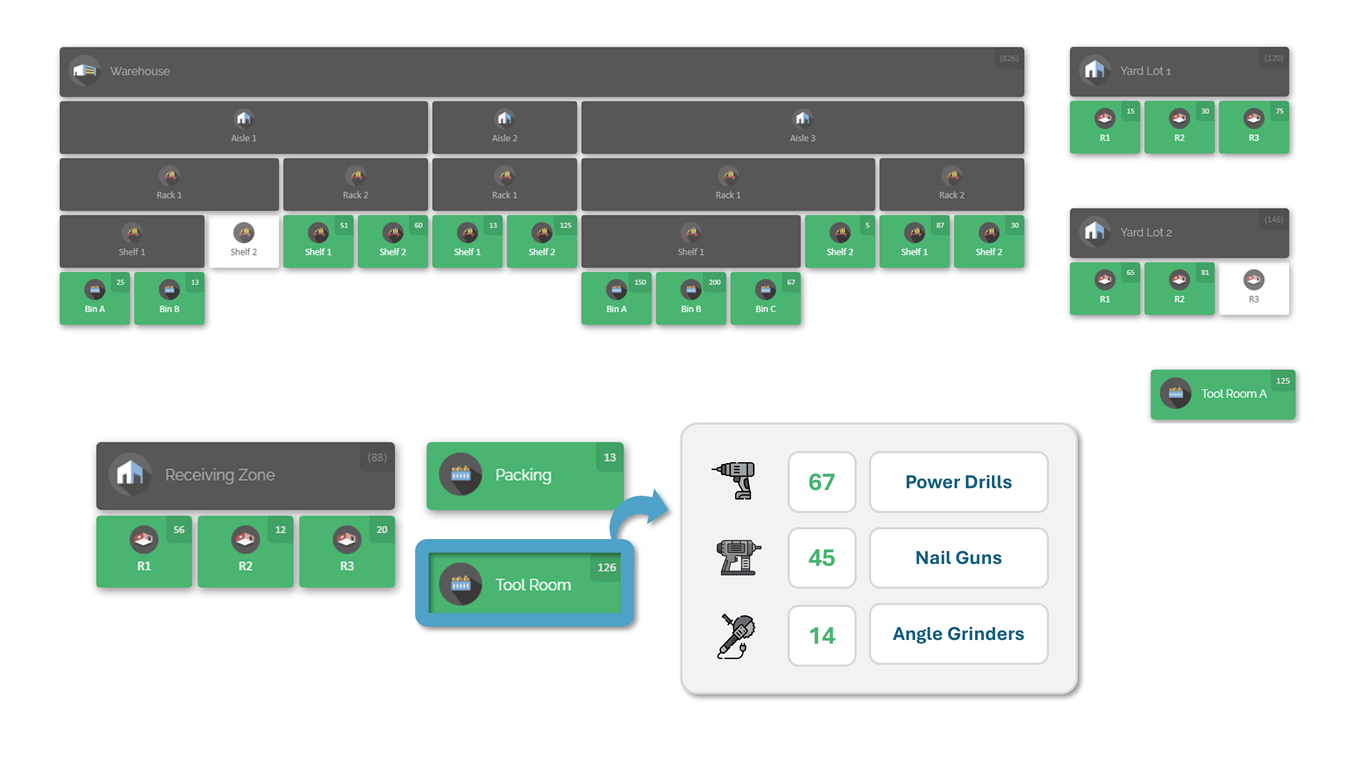
CyberStockroom emphasises customizable visual maps that represent locations and sub-locations, letting teams view the contents of any location and move items between locations using drag and drop. It also describes adding items manually, via barcode scanner, or via spreadsheet import.
Map-based location control to reduce hazards created by clutter
If you want to prevent trips and blocked routes, you need to stop storage spreading. HSE guidance explicitly warns against uncontrolled storage spreading onto footpaths and walkways and obstructing access routes or emergency escape.
CyberStockroom’s mapping approach supports this by encouraging you to define a location structure that matches how your site operates: yards, containers, staging zones, tool cribs, and even teams or trucks as logical locations on the map. Once those locations exist, the inventory conversation changes from “it’s somewhere” to “it is in Yard Zone B, Container 2, Pallet 4”, which is the kind of clarity that prevents wandering, searching, and informal stockpiles.
With CyberStockroom, you can zoom into locations to view contents and use the map as a dashboard. In practice, that helps site teams keep storage areas tidy because it is easier to spot where stock is accumulating and easier to correct it before it spills into pedestrian routes.

Barcode scanning and fast transactions to keep records aligned with reality
One of the hardest parts of construction inventory management is maintaining accuracy when items move constantly. CyberStockroom accepts barcode scanner input, and scanners can be used to add products, find them, or move them within inventory. The “Quick Scan” tool is designed to perform multiple transactions quickly, including check-ins, check-outs, and transfers between multiple locations, and it mentions scanning both products and locations.
That matters for safety and productivity because record accuracy drives behaviour:
- If records are unreliable, crews stop trusting the system and start making private stashes.
- Private stashes increase clutter and create obstacles.
- Obstacles are a known contributor to slips and trips.
Fast scanning reduces the temptation to skip transactions, which improves accuracy without adding unacceptable admin. And when accuracy improves, you can reduce over-ordering and reduce on-site stockpiles.
Activity history and reporting for accountability and loss prevention
Tool loss and material shrinkage create both cost and schedule impact. When critical items go missing, work stops or shifts to less efficient methods. Activity history is a ledger that lets you view and analyse past activity, filter history (by user, activity type, timespan, location), and export it as a downloadable report.
From a site safety viewpoint, this kind of traceability supports:
- accountability for who moved what, and where it went
- quicker resolution when a safety-critical item cannot be found
- fewer urgent searches through cluttered storage areas (which are themselves risky)
It also supports a healthier culture around shared equipment: fewer accusations, faster facts, and fewer work stoppages.
Custom fields and structured data for safer storage decisions
Construction inventory is not just “item name” and “quantity”. Safety and quality often require metadata:
- hazard class or special handling notes
- whether an item must be stored away from ignition sources
- whether an item must be segregated from incompatible materials
- whether an item must be weather-protected
- whether an item requires guarding if stored at height
Safe storage guidance stresses designated areas and segregation of incompatible materials.
CyberStockroom’s customization pages describe using custom fields on products and building a map that reflects locations down to rooms, bins, and vehicles, alongside the ability to add custom details such as manufacturer and supplier. Even if your first use case is basic, custom fields can support safer storage by making the “rules of the item” more visible at the point of issuing or putaway.
Spreadsheet import to start clean instead of starting late
Many construction teams begin with spreadsheets. The failure mode is familiar: the spreadsheet is out of date and nobody is confident enough to rely on it, so it becomes a “finance only” artefact.
CyberStockroom supports uploading products from a spreadsheet (including common fields like product number, description, manufacturer, supplier), rather than entering items one by one.
That is useful from a safety and schedule perspective because the worst time to introduce structure is after the job has already become chaotic. If you can migrate what you know today, then apply location structure and transaction discipline, you can start reducing “search time” and uncontrolled storage earlier in the project rather than later.

Turning CyberStockroom into a site safety habit
If you want CyberStockroom to support construction inventory site safety rather than becoming “another system”, build it around site behaviours you already try to enforce:
- On delivery: receive, inspect, and put away into named zones, then remove packaging waste quickly.
- During the day: move items between locations as the work moves, so storage stays intentional and walkways stay clear.
- End of day: check-in shared tools, reconcile what is left out, and clear debris from access routes.
- Weekly: cycle count high-churn and safety-critical items, then replenish before shortages trigger risky workarounds.
The system supports common site layouts for mapping, including job site layouts (staging zones, trucks, containers, crews) and laydown yard or warehouse layouts where location clarity reduces search time and prevents lost items.
A best-practice playbook for avoiding hazards and delays
The goal is not “perfect inventory”. The goal is fewer hazards, fewer delays, and fewer mornings where the site is already on the back foot by 7am.
This playbook is written for site managers, project managers, and operations leads who want practical controls that stick.
Build the system around the four failure points
Most problems in construction inventory management show up in four places:
Receiving
If deliveries arrive without a plan, you lose location control immediately.Control: define drop zones, staging zones, and putaway zones before the first major deliveries, and keep walkways and emergency routes protected from storage encroachment.
Storage
If storage is not segmented, labelled, and maintained, you get mixed hazards and unstable stacking.Control: designate storage areas by type (plant, materials, waste, flammables, hazardous substances), keep storage tidy, and apply secure stacking and segregation rules.
Issue and movement
If items are “borrowed” without record, tools disappear and private stashes grow.Control: keep transfers simple and fast, and make high-value and safety-critical items accountable through check-out and return habits.
Waste and returns
If waste is not removed regularly, the site becomes cluttered and fire load grows.Control: treat waste as a planned stream with ownership and frequency, with regular removal of combustible debris and planned skip/bins placement.
Measure what matters
To keep inventory and safety aligned, measure indicators that link directly to outcomes:
- Search time: how many minutes per shift are lost looking for tools and materials.
- Stockouts: count of work stoppages caused by missing materials, tools, or consumables.
- Access route nonconformances: how often walkways or emergency routes are obstructed by materials or waste.
- Damage rate: materials written off due to poor storage or handling.
- Loss events: missing tools or materials that require replacement or rescheduling.
The safety case is clear: obstacles, poor housekeeping, and uncontrolled storage are repeatedly linked to slips and trips, and improper handling and storage is linked to injury risk. The schedule case is equally clear: construction inventory management is widely framed as a way to keep materials and tools available when needed, avoiding delays and keeping work moving.

Closing thought
A safe site is not just the result of PPE and signage. It is the result of hundreds of small operational decisions: where materials land, where they get stored, how often waste is removed, whether tools get returned, whether pedestrian routes stay clear, and whether the site remains navigable when the work gets busy. Safety standards and guidance keep repeating the same themes, because they work: clear work areas, secure storage, planned deliveries, good housekeeping, and controlled combustibles.
When construction inventory management supports those themes, construction inventory site safety stops being a separate initiative and starts becoming part of how the job is run every day.






 CyberStockroom
Leave a comment